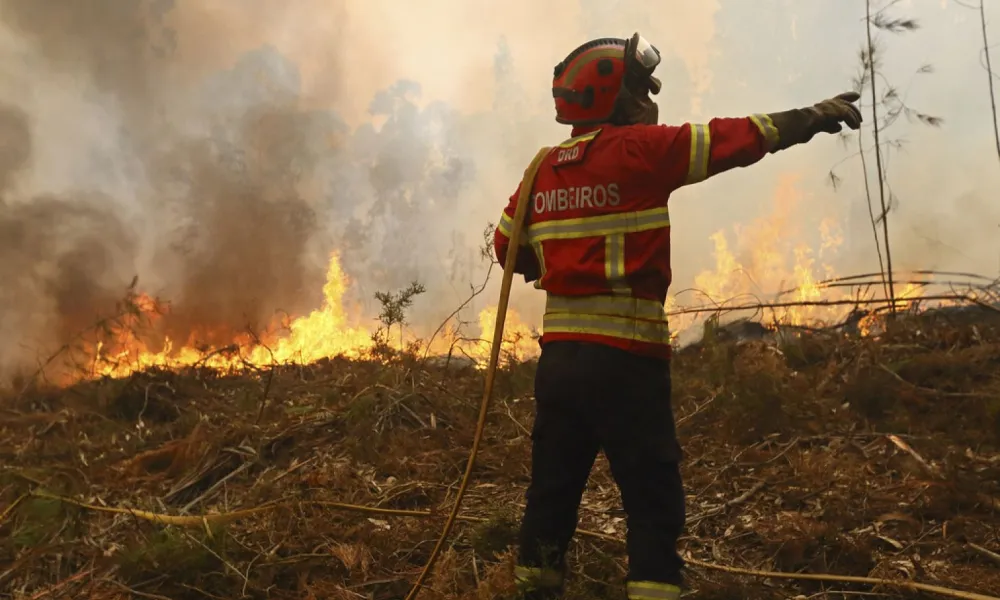

The deadly wildfire in the Limassol mountains has once again highlighted the lack of a robust systems for the prevention and management of natural and man-made disasters, such as wildfires. The Limassol wildfire started on Wednesday the 23rd of July in the community of Mallia at 650 meters altitude and spread uncontrollably downhill, eventually reaching the Limassol-Paphos highway and burning 124 square kilometers of land.
This government has repeatedly made major promises to address serious shortcomings, starting with the August 2023 wildfire in the Limassol mountains (from Korfi to Fasoula). At the time, the government was granted leniency due to its short time in power. Of particular note were the declarations made by the Presidency in March 2024. However, as this week’s events have shown, little has been done since then, shaking citizens’ confidence in their safety.
Aerial Firefighting in the National Guard
Focusing on the measures announced in 2024, key among them was the bolstering of Cyprus’ aerial firefighting capacity with more aircraft and helicopters and placing these assets under the command of the National Guard for improved coordination, as in other countries.
For the recent wildfire, the timing of aircraft arrival at the fire’s onset has been a major point of criticism. According to the Ministry of Agriculture, aerial drops began at 14:20, while the fire had started between 12:00-13:00 in Mallia - a delay inconsistent with the 2024 promises. There is also a question about the whereabouts of the loaded aircraft that should have been patrolling and ready to make initial drops.
Fire Weather Bulletin
The urgency to extinguish the fire in its first minutes - and the heightened alert it demanded - was underscored by a fire weather bulletin issued that day by private meteorologist Eric Kitas. Though unofficial, the bulletin is used by firefighting services and volunteer groups.
It warned that areas with the most dangerous conditions included Limassol, western Nicosia and Larnaca, and eastern Paphos. It stressed that any fire would spread rapidly due to wind and could spark new blazes hundreds of meters away. “A fire not extinguished within 5 minutes could have devastating consequences,” it warned -a warning seemingly unheeded by the state coordination mechanism. The state meteorological service, notably, did not issue any fire-specific weather bulletins nor provided an on-site meteorologist.
The Coordinator… in Australia
Also notable was the absence of the Director General of the Ministry of Agriculture, Andreas Grigoriou, who was in Australia - in the heart of fire season - for events marking the anniversary of the coup and invasion. Yet, the same government had appointed him in April 2023 to lead coordination of firefighting assets across departments. His absence left a leadership vacuum in managing fragmented responsibilities across the Ministries of Justice, Agriculture, and Defense. He might have been the one to redeploy firefighters from the Troodos Forest to assist in Mallia.
Detection Technology
As part of phase two of the “holistic civil protection system,” in 2024 the Presidency announced the installation of sensors for early fire detection. It remains unclear why this technology failed to deliver. There has also been no use of thermal cameras or other modern tools that could have been developed in collaboration with Cypriot universities.
Emergency Number 112
The Presidency also addressed delays in activating the EU-wide emergency number 112, which could have helped in timely citizen warnings. This gap remains. In the recent Limassol wildfire, the lack of alerts led to chaotic evacuations in communities like Lofou and Sylikou. Such systems could guide both locals and tourists toward safe evacuation routes, supported by specialized fire meteorologists predicting fire behavior.
Volunteers
Despite growing public interest in volunteering, the Ministry of Interior has yet to fully implement a proposal for volunteer recruitment, training, and insurance. Only the insurance part has been fulfilled. The Commissioner for the Citizen’s Office has been tasked with creating a national volunteer registry, but the plan remains on paper, with implementation pushed to after 2026 when the relevant legislation is expected to be submitted to Parliament.
Vegetation Clearing
The government had also promised actions to clear overgrown vegetation. However, progress has been fragmented or limited to pilot projects (controlled burns, grazing). Most communities in Cyprus still lack safety buffer zones, allowing fires to spread into residential areas — as seen in the recent Limassol wine village blaze. Additionally, local authorities have been slow in removing illegal dumps. A recent report showed that of 76 approved local authorities, only 36% had made progress — despite being in the peak fire season. The government shifts blame to local authorities but must find ways to enforce its own plans.
Ongoing Crises
The recent pattern of natural and man-made disasters paints Cyprus as a “dwarf” in civil protection. Between 2023 and 2025 alone:
- A burning recycling plant was visible for days (Geri, July 2023)
- A large wildfire lacked aerial support (Limassol mountains, August 2023)
- Deadly floods from storm Daniel affected nearby countries (Libya, Greece, Turkey, September 2023)
- Two tornadoes hit urban areas (Limassol, February 2024)
- Another major wildfire lacked aerial coverage (Paphos, June 2024)
- And now, the deadly Limassol wine village fire
All these cases will be further analyzed during a special session of three Parliamentary Committees scheduled for the coming Tuesday.
The experience of these events shows that the Republic of Cyprus continues to take piecemeal actions and has failed to adapt to the growing challenges posed by climate change.