
More than 2,200 members of the National Guard began carrying service-issued weapons in Washington D.C. Sunday evening, marking a significant escalation in federal involvement in the nation’s capital after President Donald Trump ordered troops into the city to “clean up” what he describes as a surge in violent crime.
A Turning Point
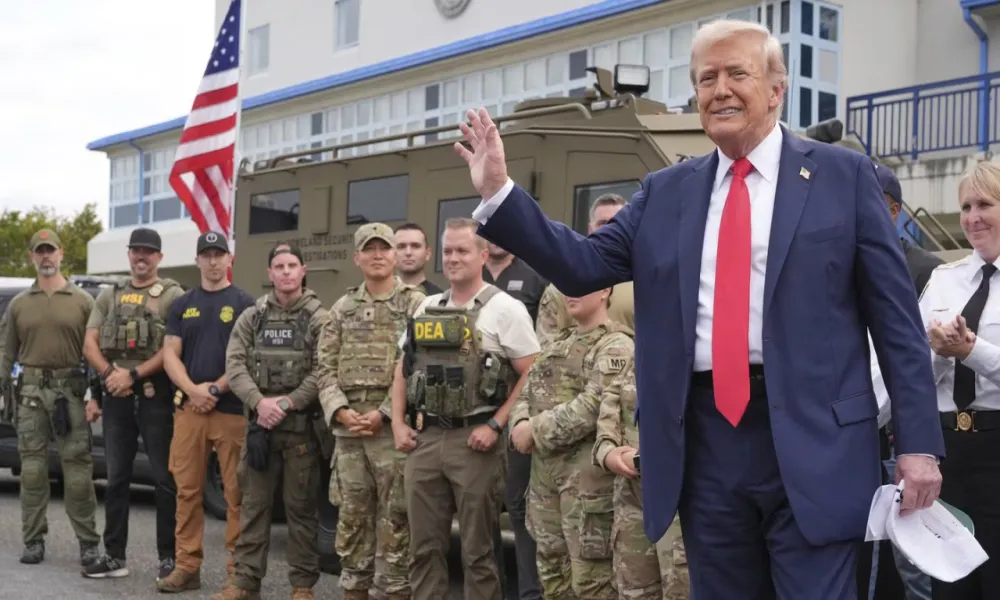
The deployment includes not only National Guard soldiers but also federal law enforcement personnel from the FBI, ICE, and the DEA. According to Reuters, this marks a turning point after weeks of Guard presence without weapons, now officially authorized to carry firearms while supporting law enforcement operations. Officials emphasized that troops are authorized to use force only as a last resort, strictly in response to imminent threats of death or serious injury. They are not performing routine policing or arrests but can temporarily detain individuals until local authorities arrive, the Associated Press reported.
Trump has justified the military presence by claiming that Washington is under siege by gangs, framing the deployment as essential to restore safety. Yet crime statistics suggest a more nuanced reality. Data from the Metropolitan Police show that violent crime in the city actually declined between 2023 and 2024, following a sharp post-pandemic spike. The Washington Post highlighted this discrepancy, noting that the President’s rhetoric appears to exaggerate the threat relative to current trends.
Strong Public Opposition
The visible deployment of armed Guard units at major transit hubs and federal buildings has already drawn attention. The Wall Street Journal described soldiers carrying sidearms at Union Station and other high-traffic areas, tasked with deterring criminal activity and protecting federal assets. At the same time, polling reported by the Post suggests strong public opposition, with a majority of residents concerned about federal overreach and the presence of armed troops in civilian spaces.
Protests against the deployment have emerged, echoing concerns from civil rights advocates that this could set a precedent for future interventions in other Democratic-led cities. The Daily Beast reported that while some property crimes have declined, assaults and immigration-related incidents have risen, lending complexity to the administration’s narrative of a city “overrun by crime.”
The arming of the Guard also raises legal and constitutional questions. The Associated Press and Reuters highlighted that all troop movements and weapon use are constrained by the Posse Comitatus Act, which limits the military’s role in domestic policing. Analysts have pointed out that the symbolic presence of armed soldiers in the nation’s capital may have as much impact on public perception as their operational role.
For Washington residents, daily life now intersects with heightened federal authority and ongoing civil debate. Armed National Guard troops patrol the streets alongside federal agents, protests continue, and the city faces a tense balance between perceived security needs and civil liberties. How this strategy will affect crime rates and public sentiment remains uncertain, but it has already transformed the atmosphere in the nation’s capital.