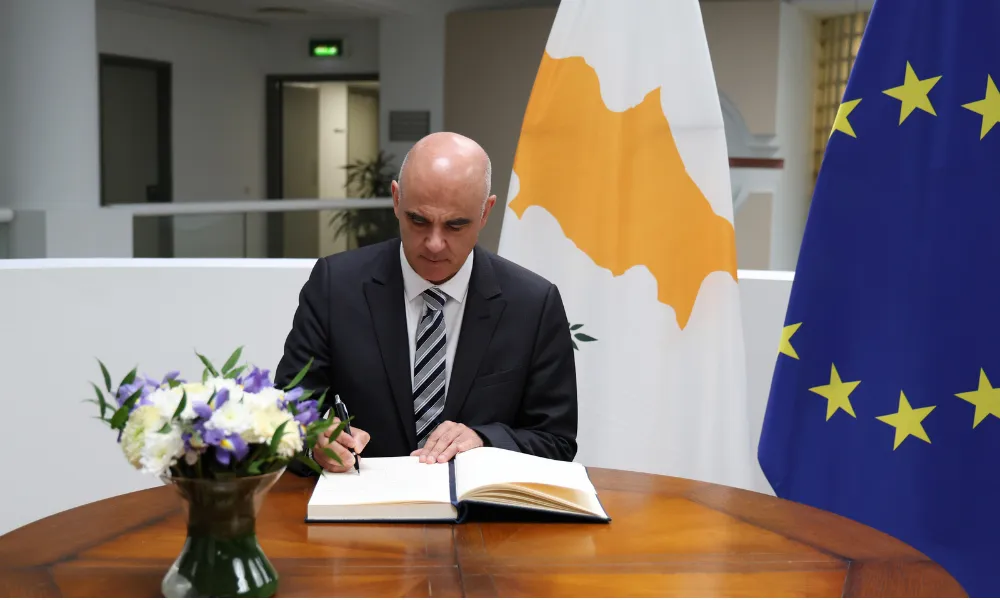

The Council of Europe (CoE) will dispatch a technical mission to Cyprus in the coming weeks to examine ways of unblocking the long-delayed execution of European Court of Human Rights (ECHR) judgments related to the island, CoE Secretary General Alain Berset told CNA in an interview.
Berset, who met President Nikos Christodoulides, said his visit was intended “not just as a courtesy, but as the first step in a process.” He acknowledged that compliance with the judgments was currently “blocked,” and stressed the mission would explore scenarios for progress.
The Secretary General confirmed he had been briefed in detail about the five elderly Greek Cypriots detained by Turkish Cypriot authorities in Trikomo since July 19 after visiting their properties there. Berset noted that ways the Council of Europe could contribute to the matter would be explored.
A city divided in two
Walking along the UN-controlled Green Line in Nicosia, Berset noted the importance of experiencing first-hand what it means on the ground to have a divided population and country. He said he spoke with Nicosia Mayor Charalambos Prountzos on cooperation across the divide.
“It is impressive — the city is cut into two parts,” he said.
The Secretary General welcomed the willingness he heard “to work on really concrete elements to make some progress for the people, and then to hope that it would help to have a movement to solve the problem.”
He underlined that the CoE’s role in helping resolve the long-standing division would involve promoting execution of ECHR rulings, working alongside the UN, EU and local actors, and supporting practical initiatives on the ground.
Wider role on Ukraine and beyond
Turning to Ukraine, Berset stressed the Council’s central role in accountability, pointing to the ECHR’s jurisdiction over war-related cases and to the Register of Damage established at the Reykjavik summit. This, he said, would be a crucial tool for reconstruction and reparations. He also referred to the ongoing debate over a tribunal on the crime of aggression and the Council’s action plan for recovery and reconstruction in Ukraine.
“The war is escalating, clearly getting worse. I cannot predict when it will end. The only certainty is that we must do everything possible to achieve a just and lasting peace,” he said.
Berset added that instability and human rights violations in the Middle East and North Africa were issues of concern to the Council of Europe, that were also discussed in his meeting with Christodoulides.
Shared priorities with Cyprus
Berset welcomed the “really strong” alignment between the Council’s priorities and those of the upcoming Cypriot EU Presidency, citing the protection of children, young girls, gender equality and the rights of persons with disabilities. He cautioned that Europe’s “hard security” must be matched by “democratic security” grounded in democracy, human rights and the rule of law.
Challenges to democracy
He also highlighted the Council’s New Democratic Pact, launched in response the new challenges facing democracy today such as polarization, hate speech, social media and artificial intelligence. The goal is to work with member states “to ensure democracy continues to function in the future – in 10, 15, 20, 25 years – allowing societies to decide what government they want,” he said.
The initiative entails planned conventions on artificial intelligence, protection of lawyers, and countering foreign interference and disinformation.