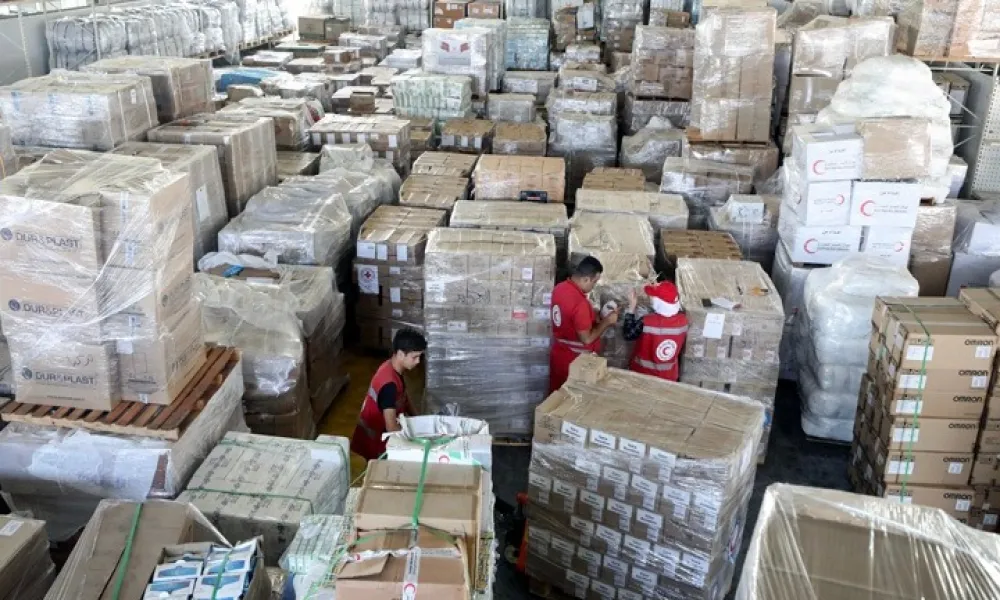

The UN’s Deputy Secretary-General for Humanitarian Affairs and Emergency Relief Coordinator, Tom Fletcher, unveiled a detailed 60-day response plan for Gaza from UN headquarters, following the announcement of the ceasefire agreement between Israel and Hamas under U.S. President Donald Trump’s peace plan.
Mr. Fletcher described the moment as “a day of hope and opportunity,” stressing that the Trump plan “must serve as the foundation for saving tens of thousands of lives.”
He presented a package of measures including food aid for 2.1 million people, restoration of the collapsed health system, safe water and sanitation for 1.4 million residents, and a large-scale shelter campaign ahead of winter.
10 Conditions for Success
Fletcher listed ten conditions essential for the operation’s success: entry of fuel and gas, the opening of multiple humanitarian corridors, protection for aid workers, and full funding of the plan, noting that only 28% of the $4 billion “Flash Appeal 2025” has so far been secured.
Answering reporters’ questions, he confirmed that the UN, UNRWA, and NGOs are fully mobilised to implement the agreement, stressing that “the blockade of Gaza must be lifted” to ensure unrestricted humanitarian access.
He also expressed his intention to visit Gaza personally, adding that the UN is in continuous dialogue with Israeli authorities to guarantee safe and rapid aid delivery.
UN’s Central Role
Asked whether Israel and Hamas had signed off on the UN leading the major humanitarian operation in Gaza, Fletcher said:
“The mediators’ 20-point plan includes explicit recognition of the UN’s central role in coordinating the humanitarian response, and that guides us. The entire UN family is mobilised to deliver. UNRWA is irreplaceable, and we are also relying on NGO partners and the private sector. Saving lives at this scale requires a massive collective effort.”
He warned that “extremist elements on both sides” have previously sought to derail hostage releases or obstruct aid, but voiced hope that broad international backing for Trump’s plan and firm commitment from regional foreign ministers would isolate those voices.
“We have the experience, the will, and the obligation to save lives on a large scale,” Fletcher concluded. “For those who have lost everything, and for those who have worked tirelessly to save others, we must act, and we will.”
CNA