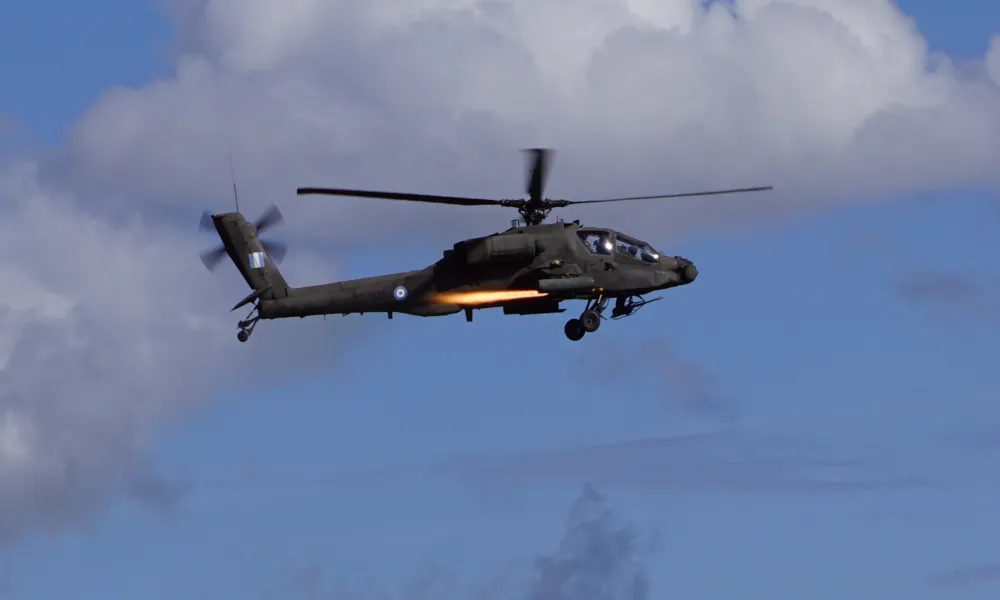


A US Army Apache attack helicopter went down near the Strait of Hormuz on Monday, the latest incident to put the world's most strategically sensitive waterway under the spotlight as a fragile ceasefire in the Iran war showed fresh signs of strain. Both crew members were safely rescued. The cause of the crash has not been established.
President Donald Trump confirmed the incident to reporters late Monday on the runway at John F. Kennedy International Airport, where he had been attending the NBA Finals. "The pilots are fine, nobody injured," he said, adding that a formal report would be issued on Tuesday. Neither the White House nor US Central Command had announced the crash before the New York Times reported it, citing two people briefed on the incident.
It is the first instance of a downed Apache since hostilities between the United States and Iran began on 28 February. Whether the helicopter was shot down by Iranian fire, suffered a mechanical failure or encountered another problem remains unclear, with an investigation now under way. Iran has claimed to have shot down approximately 30 MQ-9 Reaper drones since the war began. Fighter jets have also been reported downed over the Gulf during previous operations.
Apache helicopters have been a key asset for the US military as it enforces a blockade on Iranian crude oil shipments and tankers, seeking to pressure Tehran into reaching a deal. Central Command has deployed the aircraft alongside MQ-9 Reaper drones and F-35 fighter jets as part of the ongoing operation to assert control over the strait. CENTCOM has said the threat environment around the strait has been active in recent days, having intercepted Iranian ballistic missiles and drones launched toward the Strait of Hormuz and Gulf neighbours as recently as 5 June, and has warned the Islamic Revolutionary Guard Corps to avoid escalatory behaviour at sea.
The incident underscored how quickly a military mishap near the strait can become a strategic flashpoint, particularly when analysts and commanders are already watching closely for any sign that the ceasefire is slipping. The crash occurred less than 24 hours after Iran and Israel exchanged their worst strikes since April, in an escalation that briefly threatened to restart full-scale war before both sides signalled a halt to hostilities on Monday afternoon.
The Strait of Hormuz, the narrow waterway between Iran and Oman, has been effectively closed since 28 February, when the war began, causing a global fuel crisis and prompting a US-led aerial campaign on Iranian targets along the strait and a naval blockade of Iran. Roughly one-fifth of the world's oil and gas normally passes through the waterway. Its continued effective closure is the single largest factor keeping global oil prices elevated, with Brent crude trading above $95 a barrel on Monday.
The US military had not announced an official cause of the crash by the time of publication.
Sources: Reuters, New York Times, NPR, CNN