
By Christos Georgiou
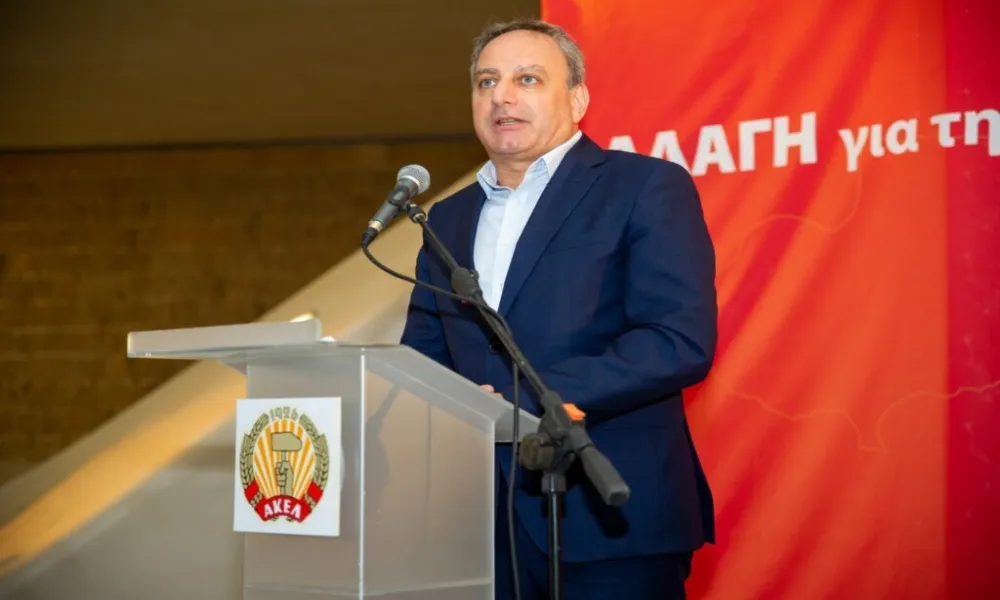
As internal processes intensify within AKEL for the composition of its electoral lists ahead of next May's parliamentary elections, names are either being leaked or formally announced as representatives of what the party refers to as its "new forces." Some of these individuals arguably do embody such a role – actress Melanie Stelios, former senior civil servant Andreas Assiotis, and lawyer Alexia Koundouri, whose name was recently mentioned in relation to a potential candidacy.
The issue, however, is not so much with these individuals per se. It is, after all, AKEL’s prerogative to present veteran footballer Panikos Xiourouppas as a "new force," just as it may do with others who are not party members but maintain close ties to it – such as Sara Aivalioti and Nicole Georgiou. What this indicates, in essence, is the party’s growing difficulty in identifying people from broader social movements to engage with, as it once did more effectively. Once considered a meaningful and innovative political practice, this outreach appears increasingly strained.
Loss of Momentum
Beyond the drop in its vote share and the loss of a European Parliament seat – despite an increased voter turnout – the recent European elections also exposed a significant weakening of AKEL’s much-touted “social alliance.” That alliance, which had been carefully cultivated during the 2023 presidential campaign, has since lost much of its energy.
One of the party’s most evident failures has been its inability to foster a culture of political inclusion. New forces that might have revitalised AKEL have instead been regarded, and treated, as peripheral – token figures used to demonstrate the party’s supposed openness to society, rather than genuine contributors to its renewal.
Stuck in the same pattern
What has emerged so far regarding the inclusion of so-called new forces makes it clear that AKEL remains trapped in the same old patterns. It lacks the conceptual tools to fully appreciate the role, potential, and scope of a past practice: inviting participation from outside its formal structures.
These were once personalities who viewed the party space as a creative and effective platform for political engagement – but crucially, without being burdened by strict party discipline or outdated ideological constraints. Constraints which, to this day, AKEL has not shown the willingness or capacity to discard from its daily operations.
Overreach without autonomy
The previous election cycle exposed the party's structural incapacity to engage in an open and honest dialogue with these external forces. Though they are invited to participate, they are also expected to submit fully to party discipline. AKEL has yet to make the kind of bold internal shifts that would allow it to recognise that its so-called “social alliance” – a term it invokes with much ceremony – requires a credible institutional framework, in which participation is equal, respected, and mutually accepted.
As it stands, any effort to revitalise this social alliance remains trapped in a mindset of full subordination, dooming the initiative to inevitable failure.
After the 2023 presidential elections
Concerns about the status of these “new forces” became more pronounced following the 2023 presidential elections. Towards the end of that year, AKEL attempted to modernise its organisational structures – ostensibly to make a fresh start and to support its long-standing goal of expanding its base. This included outreach not only to those close to the party but also to the broader centre-left.
Some procedural changes were introduced, particularly in relation to the leftist forces, but these failed to bring about any meaningful rupture. Nor did they attract disillusioned or inactive elements of the broader left.
These organisational reforms did not deliver even a minimal shift in the party’s internal operations. They failed to embed structural features that might have helped AKEL break away from its entrenched red lines. As a result, there has been little to suggest – either within the party or in public perception – that anything substantially different is taking place on the left.
No foundation for renewal
It must also be noted that neither the party statute revisions nor the changes proposed at AKEL’s most recent congress created a meaningful foundation for modernisation. Nor did they open space for serious discussion of the ideological framework or the real social problems facing the country.
In this context, it is no surprise that communication between the party and key segments of society remains weak. Groups who might be interested in collaboration or greater engagement with AKEL are discouraged – not necessarily because of ideological differences, but because they see no living political ecosystem within the party that reflects the realities of contemporary Cyprus.
Ideological fixation and Ukraine
A clear example of this disconnect is AKEL’s position on the war in Ukraine. The party continues to emphasise NATO’s “provocations,” the “responsibility of the West,” and its traditional anti-European stance, while avoiding any unambiguous condemnation of the Russian invasion as a clear act of aggression and a breach of international law.
Simultaneously, AKEL has criticised the EU’s support for Ukraine, accusing Brussels of “wasting resources” and “impoverishing its peoples.”
This is not merely a geopolitical disagreement; it reflects a broader inability to understand the modern international order on contemporary terms.
Stuck in the past or ready for the future?
This ideological rigidity has consequences. Many groups that could help co-create a progressive agenda with AKEL – young professionals, precarious workers, feminist and environmental movements, artists, and independent activists – see no viable channel of engagement. Not because they lack shared values, but because they do not perceive AKEL as a vibrant political force rooted in today’s social realities.
At some point, AKEL must come to terms with today’s political and social conditions. It must choose: continue maintaining a narrow, ideologically “pure” – but socially isolated – role, or undertake a genuine transformation that does not abandon its foundational principles, but reinterprets them for the realities of 2025.