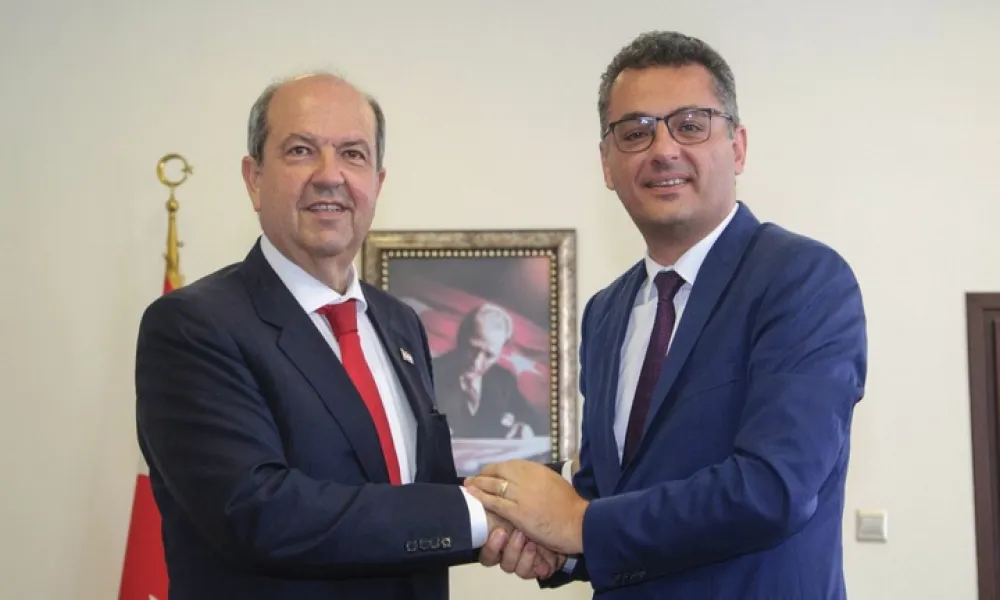

On 19 October, 'presidential elections' will be held in the Turkish Cypriot community. The left‑wing candidate from the Republican Turkish Party (CTP), Tufan Erhürman, hopes to defeat the right‑wing incumbent Ersin Tatár, leader of the National Unity Party (UBP). It is an election nobody can predict, because it is extremely close. Tatár enters the race with a clear narrative on the Cyprus issue—his familiar position favouring a two‑state solution—and aims to secure the vote of the Turkish Cypriot right and nationalists within the community. Erhürman rejects Tatár’s line as unrealistic, advocating instead a return to the United Nations Security Council resolutions for a federal solution, though he lets it be known that he is prepared to discuss a loose federation with a timetable in negotiations, even if these may ultimately end in failure.
Tatar Camp
“At present there is no clear favourite,” said Nikos Stelias of the Cyprus News Agency, who has been closely watching developments among the Turkish Cypriots and in Turkey. “There is contradictory information coming from both camps,” he added, with each side citing its own opinion polls and challenging the results published by the other.
Speaking specifically about Ersin Tatár’s camp, Stelias said they argue that Tatár enjoys backing from the strongest political force, the UBP. They also point to support from the Rebirth Party (the party of settlers) and the Democratic Party, while claiming that voters with nationalist leanings will support Tatár.
However, Stelias notes that the Democratic Party (DP) is currently in a state of disintegration, though it still retains some electoral base. He stressed that “it will become clear in the ‘elections’ whether the DP can attract the electoral forces it had in the last electoral process.” He also reminded that the founder of the DP, Serdar Denktas, has left and founded the “Social Justice and Struggle” (TAM) party, and has in fact announced his support for Erhürman.
Asked about internal conditions within the UBP, Stelias stated that things have not been running smoothly since Tatár assumed the so‑called presidency, and that various factions are clashing. Nonetheless, Tatár’s team argues that UBP voters will turn out. Stelias expressed reservations: intra‑party disputes have worsened in recent years, evidenced by the UBP’s inability to elect a “speaker of parliament” and numerous interventions from Ankara.
Erhürman Camp
Stelias noted that Tufan Erhürman has assembled a coalition to try to win the election. This alliance includes the CTP, which the CTP’s own polling shows as the largest political force, though polls from Tatár’s camp put it second. Also in Erhürman’s coalition is the Communal Democracy Party (TDP), though it no longer has the electoral strength it once held. “Indeed,” Stelias pointed out, “in the penultimate parliamentary elections it failed even to enter the ‘assembly’, having not passed the 5 % threshold.” Yet the new leader of the TDP, Zeki Çeler, has announced his support for Erhürman and plays an active role in his campaign. The TDP is the party formerly associated with Mustafa Akinci.
Stelias went on to say that there are smaller left wing groups in Erhürman’s coalition. He also noted that there are Turkish settlers who, in Turkey, support the opposition, and who now support Erhürman. “This phenomenon,” he added, “is stronger in areas with a higher presence of Turkish settlers who have obtained voting rights, and essentially send a clear message to Ankara that they reject the policies being pursued there by siding with Erhürman.”
On settlers and voters
Regarding the Turkish settlers eligible to vote in these 'presidential elections,' Stelias said that the number of voters has now exceeded 215,000. In the previous 'presidential elections' there were about 199,000 voters. He further argued that, in the registers of the Republic of Cyprus, Turkish Cypriots do not exceed 100,000. “So,” he added, “those of us focusing on the puzzle of the composition of the Turkish Cypriot community try to form an image and draw conclusions based on these numbers.” He noted however that exact calculation is not possible.
Stelias also emphasised that in every election over the past 15 years conducted in Turkey where Turkish citizens voted in polling stations in the occupied territories, Erdoğan has always lost—and the winner has been the Turkish Republican People’s Party (CHP). He pointed out that a major court decision is expected on Monday in Turkey regarding the CHP. “If,” he said, “a decision is made that is anti‑democratic, removing the leader of CHP and placing a trustee in charge, then there may be unforeseen developments in Turkey,” hinting that such an event could also affect the Turkish Cypriot election results. He expressed the view that negative developments in Turkey may subtract votes from Tatár rather than adding to him.
Serdar Denktas
When asked what impact Serdar Denktas’s endorsement of Tufan Erhürman might have, Stelias said there are no measurable data for Denktas’s party, TAM, as it has not participated in an electoral contest. He noted, however, that in the previous 'presidential elections' Denktas stood as an independent and received 4.2 %. He said that Denktas was in the process of leaving DP, and that outcome was disappointing. He also argued that Denktas’s involvement in various “governmental formations” has not been very successful, and that the fractures in his relationship with Turkey have affected his electoral base. He emphasised that that politician no longer has the same political weight.
Kudret Özersay
He also spoke about Kudret Özersay, the leader of the “People’s Party”, saying that Özersay remains a political actor on the Turkish Cypriot right. He was a rising star until the middle of the previous decade but now faces problems. Nonetheless, Stelias said he remains popular—though that is not reflected in recent electoral results. He noted that in these “presidential elections” Özersay has left his electorate free to vote according to conscience. Journalistic gossip suggests that most of his voters will vote for Erhürman. He added that two former deputies from the People’s Party have publicly backed Erhürman.
Weaknesses of the Candidacies
Regarding the challenges each candidate faces, Stelias listed the key ones:
-
For Ersin Tatár: internal strife within the UBP; difficulty persuading voters about his Cyprus vision, which lacks resonance among many Turkish Cypriots; the claim of joining the Organisation of Turkic States being seen as political theatre rather than substance; and perhaps most critical, economic and social issues—Turkey’s worsening economy and galloping inflation are having negative repercussions in the Turkish Cypriot community. He mentioned that the price of red meat in the occupied areas has become unaffordable, leading Turkish Cypriots to come into the free areas to buy cheaper meat. He also pointed to serious infrastructure problems: electricity supply issues and blackouts in recent months; when schools reopened there were alarming deficiencies—such as decorative plaster falling onto pupils’ heads. “All these,” he concluded, “create a difficult daily reality that works against Tatár’s candidacy.”
-
For Tufan Erhürman: Stelias said that Erhürman’s attempt to woo centre‑right voters and portray a centrist political profile is a double‑edged sword: it risks alienating parts of the left. He also pointed out a lack of clarity in Erhürman’s positions on the Cyprus issue. He has recently spoken of a “loose federation” and has indicated that he has held discussions with Ankara and may coordinate with Turkey later. But many Turkish Cypriots are not convinced by his proposition of a timetable for negotiations, and wonder whether the Greek Cypriot side would accept such terms.
-
Another challenge for Erhürman is his relationship with Turkey: there are centrist voters with nationalist leanings who are not persuaded by his statements that he can reach agreement with Ankara—especially given that Turkey has supported the two‑state solution since 2017.
What Role is Turkey Playing?
When asked about Turkey’s role in the election, Stelias dismissed interpretations that Ankara is keeping its cards close to its chest. He cited, for example, the invitation by the Turkish presidency for the mukhtars of the occupied areas to visit the Presidential Palace and meet the Turkish President. He argued that “this was a clear gift to Mr Tatár.” However, he noted that Turkey is mired in its own domestic problems and occupied with other major concerns: developments in Syria, the status of the opposition in Turkey, the Kurdish issue, and the dialogue with Abdullah Öcalan. He added that “for years the Cyprus issue has not been a priority,” and that relations between Greece and Turkey are also not especially high on the Turkish agenda.