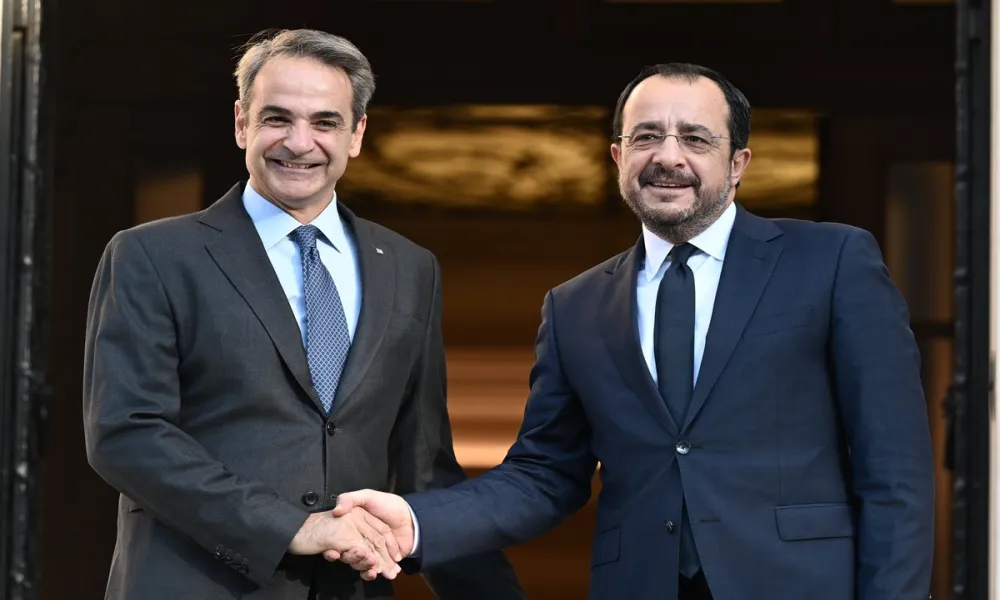
The decision by Greece and Cyprus to update the feasibility studies for the Great Sea Interconnector (GSI), the planned electricity link between the two countries, marks a shift in the project’s role, placing it within a broader geopolitical and energy framework.
Speaking at the “Greece Talks” conference, Greek Minister for Environment and Energy Stavros Papastavrou explained that the GSI is now part of the India-Middle East-Europe Economic Corridor (IMEC), a joint European and US effort to strengthen ties with India. The reframed narrative aims to address longstanding Cypriot concerns while positioning the project as geopolitically and economically strategic.
Supporters expect the updated studies to confirm the project’s viability, respond to Cyprus’s objections, and justify deeper participation by the Republic of Cyprus. The narrative is now shifting, with the GSI envisioned as part of a wider plan to transport green electricity from regions with abundant solar potential, such as Egypt, Saudi Arabia, and Gulf states, to Central and Northern Europe.
Regional role
Greek Prime Minister Kyriakos Mitsotakis described the initiative as strategically significant for both Greece and Cyprus, emphasising its national and regional importance. “These partnerships (the 3+1 framework) are vital for shaping the energy and geopolitical landscape over the next decade,” he said, noting that the project could attract new investors to benefit all parties.
Cypriot President Christodoulides highlighted the coordinated efforts of Greece and Cyprus in energy, economy, and connectivity, stressing the need for concrete actions with tangible economic and geopolitical impact.
ADMIE CEO Manos Manousakis underlined the regional role of electricity interconnections for renewable energy integration and security of supply. He noted that large projects, such as the Greece-Cyprus-Israel interconnection, could channel electricity from distant regions with different climates and time zones, strengthening both local and regional markets. ADMIE is also working closely with ELICA on the Greece-Egypt GREGY link and completing a feasibility study for Greece-Saudi Arabia.
Countering Russian and Chinese influence
The updated feasibility studies will also consider advances in subsea cable technology and new financing conditions to attract strong investors, including potential US participation through the International Development Finance Corporation (DFC), France’s Fund Meridiam, and interest from the UAE.
The project forms part of the broader 3+1 cooperation between Greece, Cyprus, Israel, and the United States, underscoring energy’s priority on the US agenda. US Ambassador to Greece Kimberly Guilfoyle highlighted the connection between energy independence, national security, and regional stability, noting the importance of countering Russian and Chinese influence in the Eastern Mediterranean.