
A new public opinion survey presented by the Cyprus Broadcasting Corporation (CyBC) records limited changes in party support compared with the previous poll released in January. The research, conducted by MRC CYPRONETWORK, examines both party performance ahead of the parliamentary elections in May and broader patterns in political behaviour among voters.
Generational shifts in political preferences
According to the findings, younger voters belonging to Generation Z and the Millennials tend to favour newer political parties. In contrast, older generations, including Generation X, Baby Boomers and the Silent Generation, continue to support the established parties of the Cypriot political system.
The survey’s scientific coordinator, Yiannis Mavris, notes that this trend reflects both the erosion and the realignment of party affiliations and is reshaping the electoral landscape.
Voting intention
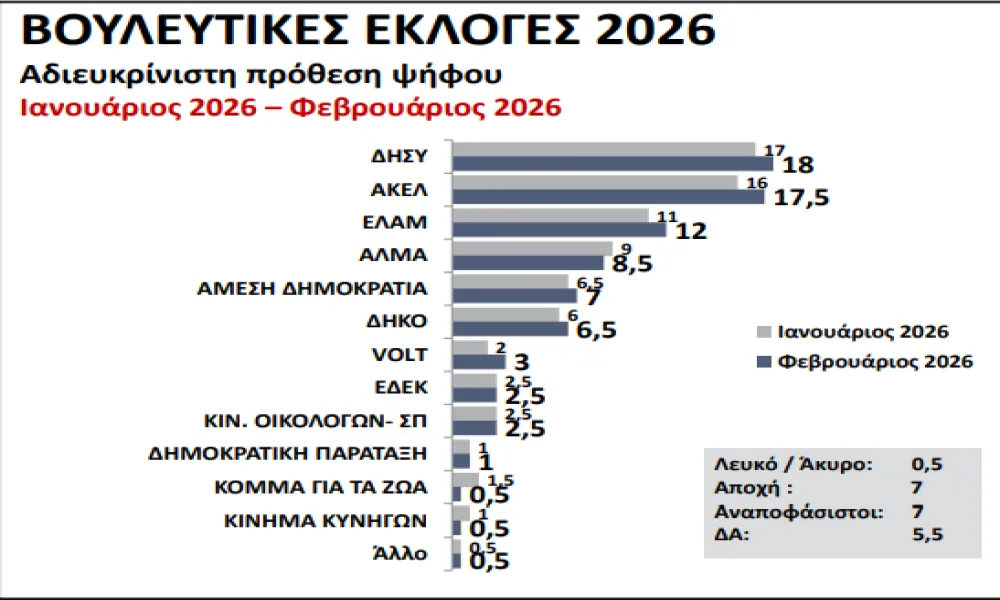
According to the survey, DISY records 18% in voting intention with party cohesion at 59%. AKEL follows with 17.5% and cohesion at 70%.
ELAM ranks third with 12% and cohesion at 83%. It is followed by ALMA with 8.5%, Direct Democracy with 7%, DIKO with 6.5% and cohesion at 58%, VOLT with 3%, EDEK and the Ecologists Movement at 2.5%, and DIPA at 1%.
Corruption as a dominant concern
One of the main issues identified in relation to political behaviour is corruption, which six in ten voters consider the most significant problem.
The survey indicates that 61% of respondents view corruption as the most serious issue affecting the country and express a pessimistic outlook, believing that Cyprus will always face corruption.
This perception may influence the voting behaviour of a significant share of the electorate that currently feels distant from all political parties and oscillates between abstention and protest voting. This group is estimated at approximately 16% of the electorate, or around one in six voters.
The research also records the main voting criteria among those intending to vote, with domestic governance emerging as the most important factor.
Cyprus issue
Beyond the emphasis on internal governance issues, the findings also show strong pessimism regarding prospects for resolving the Cyprus problem.
According to the survey, 71% believe that under current conditions an acceptable and viable solution cannot be reached.
The Cyprus problem appears to carry limited weight in voter decision-making, with only 5% saying it will be the main factor influencing their vote in the elections. This is the lowest level recorded in RIK surveys for the period 1996 to 2026. By contrast, governance-related issues reach 22%.
At the same time, 57% of respondents state that both governance issues and the Cyprus problem will influence their vote.
Trust in institutions
The survey also records a widespread and continuing decline in public trust in institutions.
This decline affects primarily representative institutions such as Parliament, political parties, trade unions and municipalities. It also extends to institutions of the executive and judicial branches, including the government, the public service, the judiciary and the police.
To a lesser extent, the decline in trust also affects the National Guard and the Church.