


The most decisive finding of the second Noverna poll conducted on behalf of Politis is the share of undecided voters, which reaches 28.5 percent. This means that nearly one in three voters has not yet settled on a choice.
The survey points to a highly fluid political landscape, with near parity between the two major parties but also a strong presence of smaller political formations. The findings suggest that the traditional model of political dominance by the two main parties still exists, though at significantly lower levels than in the past, while at the same time a clear trend towards multi-party competition and voter movement is emerging. The poll was conducted between 26 February and 11 March 2026, with 1,020 participants.
At the same time, almost three in ten voters say they remain undecided, indicating that the final electoral outcome is still volatile and that the campaign period ahead could alter the current balance.
Vote intention: DISY and AKEL in close race
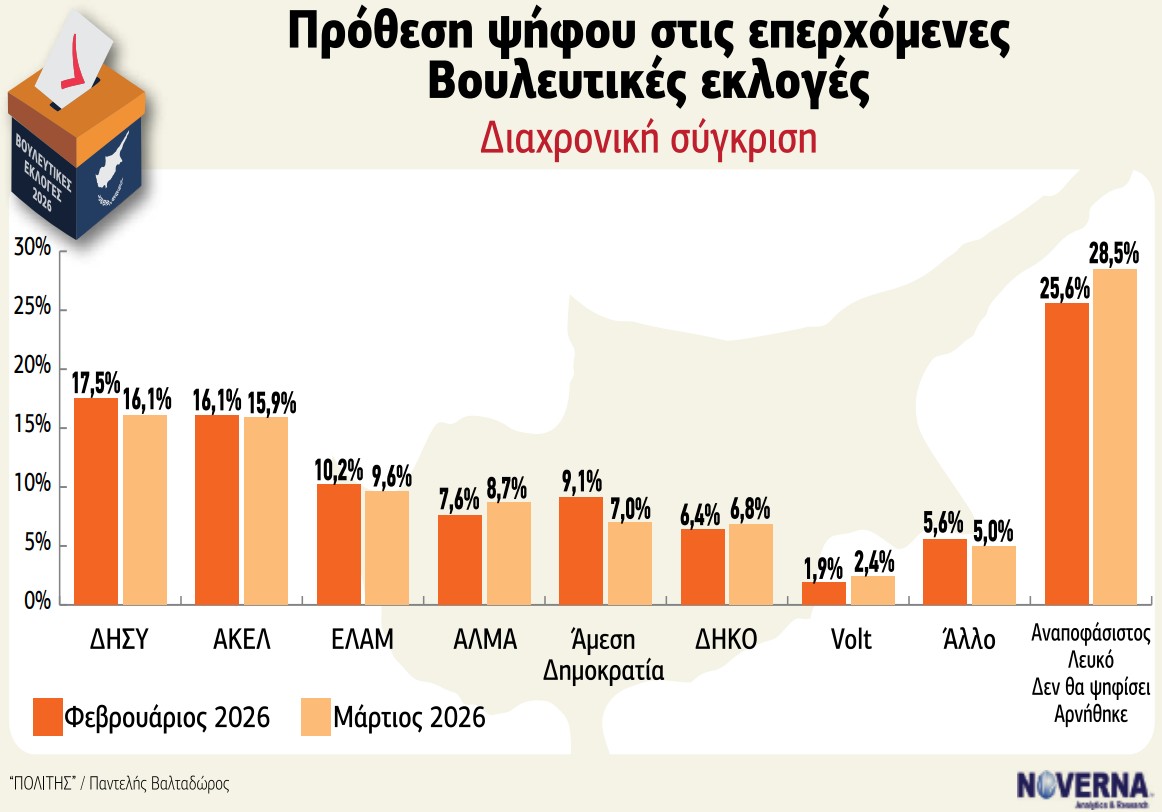
In vote intention across the full sample, Democratic Rally (DISY) appear marginally ahead with 16.1 percent, closely followed by AKEL with 15.9 percent. The difference between the two parties is practically negligible and falls within the margin of statistical error, suggesting that the contest for first place remains open.
Compared with the previous month’s data, both parties show relative stability. DISY records a slight drop compared with February, while AKEL remains essentially at the same level. The picture suggests that the two largest parties maintain a stable core of voters, though for now neither has succeeded in significantly expanding its influence.
ELAM in third place
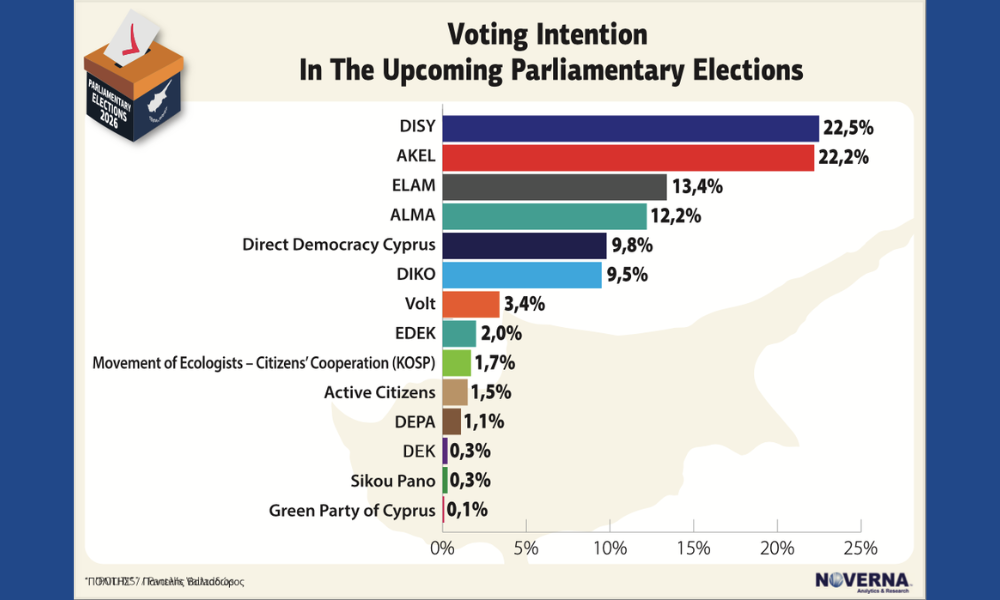
ELAM ranks third in vote intention with 9.6 percent. The party maintains a steady presence at relatively high single-digit levels, confirming the gradual strengthening it has recorded in recent years.
The party’s momentum becomes even clearer when vote intention is calculated only among respondents who declared a specific party preference. In that case, ELAM reaches 13.4 percent, clearly securing third place in the political landscape.
Rise of new political formations
One of the most notable findings of the poll is the presence and relative strengthening of newer or smaller political formations.
ALMA records an increase compared with the February survey, appearing at 8.7 percent of the total sample. When calculated among decided voters, it reaches 12.2 percent, showing an increase from the previous month and indicating that ELAM’s hold on third place may not be secure.
A similar picture emerges for the Direct Democracy party, which records 7 percent of the total sample, though with a decline, and 9.8 percent when recalculated among decided voters.
The presence of these formations suggests that a significant portion of the electorate is seeking political alternatives beyond the traditional parties.
DIKO remains in single digits
The Democratic Party (DIKO) appears at 6.8 percent in vote intention and 9.5 percent after recalculation among decided voters. The party records a slight increase compared with the previous month and appears capable of overtaking Direct Democracy, which seems to be losing support.
The data nonetheless reinforces the view that DIKO continues to face difficulties in consolidating and reconnecting with part of its electoral base. However, if it moves around the 10 percent range, it may still manage to stabilise its position.
Large share of undecided voters
The most decisive element of the poll remains the share of undecided voters, which reaches 28.5 percent. This means that nearly one in three voters has not yet settled on a choice.
This percentage is a crucial factor for the final outcome of the elections, as it could significantly affect the ranking of parties as well as the overall composition of the next House of Representatives.
Party cohesion
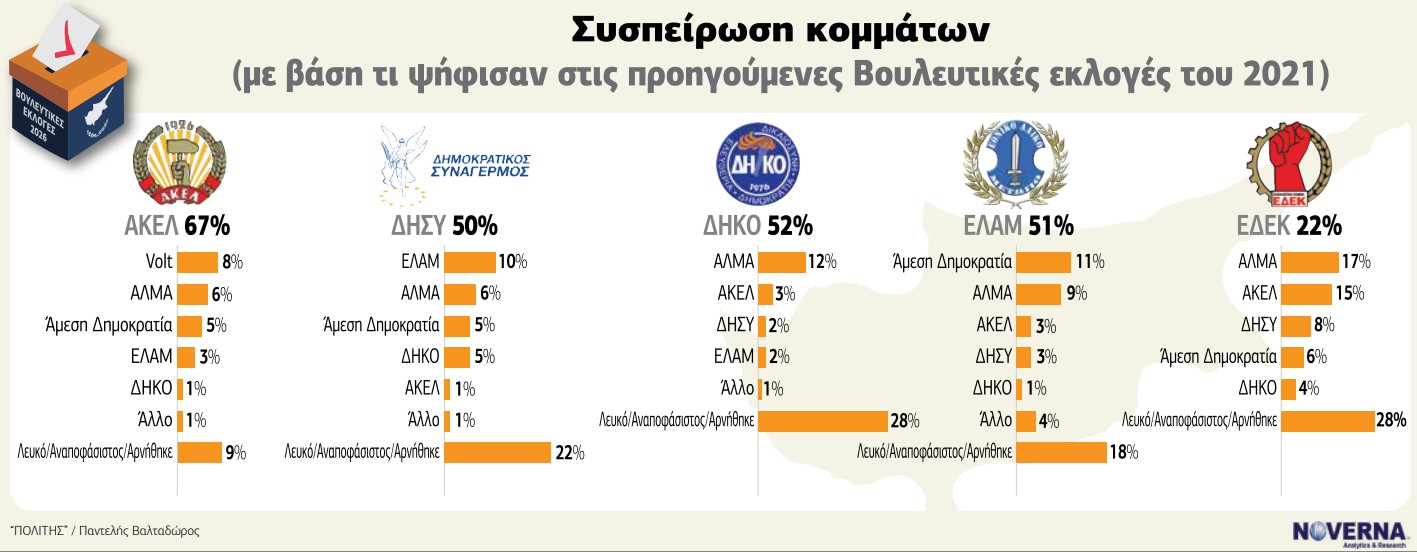
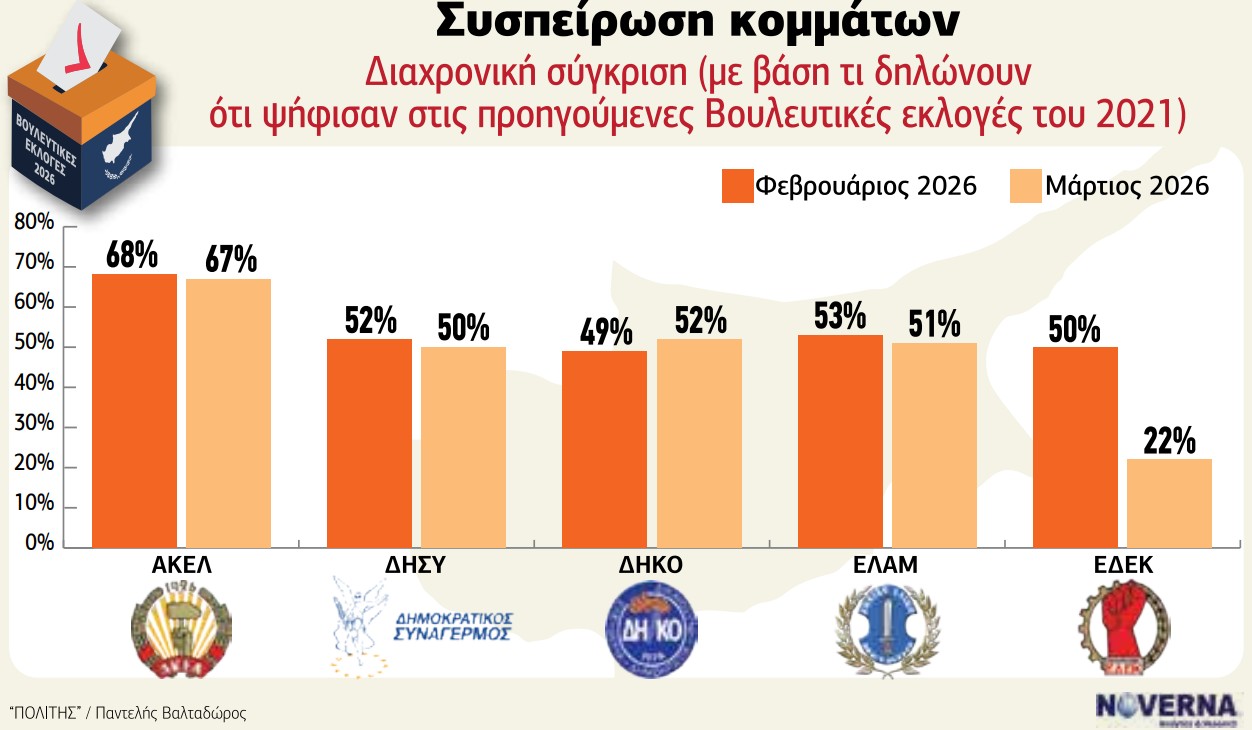
The analysis of party cohesion, based on what voters say they supported in the 2021 parliamentary elections, also produces interesting findings.
AKEL records the highest level of voter loyalty, with 67 percent of its voters saying they remain with the party. It is followed by DIKO with 52 percent, ELAM with 51 percent and DISY with 50 percent.
At the other end of the spectrum, EDEK shows very low cohesion at just 22 percent, indicating that a large share of its voters has already moved to other political parties.
Voter shifts
Voter movements also reveal notable trends. DISY appears to be losing voters to ELAM, ALMA and Direct Democracy, while a significant share of its former voters now declare themselves undecided.
DIKO likewise appears to be losing voters to ALMA as well as to the undecided category.
EDEK voters appear particularly mobile, with movements towards various parties, mainly ALMA and AKEL.
Geographical distribution
An analysis of results by district shows significant variations in party strength.
In Nicosia, DISY and AKEL appear at similar levels, while the share of undecided voters approaches 30 percent.
In Limassol the distribution between parties is relatively balanced, with the undecided share again remaining high.
In Larnaca both AKEL and DISY show strong support, while the picture in Paphos is more fragmented across several parties.
Particular interest is observed in the Famagusta district, where ELAM records a very high percentage, reaching 24 percent and appearing as the leading party.
Certainty of vote
The poll also records the degree of certainty voters express about their choice.
DISY voters appear the most certain, with 80 percent saying they are absolutely sure of their vote. A similarly high level of certainty is recorded among AKEL voters at 78 percent.
They are followed by Direct Democracy with 69 percent, ELAM with 64 percent and DIKO with 60 percent. The lowest level appears for ALMA, where fewer than half of voters say they are fully certain about their choice.
Cost of living and public concerns
The Noverna poll also clearly records the main concerns of citizens as well as their expectations from the new parliament. The findings show that the cost of living and everyday economic pressures dominate the social agenda, while there is also a strong demand for concrete institutional reforms.
At the top of citizens’ concerns is the cost of food and basic goods. Seventy-one percent say they are “very” concerned about rising prices, while a further 22 percent say they are “quite” concerned. In total, 93 percent express strong concern about the cost of basic goods, indicating that inflation remains the most pressing social issue.
The water issue also ranks very high. Sixty-one percent say they are very concerned about the possibility of water cuts, while 26 percent say they are quite concerned. Water sufficiency appears to be gaining increasing importance as drought periods and the effects of climate change increasingly affect daily life.
Similar levels of concern are recorded regarding electricity costs, with 61 percent saying they are very concerned and 27 percent quite concerned. Energy costs remain a significant burden for many households.
High concern is also recorded over wages, rents and property prices. More than half of respondents say they are strongly worried about whether wages correspond to the increased cost of living, while housing affordability also ranks high among concerns. At the same time, 51 percent say they are very concerned about the adequacy of their future or current pension.
Traffic congestion, while lower on the list, still concerns a large share of citizens, with 47 percent describing it as a serious issue.
Citizens are also clear about legislative priorities for the next House of Representatives. Sixty-eight percent say revising the framework for property foreclosures should be a high priority. Meanwhile, 65 percent support limiting parliamentary immunity and 62 percent say reform of family law should move forward.
Overall, the findings depict a society facing strong economic pressures while at the same time demanding meaningful reforms and solutions to issues that directly affect daily life.
A political system in transition
Taken together, the poll’s findings outline a political system in transition. The two largest parties remain dominant but with noticeably reduced support compared with the past.
At the same time, smaller and newer parties appear to be gaining ground, absorbing part of the voter leakage from traditional political spaces. The most likely outcome at present is a six-party parliament, although the rise of Volt could potentially turn it into a seven-party chamber.
Given the large share of undecided voters, the final electoral picture remains open. The campaign period ahead is expected to play a decisive role in shaping the final balance of power.
Survey details
Conducted by Noverna Analytics & Research, member of SEDAK and ESOMAR, on behalf of Politis.
Sample and methodology
1,020 interviews with a representative sample of the voting population in the government-controlled areas eligible to vote in the upcoming parliamentary elections, using random sampling.
Interview method
Structured questionnaire with telephone interviews conducted through CATI (Computer Assisted Telephone Interviewing).
Weighting
The sample was weighted based on the demographic profile of the electorate.
Maximum margin of statistical error
±2.7 percent at a 95 percent confidence level.
Fieldwork dates
26 February – 11 March 2026.
Tomorrow, Monday 16 March:
'How citizens assess the government'