There is a sense outside of Northern Ireland that the breakthrough in peace between nationalist (Catholic) and unionist (Protestant) communities, culminating in the Good Friday Agreement in 1998, brought an end to three decades of violence and centuries of animosity.
Delegations from conflict zones around the world visit the power-sharing institutions set up in Belfast. Tourists flock to the Northern Irish capital to photograph the ‘Peace Walls’ erected at the height of sectarian violence to keep the two communities apart. Former paramilitary members from opposing sides give talks on forgiveness and reconciliation. Catholic taxi drivers give tours of former no-go Protestant areas in Belfast and vice-versa.
A segregated, negative peace
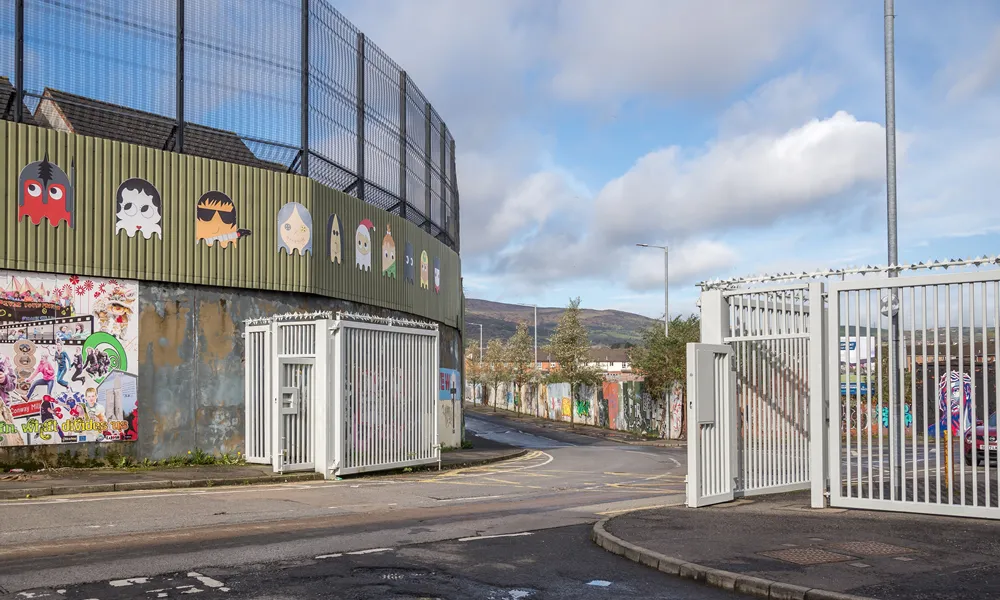
But peace is never quite so simple. There’s no switch for ‘rapprochement’ – or ‘hate’ – that you can flick on or off. The power-sharing institutions have suffered years of deadlock with political forces divided along sectarian lines. The ‘peace walls’ remain in use, not just for tourism, but to prevent the resurgence of sectarian violence. The gates of the walls separating unionist from nationalist areas, to this day, are locked every evening and opened in the morning.
Education among Protestant and Catholic communities remains segregated. Around 94% of children in Northern Ireland are still educated separately, even though they speak the same language. As for the 6% educated together, there is little if any discussion of the region’s controversial history. Segregated or not, there is no inclusion of the Good Friday Agreement in any of the education material in Northern Ireland.
Housing too is segregated, with most Catholics and Protestants – believed to be over 90% – living in separate neighbourhoods.
There is a peace in Northern Ireland, but like in Cyprus, it is a negative one. The absence of violence does not ensure that the original drivers of conflict have been addressed. The past is a touchy subject, so too is identity. Opposing narratives of the hostilities and division get passed down from generation to generation, leaving little space for a shared understanding of the lived experiences of people on either side of the conflict.
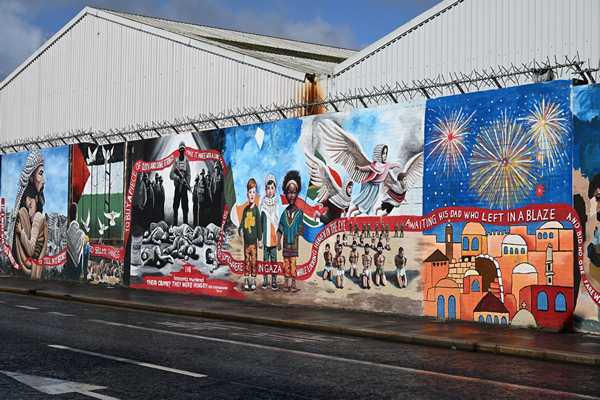
Growing up in the shadow of a ‘peace’ wall
The first barrier between the two communities in Belfast was built on Cupar Street in 1969. The wall and its gates are still in operation. Two thirds of politically motivated deaths during the ‘Troubles’ occurred within 500 metres of the peace walls. The areas around the walls remain socially and economically deprived. Even after the paramilitaries laid down their arms, youth-led violence became an ingrained feature of life near the walls.
In 2019, a survey revealed that the overwhelming majority of residents on either side of Belfast’s peace walls did not believe the walls would be removed in their lifetime. But they were “strongly in favour of barriers being removed within the lifetime of their children and grandchildren”. As one grassroots organisation put it, “the burden of responsibility to ‘deal with the walls’ had been passed on to a new generation.”
Springboard Opportunities was set up in 1992 – before the troubles had even ended – to work with both communities and particularly to engage marginalised youth with limited or no interaction with the ‘other’.
Today, Springboard works with the “children and grandchildren” of those who cannot imagine a world in their lifetime where the walls are brought down. More than half the youth involved in its activities have suffered trauma and have never been engaged in any cross-community activities before.
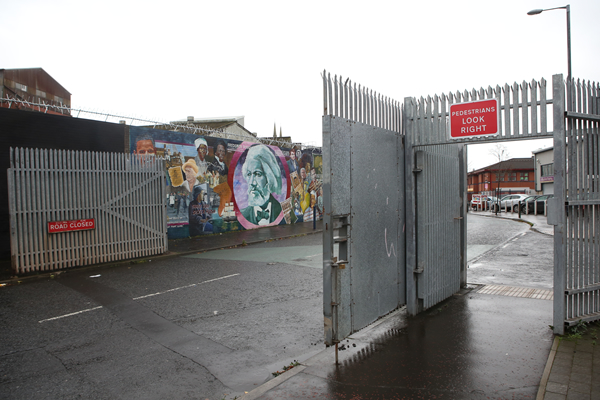
The iron gate of a Belfast peace wall. Credit: Federico Zovadelli / Shutterstock.com
Generational trauma
In 2023, Springboard launched the ‘Wall2Wall’ programme to address the enduring legacy of division in areas of social and economic disadvantage. The intensive 18-month programme brings youth (aged 16-20) together who grew up directly on either side of the peace walls.
The highlight of the programme is a study visit to Cyprus to explore the island’s own walls of division, to discuss issues of identity and language, speak with local youth from both sides of the dividing line, and to help contextualise their own circumstances.
“We wanted to work in areas where young people were affected by socio-economic disadvantages and trauma, a legacy of the troubles,” said Steph O’Rourke.
Springboard’s Executive Director noted that generational trauma from the troubles has contributed to Belfast having the highest rate of anti-depressant medication in Europe, with high levels of prescription addictions, which in turn creates mental health and employment issues.
Springboard Coordinator, Sam McCaw noted that the end of the violence brought investments and tourism into Northern Ireland. But many people in deprived areas felt left behind while little progress was made on integrating the two communities, or on issues of identity and acceptance.
A fragile peace
When Brexit came to shake the delicate balance in the region, the fault lines reappeared. Unionists wanted a hard border with EU-member the Republic of Ireland, while nationalists pushed to unite the island. This only served to stoke tensions, maintain the ‘us’ versus ‘them’ sentiment and feed suspicion of the other’s intentions. Both sides felt their identity was being threatened by the changes taking place, leaving little room for a sense of common interests or future.
Power dynamics changed too, with preferences within each community shifting from the centre to the edges of the political spectrum.
Like in Cyprus, when the high-level politics get rocky, the reverberations are felt closer to the ground, affecting grassroots work to bring the communities closer.
“Our place is very fragile still,” said O’Rourke.
“It shows how long it takes to build trust,” she said, noting that the progressive work done between the two communities is what kept things together when the region had no government for two years.
“People are hugely influenced by family, and the people around them. Their views are not necessarily their own,” said McCaw.
“I came from a very segregated community living close to the peace wall. It was very much a single identity, with one set of beliefs, based on things seen or witnessed.
“Until I was exposed to different perspectives. You meet people who feel the exact same way as you, struggling with the same issues, but from the other side of the wall, so from a different point of view,” he said.
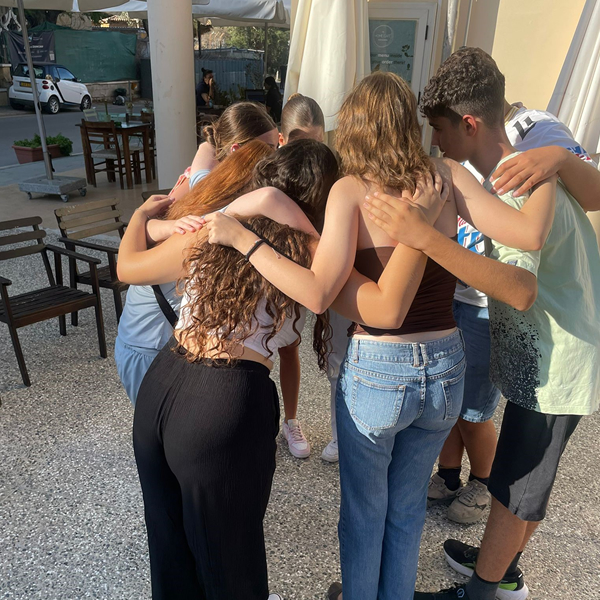
The elephant in the room
Both peace activists were adamant that it takes more than just contact to break barriers. Arranging for people from both communities to meet up for a few hours is not enough. It doesn’t work, argued O’Rourke.
“It’s not just about contact. Many people will meet someone from the ‘other’ community for the first time when they get their first job for example. But you can’t have a dialogue on the important stuff just by meeting.
“You have to get below the surface, engage in activities, go deeper and be able to talk about the elephant in the room,” she said.
The Springboard Director highlighted the importance of doing the work so that people can discuss the difficult issues that keep cropping up. Such as the controversial anniversaries that come up throughout the year, and which, like Cyprus, spark celebrations in one community and commiserations in the other.
“Depending on how contentious the anniversary is, it can stoke tensions. But if you can’t talk about it with the other, then you will likely take to social media to provoke them instead. And then things get heated,” said O’Rourke.
By creating a space for young people to talk with someone from the other community, probably for the first time, and about the hard issues, it creates prospects for the same people to become peacemakers. Next time things get heated next to the walls, they could literally calm things down early on, simply through dialogue.
“You don’t have to agree with the other person, but you can try to understand where they’re coming from,” said McCaw.
Springboard has brought youth together in workshops that have put the wife of a victim of a bomb attack with a woman who served in the same paramilitary unit that placed the bomb. The two are now friends.
“How can we hate each other, if they can forgive each other. We need to talk about these issues. It’s not all about what you see or hear on TV or in your family or community,” he said.
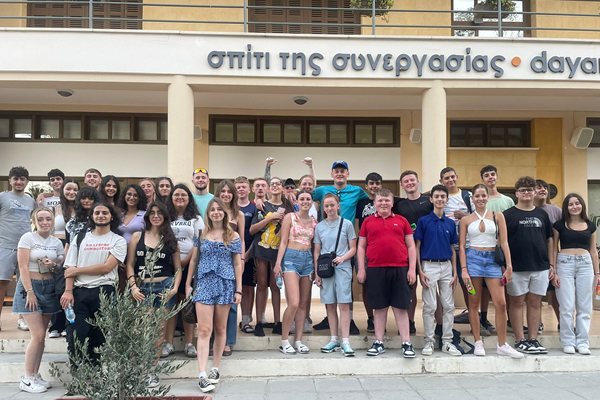
Seeing conflict through Cyprus lens
On bringing the groups to Cyprus, McCaw explained that many of these youth normalise the ‘peace’ wall they live next to and walk passed every day. They don’t see it anymore as it becomes part of their psychology, like a seed planted for years in their heads. Bringing them to Nicosia to see another wall brings the physical aspect of the division to their conscious minds.
“In Cyprus, you see the physical aspect of it, you see people live very much segregated. They have to show their passports to cross,” he said.
“We don’t have to show anything in Belfast but we still don’t cross,” noted O’Rourke.
“Culturally and in terms of language, there are stark differences here in Cyprus. I think our people thought they had barriers until they came here and saw the challenges you have just to get to a bicommunal gathering.”
She added: “Cyprus gives us that ability to see our context through a different lens.”
The work clearly has an impact, as seen from the reactions of youth who participate.
Caitlin, 18, from the Clonard (Catholic) area of West Belfast had no experience of engaging with the Protestant community before joining the Wall2Wall programme. On the Cyprus study visit, she said:
“Meeting young people experiencing the Greek and Turkish Cypriot divide was transformative. Looking at their history and comparing it to our own made me think about how far we’ve come at home, but that there is still a lot of work left to be done.”
Stephen, 18, from the Shankill (Protestant) area of Belfast lived near a peace wall all his life. He described his trip to Cyprus as one of the best experiences of his life.
“It made me think about the future I want – one where we’re not hiding behind walls or afraid of what’s on the other side. I imagine being able to walk freely, go wherever I want, without fear.”