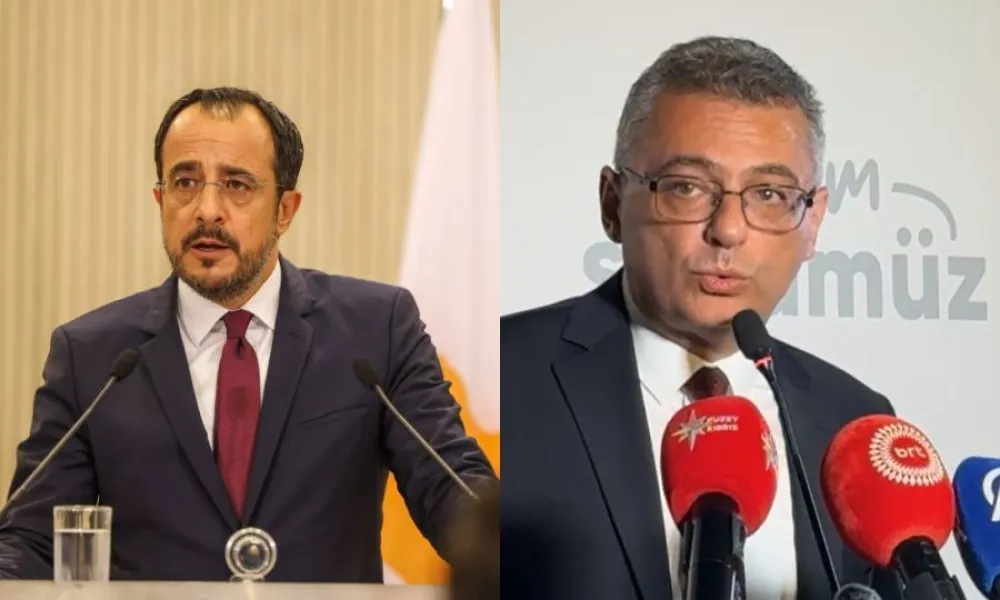
President Nikos Christodoulides and Turkish Cypriot leader Tufan Erhürman will meet at the old, defunct Nicosia airport in the UN-controlled buffer zone on Thursday, with the weight of a divided island on their shoulders.
After eight years without peace negotiations, all eyes with an interest in the future of Cyprus will be on this first meeting between the two leaders, and what happens next.
Christodoulides said on Tuesday he hopes to achieve specific results from the meeting that would lead to a resumption of talks from where they were interrupted at Crans-Montana in July 2017.
‘Sole objective, resumption of talks’
“It is certainly not a meeting of a social nature, even though it is our first meeting,” he said.
He added that the “sole objective” of the meeting was to achieve positive results that would allow the sides to immediately begin the “major effort” of resuming peace talks from where they left off.
“We are fully ready and, I repeat, I hope there will be a response from the other side so that negotiations may begin as soon as possible.”
‘Freedom for Turkish Cypriots’
For his part, Erhürman noted on social media on Tuesday that “many negative developments” have occurred around the Cyprus issue since Crans-Montana. He acknowledged that the leaders were obliged to create an atmosphere in favour of a settlement as soon as possible.
“We have a duty to reorganize the Turkish Cypriots’ communication with the world, to engage with every audience we can reach, and to explain to everyone our people’s will for a solution and for engagement with the world, as well as the realities on the island.”
In a nod to the increasing interference of Ankara in the domestic affairs of the Turkish Cypriots during his predecessor Ersin Tatar’s tenure, Erhürman also spoke about the need to improve relations with Ankara and to make Turkish Cypriots better understood by the Turkish public.
He stressed the need “to help the Turkish Cypriot people stand on their own feet,” highlighting that “freedom of thought and tolerance” are most important virtues of the Turkish Cypriots.
Erhürman strongly rejected the mindset that nothing can be done or nothing ever changes.
“The Turkish Cypriot people are one of the actors on this island and in the region. A chessboard now lies before us, and we will determine and implement the right strategy together.”
The end goal and the way to get there
One of the obstacles to resuming the peace process has been the formal position of the Turkish Cypriot side, supported by Ankara, in favour of “sovereign equality” and “equal international status”, with differing accounts of what that may mean in practice.
During Erhürman’s election campaign, he broke from Ersin Tatar’s Ankara-backed position on a supposed two-state solution and made his support for a federal solution clear. He also set out four conditions for peace talks to resume:
· Recognition of political equality
· Time-limited negotiations
· Acceptance of all past convergences
· No return to the status quo if the talks fail
It remains to be seen whether Erhürman will manoeuvre with Ankara’s backing in a way that allows for a resumption of talks within the UN framework, that is, a bicommunal, bizonal federation. To do so, he will likely insist on having his other concerns, laid out above, addressed.
Whether talks will resume might depend on how he presents these issues – as points for discussion or preconditions – and whether Christodoulides will meet him some way to assuage any concerns about the Greek Cypriot side’s will to go the final lap. It’s worth noting that the relevant actors in Crans Montana acknowledged after the fact that the sides were within arms’ reach of an agreement before the conference collapsed on the Swiss mountaintop.
EU-Turkey relations
One approach that seems clear enough is Christodoulides’ effort to leverage Turkey’s relationship with the EU to improve Cyprus’ relations with the candidate country and the chances of a resumption of talks.
As hinted during his recent trip to Berlin to meet German Chancellor Friedrich Merz, the president wants to dangle carrots before Ankara, in the shape of limited visa liberalisation, participation in European meetings etc, in the hope of getting something back. At the same time, Christodoulides stresses there will be no Turkish movement towards the EU without progress on Cyprus.
Apart from agreeing to play the role of messenger in the effort between Cyprus, the EU and Turkey, Chancellor Merz also highlighted in the Berlin meeting the need for closer cooperation with Turkey. How Ankara responds to this approach has yet to be seen.
Concerns and expectations
Statements issued in the run-up to Thursday’s meeting give an indication of the difficulties ahead. Greek Prime Minister Kyriacos Mitsotakis reiterated on Tuesday that the two-state solution is rejected by definition “by the entire international community”.
In an interview with ERT news, he said he was concerned about the continuing public statements on a two-state solution, adding that he had “expectations” from the first meeting between the two leaders.
On Monday, Greek Cypriot negotiator Menelaos Menelaou appeared to reject the notion of imposing a timetable, referring to the previous negative experience on timeframes. Former Turkish Cypriot leader Mustafa Akıncı called on people not to raise their expectations too high, and on the leaders to focus on small actionable commitments to get the dusty ball rolling.