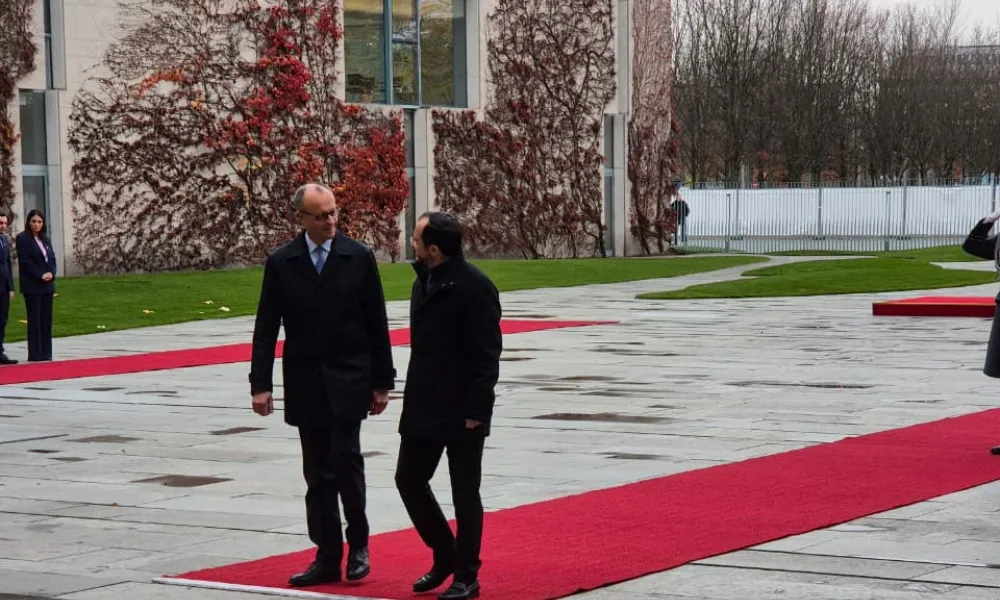
Despite the difference in size and population – 84 million people inhabiting a total land area 39 times larger than an island of one million – the leaders of Germany and Cyprus had plenty to discuss in Berlin on Friday.
The sheer number of issues on the agenda highlights the special nature of the European Union, as a place where large and small alike have a role to play and an opportunity to show what they can bring to the shared table.
Bilateral discussions between German Chancellor Friedrich Merz and President Nikos Christodoulides covered: Cyprus’ upcoming EU Presidency, the bloc’s multi-annual financial framework, EU competitiveness, Ukraine, EU-Middle East relations, the Mediterranean, bilateral relations, Cyprus and the EU’s relations with Turkey, and of course, the Cyprus problem.
Cyprus’ EU Presidency
For Cyprus, Germany is a crucial partner in the planning and success of the European agenda during the island’s tenure at the helm of the EU Presidency in the first half of 2026. Germany provides technical support in a number of areas in preparation for the Presidency, including on environmental issues.
For its part, Germany wants to see a small member state like Cyprus which has less skin in the game, so to speak, to play the honest broker between the various factions as the EU bloc seeks to negotiate its annual budget for the next seven-year period (2028-2034). With elections coming up in France and Poland, Berlin set as a priority to see the negotiating package on the contentious budget framework reach sufficient maturity within the Cyprus Presidency. This is no small feat as the sums discussed are eye-watering while different member states have different ideas on the areas where the EU should focus, e.g. defence, competitiveness, social cohesion, agriculture policies, migration, climate change adaptation, etc.
On the issue of competitiveness, Merz led an initiative last month, getting 21 other EU leaders to agree on the need to cut down EU bureaucracy and either get rid of or simplify rules, giving businesses an easier hand in setting up and scaling up operations. He has requested an ad hoc meeting of the European Councuil to discuss this issue, which will take place during Cyprus’ Presidency on February 12, 2026.
On Ukraine, Christodoulides informed Merz that he will visit Ukrainian President Volodymyr Zelenskyy on December 4, 2025. He underlined the need for effective implementation of the sanctions policy against Russia, noting that it was a common secret that Turkey greatly assists in the circumvention of sanctions while benefitting from doing so.
According to sources, the Cypriot president shared data on companies in Turkey that play a significant role in the circumvention of sanctions, particularly in the shipping sector. He argued that Turkey is a key channel for importing Russian products (including oil), noting that the country has enjoyed a significant increase in its GDP as a result of its actions.
Christodoulides used the opportunity to highlight the importance for more active EU involvement in the Middle East region, noting the enormous prospects for synergies, especially in light of the ambitious planning for the IMEC (India-Middle East-Europe) corridor that extends beyond trade and into the energy field. This dynamic interest in the region, especially with the IMEC perspective, can also be a key point of convergence with the United States. In a recent interview, the Cypriot president had called on the EU to find more points of convergence with President Donald Trump, arguing that he had a plan for the region, and the EU needed to also be present.
Another goal of Cyprus’ EU Presidency is to begin implementation of the EU’s Pact for the Mediterranean which aims to increase cooperation and economic connection across the Mediterranean Sea.
Bilateral relations
Regarding bilateral relations, Cyprus has greatly appreciated the change in stance of Germany with regard to its actions in the Council of Europe, specifically regarding the question of checking Turkey’s implementation of its obligations following rulings by the European Court of Human Rights on Greek Cypriot property cases.
The first visit of a German President to Cyprus took place in February 2024, while Christodoulides and Merz have already held a bilateral meeting earlier this year. The two countries collaborate on defence and security issues, including humanitarian evacuations and Search and Rescue operations, but also in tourism, shipping, education and on migration.
Christodoulides thanked Merz for Germany’s offer to represent Cyprus in seven states where it does not have an embassy so as to meet its obligations when Cyprus finally joins the Schengen area.
And of course, the two also discussed the Cyprus problem and EU-Turkey relations, exploring how to create mutually beneficial progress in both areas in parallel. Christodoulides argued Turkey needs to take substantial steps, particularly regarding agreement on the negotiating framework for a solution, in order to make corresponding progress in the areas of EU-Turkey relations that its interested in.
For more on the latter, read here.