
By Krassen Nikolov
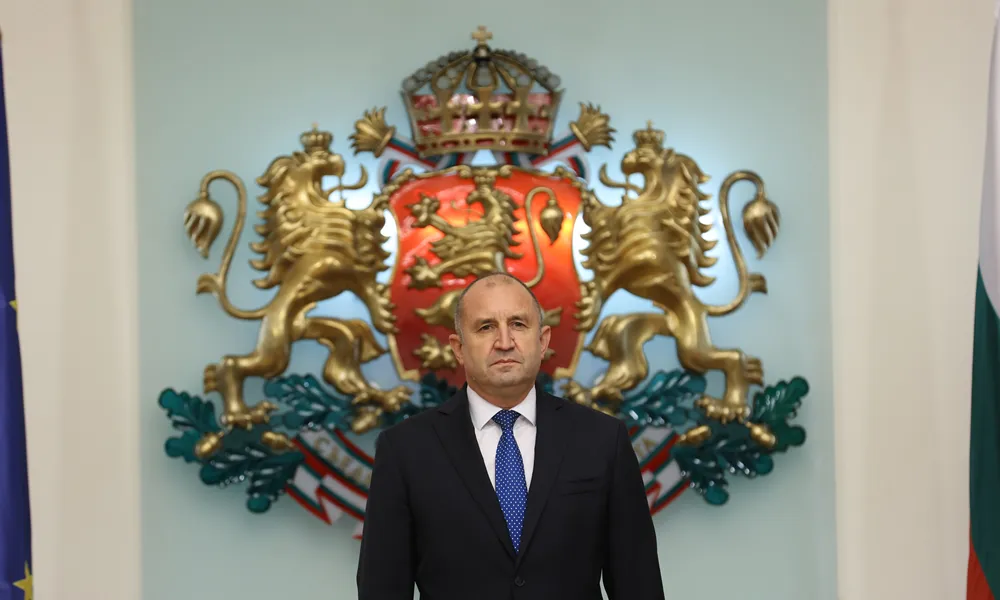
Bulgarian President Rumen Radev announced his resignation on Monday to enter party politics, pledging to “save Bulgarian democracy” from oligarchic influence and what he described as a captured state. Bulgaria will hold early parliamentary elections probably by the end of March.
His move comes on the anniversary of his ninth year in office, one year before the end of his second and constitutionally last term.
The presidency will temporarily pass to Vice President Iliyana Yotova, a long-time ally of Radev, who will appoint the next caretaker government tasked with organising the upcoming early parliamentary elections. Yotova is a former MEP from the Bulgarian Socialist Party.
Geopolitics was notably absent from Radev’s address. Yet his divisions with other anti-corruption political forces largely stem from his foreign policy positions, which have often been interpreted as anti-Ukrainian and pro-Russian. Over his nine years in office, Radev was among the most vocal opponents of military aid for Ukraine and repeatedly expressed approval of Hungarian Prime Minister Viktor Orbán’s foreign policy stance.
At the same time, the domestic agenda pursued by Radev’s caretaker governments has differed markedly from Hungary’s Fidesz model, following an explicit anti-corruption line.
“Bulgaria has completed its European integration – we are now members of Schengen and the euro area – but we must ask why achieving these goals has not brought satisfaction to Bulgarian citizens,” Radev said on Monday.
He argued that public trust in the media and the judiciary has eroded due to a “vicious model of governance” that operates “through the mechanisms of democracy but follows the laws of oligarchy”.
“The puppet-masters do not hesitate to issue orders. They seize banks, parties and media outlets. They use power as a stick against their opponents,” Radev said.
He also pledged to preserve “civic and ethnic peace” together with his political allies.
“Today’s political class has betrayed people’s hopes, which is why they no longer vote, and a new social contract is needed. Our democracy will not survive if we leave it in the hands of corrupt actors, deal-makers and conformists,” Radev added.
Pollsters have yet to provide a clear picture of potential support for a future political formation led by Radev, but most observers agree it would become a significant force in the next Bulgarian parliament.
Krum Zarkov, until recently Radev’s legal adviser, told Nova TV that the launch of a political project by the president was good news for several reasons.
“A new political party could finally help us find a solution to a problem we have failed to resolve for years: achieving stable and competent governance,” Zarkov said. Indeed, Bulgarian politics in recent years have been marred by unstable coalitions and short-lived governments.
There is little doubt that a potential Radev-led project would position itself firmly within the anti-corruption space and oppose the establishment, embodied by Boyko Borissov, the long-serving leader of GERB and Delyan Peevski, the Magnitsky-sanctioned oligarch perceived as what Radev called the puppet-master.
“And last but not least, for the first time in our country’s history we will have a woman president, which in itself seems like good news to me. It should be clear, however, that we should not expect Radev to fix everything for everyone,” Zarkov added.
The largest anti-corruption opposition force, the We Continue the Change – Democratic Bulgaria coalition, has left the door open to potential cooperation with Radev, saying it will wait to see whether he clearly positions himself as a fighter against corruption and pursues pro-European policies.
Radev’s entry into party politics is expected to weaken several pro-Russian forces, including Vazrazhdane and the Bulgarian Socialist Party, as well as populist projects such as MECh and Velichie, as parts of their electorates are likely to gravitate towards the country’s new political heavyweight.
Radev and Europe
President Radev’s decision to enter party politics is set to have repercussions beyond Bulgaria’s domestic scene, including in Brussels.
Alongside Hungary’s Orbán, Radev has been among the most outspoken critics of military assistance for Ukraine as in his words it only makes the war last longer.
Since the start of Russia’s full-scale invasion in 2022, Radev has consistently opposed Bulgaria’s involvement in supplying arms to Kyiv. He has frequently used the term “party of war” to attack pro-European governments in Sofia. His argument that arming Ukraine “adds fuel to the fire” stands in stark contrast to the EU’s common position, but resonates in a country where historical ties with Russia continue to carry weight.
While a significant portion of Bulgarian society views him as a promoter of peace, his critics accuse him of being a pro-Russian politician willing to bow to the Kremlin’s unlawful use of force.
In 2021, Radev triggered a diplomatic scandal by calling Crimea “Russian” during a televised presidential debate ahead of his re-election. A year later, he held a notably frosty meeting with Ukrainian President Volodymyr Zelenskyy in Sofia, avoiding the word “war” when referring to Russia’s invasion and instead using the term “conflict”, which implies shared responsibility, including on the part of Kyiv.
Although Radev later clarified that he had been referring to the de facto occupation of Crimea, the remark placed Bulgaria in a delicate position vis-à-vis its NATO allies. In early 2026, his calls for “peace at any cost” in Ukraine also raised eyebrows among Western partners.
As President, Radev has been critical to the VMRO-DPMNE-led government in Skopje, accusing it of violating the rights of the Bulgarian minority and of tolerating hate speech.
Energy policy
In 2022, after Russia unilaterally halted gas supplies to Bulgaria, Radev’s caretaker government sought to resume negotiations with Gazprom and delayed legal action against the Russian company.
Radev has also faced strong criticism over a deal signed by his caretaker cabinet with Turkey’s state-owned energy company BOTAŞ, granting Bulgaria access to Turkish liquefied natural gas terminals. The agreement has been barely used, yet reportedly costs Sofia around half a million dollars per day.
Source: EUalive.net