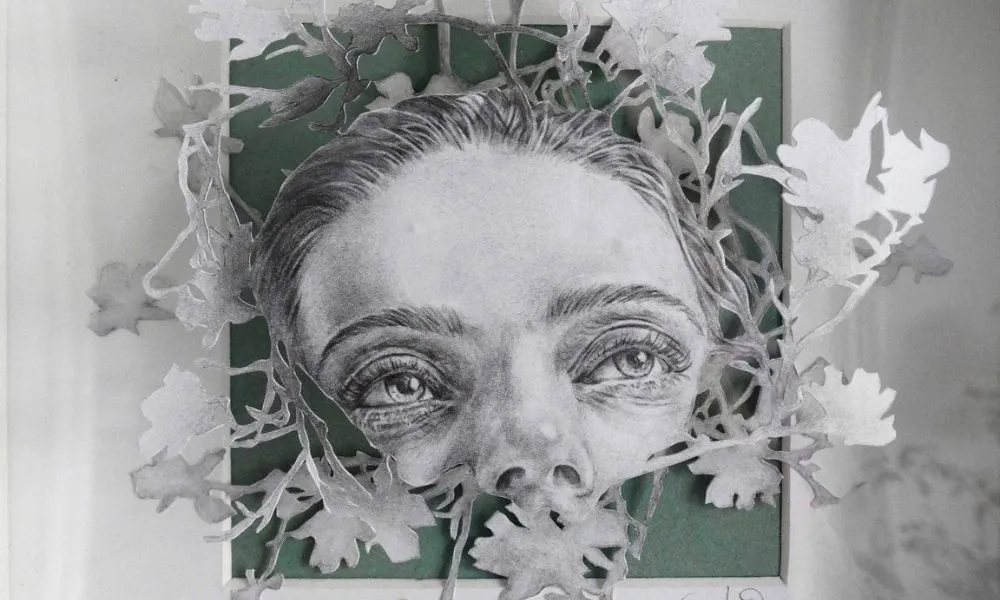

From the summer landscape of Paphos to the winter dialogue of Nicosia. With its new exhibition Electric Dreams, presented at Isnotgallery, a conversation opens around the fragile meeting point between reality and desire, collective experience and personal dreaming. At a time when everything feels fluid, Andros Efstathiou insists that art feels more necessary than ever, not as a means of escape, but as a field for comprehension, interpretation and repositioning.
The exhibition continues and expands the dialogue initiated last summer with I Have Marked an Island in Paradise, presented at the Almyra Boutique Hotel. This time, however, the narrative shifts into the urban fabric of Nicosia, into a different spatial and emotional territory, more public, more immediate, more demanding.
A city in the process of redefining itself
Moving between Paphos and Nicosia, Efstathiou carries the atmosphere of summer ease into a rain-soaked winter setting, without any trace of nostalgia. The desire for dialogue, for the sharing of social and personal dreams, forms a compelling mosaic of narratives that leaves no room for detachment. The viewer stands before the works recognising fragments of themselves, observing change and tracing evolution.
The exhibition unfolds within a curatorial framework shaped by Efstathiou himself, designed to highlight the dynamism of a city that is contemporary, creative and dialogic, and ready both to redefine and be redefined. It is precisely this ongoing evolution of Nicosia that makes it so compelling.
Electric dreams, urgent questions
The title Electric Dreams sets the tone, referring not only to the pervasive aesthetic and technological charge that affects us all to varying degrees, but also to the intensity of the present era. The works point to constant stimulation and underlying tension, alongside a deep need to reconnect with the intangible, the imaginary and the dreamlike.
In a Cyprus where global developments influence even the most everyday interactions, and certainly the art market, Electric Dreams attempts to capture the tensions, concerns and artistic directions of the contemporary scene. It does so without losing its sense of place. On the contrary, it foregrounds locality and places it firmly at the centre of the conversation.
In this context, Isnotgallery repositions itself as an active hub of contemporary creation, opening a dialogue not only with the artistic community but also with a wider audience seeking meaning, optimism and new narratives.
Conversations shaped by contrast
The discussion with Efstathiou around Electric Dreams unfolded across multiple conversations, marked by interruptions and shifts in tone. At times, the emphasis leaned towards theory and spirituality; at others, towards a realism that did not disrupt the need for dreamlike exchanges.
What changes when the narrative moves from a hotel space to wintertime Nicosia?
Primarily, intensity and proximity. Winter Nicosia is rawer, more direct, less filtered. The visitor is no longer in a space of leisure but in one of everyday movement and thought. This makes the encounter with the works more demanding and, ultimately, more honest. The city becomes an interlocutor rather than a backdrop.
How does the charged nature of the times affect art and collecting?
“The times are charged. You don’t need to read the news, you just need to read people. You see tension, insecurity, and a need for something optimistic, something calm but not dull, something that wakes you from the nightmare and guides you back into the dream. I see less exhibitionism and more searching for meaning. People want something real, sustainable, something they can live with.”
Collective and individual reflection
Asked whether audiences are ready to see art as a mirror of their time, Efstathiou speaks of a multi-layered maturity. Viewers are no longer afraid of not ‘understanding’. They accept art as dialogue rather than a test. Questions of identity, for both artists and audiences, are now discussed more openly and with greater depth. Fear, he notes, has never hindered art. It has driven it.
Artist selection, he explains, is always based on dialogue rather than résumés. Established artists trust the gallery enough to present works dating back decades at accessible prices. “This,” he says, “is a deeply political act. Art belongs in homes, not behind glass.”
In a small market like Cyprus, group exhibitions are essential to shaping visual discourse. Efstathiou maintains that collective exhibitions reflect the very essence of art. While creation may be solitary, artists remain acutely sensitive to social change. Dialogue, he argues, has always been more enriching than monologue.
A changing audience
There is a noticeable shift in how Cypriots approach contemporary art. Curiosity has grown, fear has diminished, and participation has increased. Parents visit galleries with their children, engaging openly with works, questioning, disagreeing, even rejecting them. Cultural spaces, he observes, have undergone a form of rebranding, attracting new audiences and fostering optimism.
The gallery today
For Efstathiou, communication is the foundation of a gallery’s role. Without meaningful exchange with society, no commercial, curatorial or educational function can succeed. The gallery must remain a safe space for dialogue, debate and even disagreement.
If Electric Dreams were to leave visitors with one feeling, what should it be?
“Ecstasy. Ideally, visitors leave having encountered a work that speaks to them, one they understand and that allows for a dialogue that helps them grow. Anything that helps us evolve keeps us from stagnation, and that is a powerful motivation today.”
Participating artists
Elysia Athanatos, Vasilis Vassiliadis, Stelios Votsis, Theano Giannesi, Yiannis Kofteros, Maria Kofterou, Charoula Nicolaidou, Christina Papaioannou, Yiannis Sakellis, Konstantinos Stefanou, Panikos Tembriotis, Elena Tsigaridou, Alekos Fassianos, Savvas Christodoulides, Erro, Fikos.