Interview by Katerina Eliadi
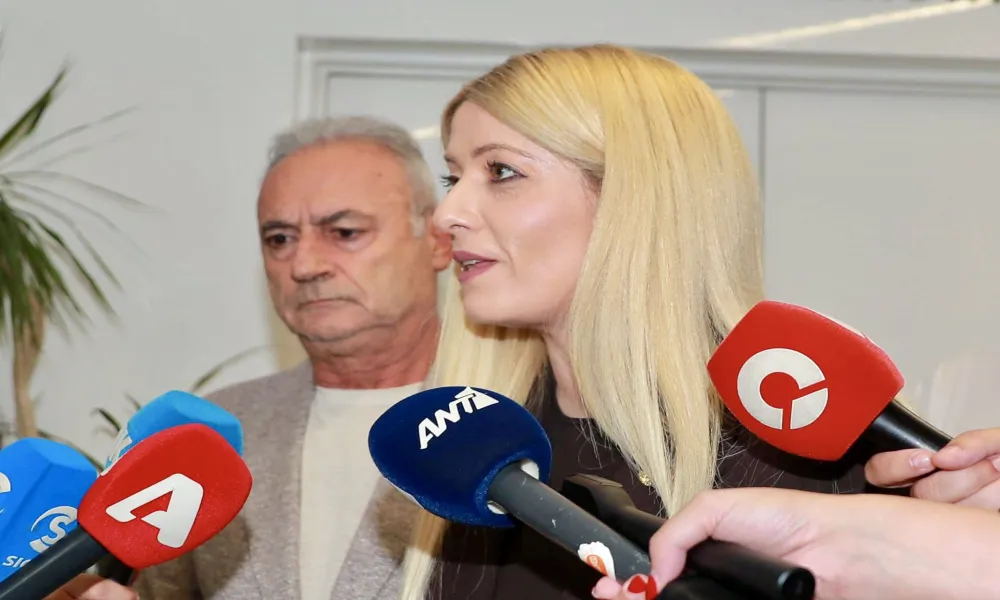
Her name is Narcie, although many in Cyprus still call her Georgia. She was born on the island but grew up in the United States, where she studied conducting at Berklee College of Music before finding her second great passion, digital marketing and technology. In America she founded her own company, Global Titan Digital Marketing, based in Kentucky but working with clients around the world.
She initially came back to Cyprus for family reasons. “But life, as Camus writes in The Stranger, has a way of placing us in the middle of events we never expected. And so I found myself in the midst of a deadly wildfire, escaping with the flames blazing across the mountains before me.”
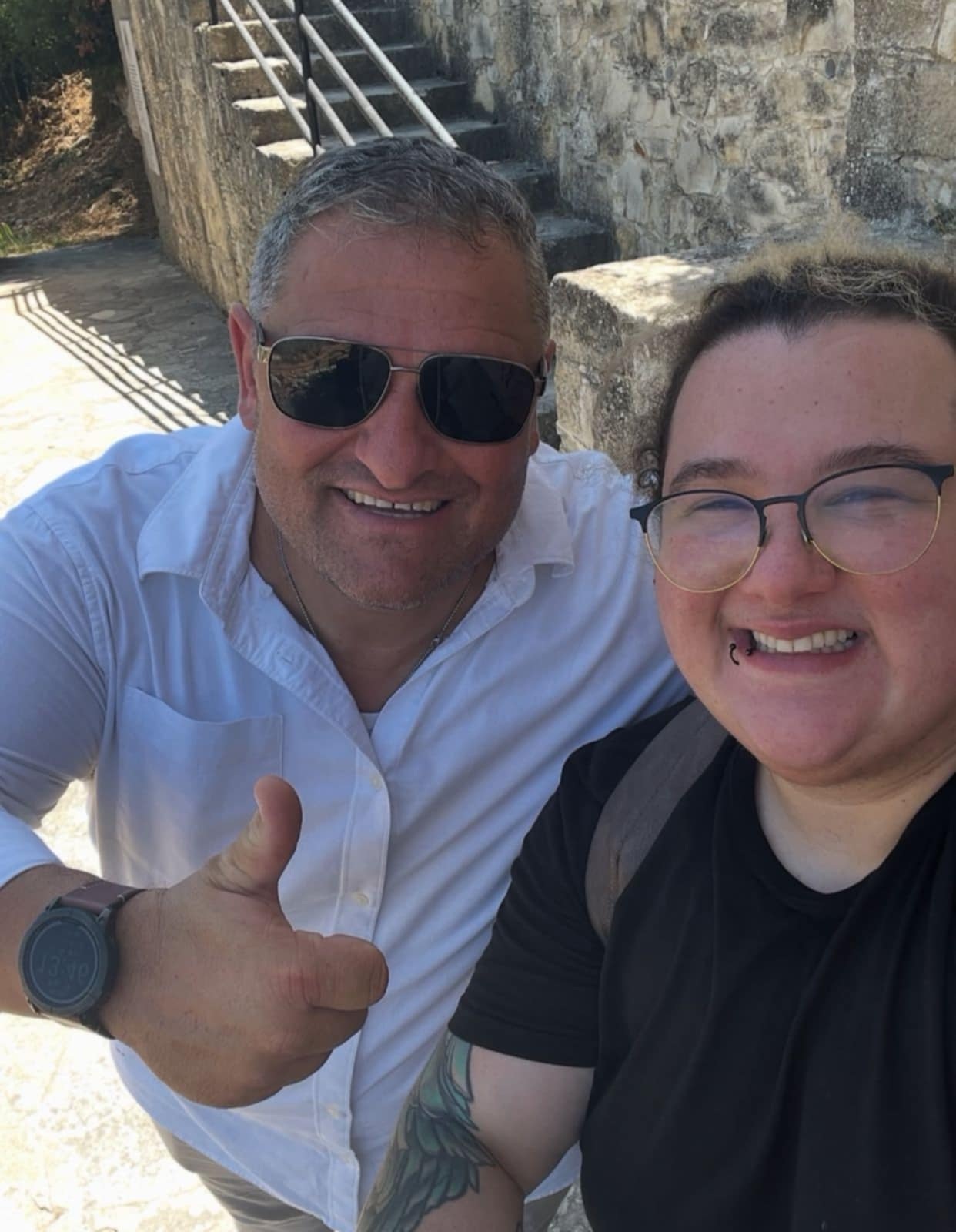
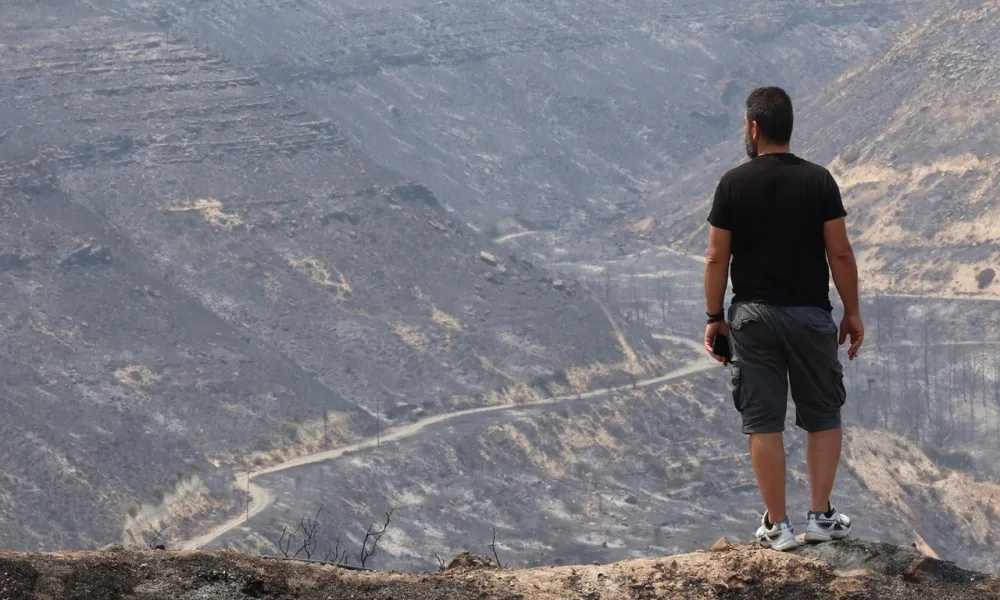
This is Narcie Hadjiconstantinou, who within less than 24 hours created with her team the Cyprus Fire Watch platform in response to the devastating wildfire that swept the foothills of Limassol on 23 August 2025. She watched the blaze unfold and decided to act, designing a platform to provide citizens with what the state could not: fast, reliable information. She also launched an advertising campaign for the fire-hit village of Lofou, to show that the heart of the community was still intact and to help revive visitor numbers, giving local businesses and residents hope amid the ashes. Everything she did was voluntary and free of charge.
“I had to do something”
What exactly is Cyprus Fire Watch, and how did it come about?
“I remember the moment vividly. I had just reached Nicosia, after leaving the fire-stricken areas, when I learned that two people had died in the flames. It was inconceivable. My heart broke. In that moment, I was so angry that I said to myself: ‘I must do something.’ That is how Cyprus Fire Watch began.
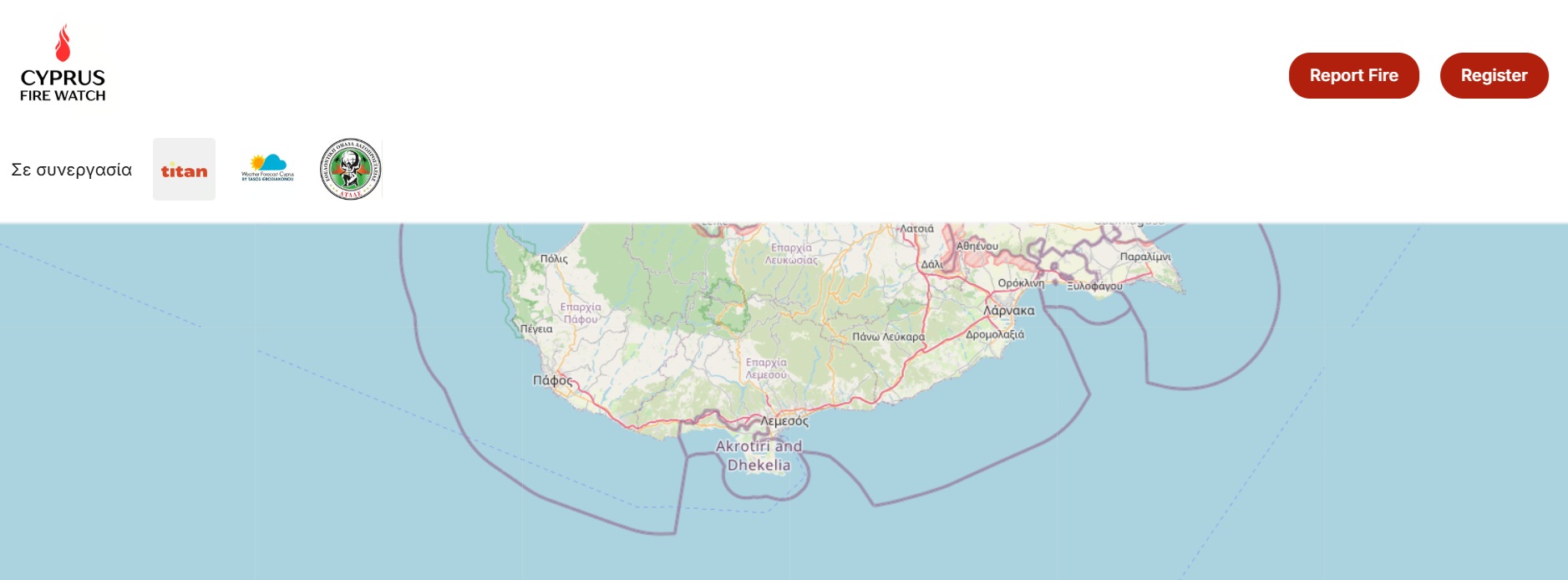
We created a map that tracks wildfires in real time, combined with a notification system for mobiles and emails. Within the first 48 hours more than 3,000 people registered on the platform. Soon after, it was used to coordinate volunteer efforts. The first days were chaotic. I had to call the Fire Coordination Centre every three hours for updates, because there was no API or digital mechanism to monitor the fire. For three or four days I lived by my alarm clock, calling again and again to make sure we had the right information. It infuriated me.
That is when I realised the software was not just useful, it was absolutely essential. I decided to build it for my fellow citizens, because I knew people were panicking and needed a reliable source. Social media was flooded with misinformation and exaggeration. That is how Cyprus Fire Watch was born: a platform for timely, factual information, without advertising, without profit. Everything remains free because I consider it a matter of social responsibility.”
“You just act”
How can someone so young build and run what is essentially a 112 system, before the government itself?
“When you see fire devouring the earth and smoke blotting out the sky, you do not ask whether you have the authority. You just act. Youth often does not carry the weight of bureaucracy or the fear of failure. Something needed to be done, I could do it, so I did.”
2025, really?
Where does the state fall short?
“The state is often too slow. Government is like a giant machine: complex, sluggish, bound by procedures. Technology, however, is like water, it needs to flow quickly and adapt.
In the last three weeks, going through government buildings, I saw things that left me speechless: old PCs with dates frozen on their screens, notebooks and pencils instead of digital tools, offices in poor condition. It felt as though technology had barely touched the state.
When officials are still working with pen and ledger, how can we dare to speak of digital transformation? Honestly, I think the government needs a hard reset of its technological infrastructure. I lived 15 years in the United States, and perhaps I am biased, but the comparison is like a village next to a metropolis. Yet it is 2025, and Cyprus should be living in 2025.”
So what does this mean in practice?
“While other governments are building systems and platforms, here I saw officials working in Excel. That explains the delays and poor coordination we all witnessed. There is no integrated software or application to connect the departments that must work together in a crisis. People rely on outdated tools, which is simply unacceptable.
And this is not just the fault of the current government, it is a problem that has built up over many years. To understand how far behind we are: in the US, the Reverse 911 system has been in operation for more than two decades, sending automatic alerts to citizens about evacuations and danger. That is not even innovation, it is basic responsibility.”
Money from the ashes
Is there such a thing as ethical and unethical programming?
“Of course. It depends on the intention and moral compass of the developer. During the course of Cyprus Fire Watch, I was pressured to exploit it politically or financially. I refused, because if money or power came first, we would lose the essence: truth and trust.
Even someone very close to me asked: ‘So you still haven’t managed to make money out of the ashes?’ Outrageous. Disgusting. Sometimes people in Cyprus really drive me mad. Where is altruism, where are ideals? Why must everything be measured in money? How useless must you be as a human being to think of profiting from such a tragedy?
My answer was clear: ‘The moment I accept blood money is the moment I sell my soul and die inside.’ Someone must care about this country. I care. Others? I pity them. Because Cyprus Fire Watch proved that we can unite and act collectively. Not everyone, but many of us.”
“Not theories, but facts”
“These are not theories. I coordinated, we coordinated, 100 people to clean up Lofou. We sent 200 hunters to clean houses. I organised the delivery of air purifiers to villages. We collected furniture and, with the help of more than 230 donors, delivered it to Civil Defence.
Many developers approached me, offering to help free of charge. And together, ordinary citizens made a real difference. Because we could, because we wanted to, and because we care. Without parties, without hidden agendas. Simply because we had been left to burn alive.
My life motto? ‘The more of us there are, the fewer of them.’”
Like a dystopian novel
Narcie, what were your own experiences during the Limassol wildfire?
“I remember leaving with the flames right before me, on the mountain. For a moment I thought of heading down towards Trimiklini, but an elderly woman stopped us and told us to go up through Troodos, because Alassa was burning. It was chaos.
As I drove towards Troodos, the sky turned blood-red, almost surreal. Fire whirlwinds rose before my eyes, and the air was so suffocating it felt like a scene from a dystopian novel. My car’s air-conditioning reeked of smoke and death.
I left everything behind. For three days my life fit into a backpack: a laptop, a phone, three T-shirts, three pairs of trousers and one pair of shoes.
On the second day, when the government announced there might be an arsonist on the loose, I joined ten other volunteers to patrol the mountains. We had more cars than the police. Strangers came together, self-organised, and we managed to cover Troodos from midnight to six in the morning. Even now, describing it, I can hardly believe the horror I witnessed.”
The real Paradise
How do you see technology today? Can it replace real life?
“Technology is an extension of our existence. The question is not whether it will replace life, but whether we allow it to alienate us. Proust wrote that ‘the real Paradise is in our lost time.’ If we surrender entirely to screens, we risk losing that Paradise.
But if used wisely, technology can be liberating. It can bring us closer, give us knowledge, even save us from a wildfire. It is not here to replace life, it is part of life.
Like any powerful tool, it can be used ethically or unethically. That is why we need ethics councils, regulatory frameworks and laws to set boundaries. Technology itself is neither good nor bad, it is neutral. What gives it colour is how we use it.
So technophobia seems outdated, almost quaint. It is like rejecting electricity because it once provoked fear. Instead of fighting progress, we must learn to use it responsibly, with an ethical compass.”
A matter of mentality
To what extent does Cyprus make use of technology?
“Cyprus is making progress, but usually in small, slow steps. It is not a matter of capability, but mentality. We lack trust in innovation, the courage to fail and try again. We are not centuries behind Silicon Valley, but we are trapped in a culture that prefers safety over risk. And that slows us down.”
Does the education system prepare today’s citizens?
“We need to teach children not to memorise, but to think critically, to use technology creatively and responsibly. Education should cultivate the ethics of digital citizenship, not just technical skills.”
False freedom
What does the toxic behaviour on social media reveal?
“It shows something deeply human: our need to be heard, even when we have nothing to say. Socrates spoke of ‘alogos logos’, speech without reason or truth. Social media is full of it.
But users can choose differently: to use platforms for learning, for collaboration, to give ideas a stage. It is up to us whether we turn them into a coffeehouse or a tool of progress.
Behind a screen people feel a false sense of freedom. They use it as a kind of therapy, but it is not therapy. It is a vicious cycle that often reproduces toxicity.
Online you can be whoever you want, but that does not mean you will find your true self. And let us not deceive ourselves: drama sells, conflict sells. Social media are mechanisms of vanity.
I know this personally. I started with music and I saw how easy it is to get drunk on a viral post. On TikTok I have more than 80,000 followers, I know exactly how tempting it is. But there comes a moment when you mature. You realise life and dignity matter more than a trending video or a handful of likes. And then you decide: either you remain in that cycle, or you find a more meaningful way to use the platform.”
From the screen to the soul
Tell me something freely, whatever comes to your mind.
“What matters most in the end is kindness. To hold on to our kindness, even when it is hard. The real challenge is not speaking loudly on social media, but protecting your soul and the souls of others.
We are not here by chance. We are here to learn from each other, to act as mirrors for one another. Sadly, many influencers exploited even the wildfire tragedy for clicks and followers. That only deepened the confusion for residents and authorities.
People must stop giving power to such ‘content creators’, because every follow is a vote of confidence in someone who does not deserve it. Instead we need more education, more reading, more self-awareness. We must look inward, not only at the screen.
Altruism is not theory, it is an ideal and a way of life. I urge everyone to pursue their own gentleness, their own kind soul. As Cavafy wrote: ‘And if you cannot shape your life the way you want, at least try as much as you can not to degrade it.’ That is our duty to ourselves, and to society.”
“We are waiting for you with love” … in Lofou
How did the videos about Lofou come about, and what did you want to promote?
“First of all, let me be clear: I am not from Lofou, but now I feel like an honorary citizen. The love and warmth I received from its people was so generous that I could not remain indifferent.
The story began when, after the fires, I coordinated a large group of volunteers. More than a hundred people came to Lofou with their own brooms and bags to clean the village, after a request from Mrs Christalla, the mother of the village priest. There I also met the community leader, Yiannos Neophytou, who explained that misinformation was spreading online from influencers, claiming Lofou had been completely destroyed, which was not true.
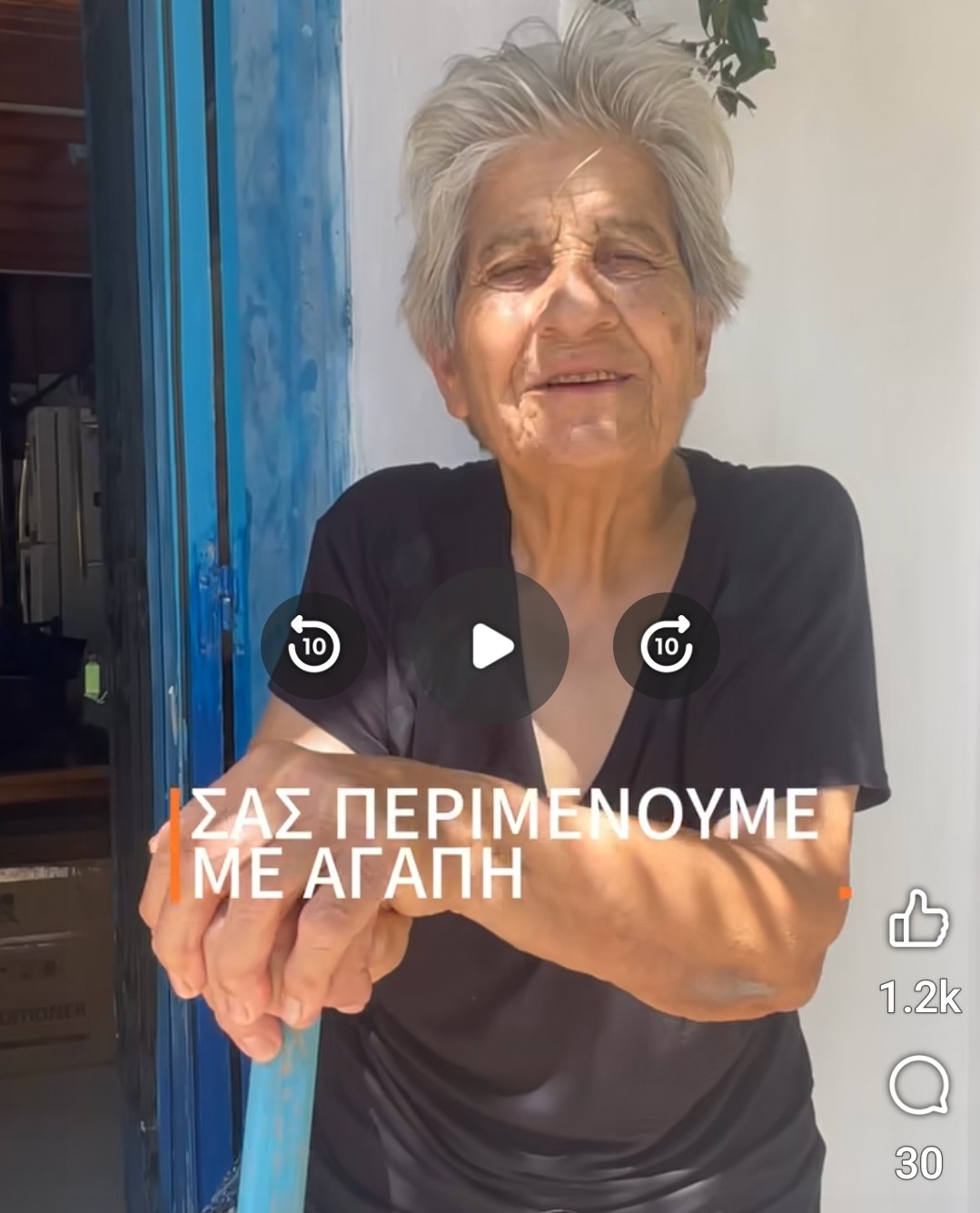
At that moment I decided to act. I offered to create a voluntary campaign to show the truth, to highlight the beauty of the village and the strength of its people. This is how the campaign ‘We are waiting for you with love’ was born. I personally produced the videos with my team and covered the costs.
We did not want to show destruction or tragedy. We wanted to show warmth, positivity and the hospitality that I myself experienced. And yes, the message worked. The videos were viewed by hundreds of thousands of users, encouraged people to visit Lofou, and gave the local economy a breath of life after the disaster.”