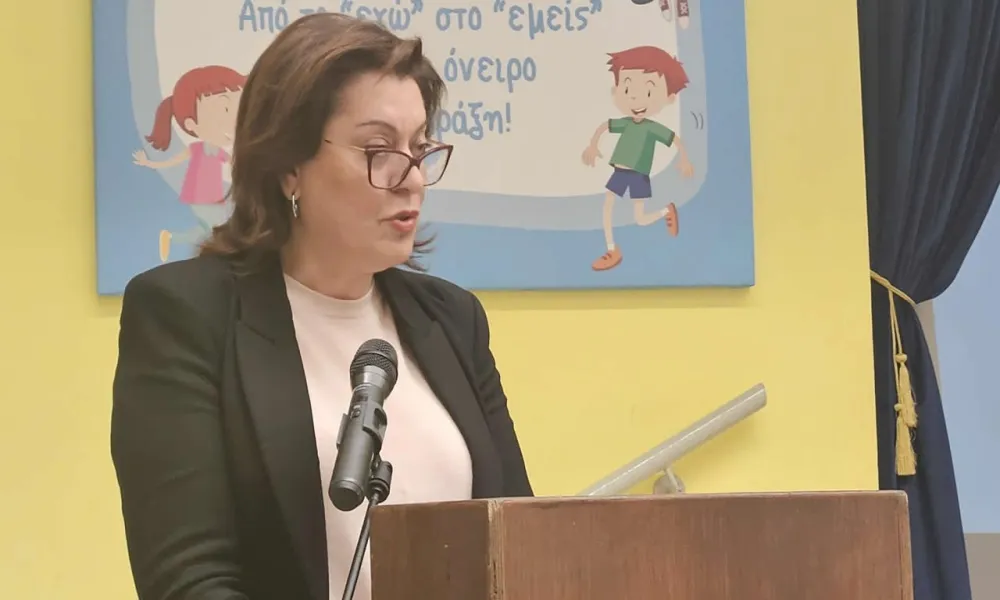

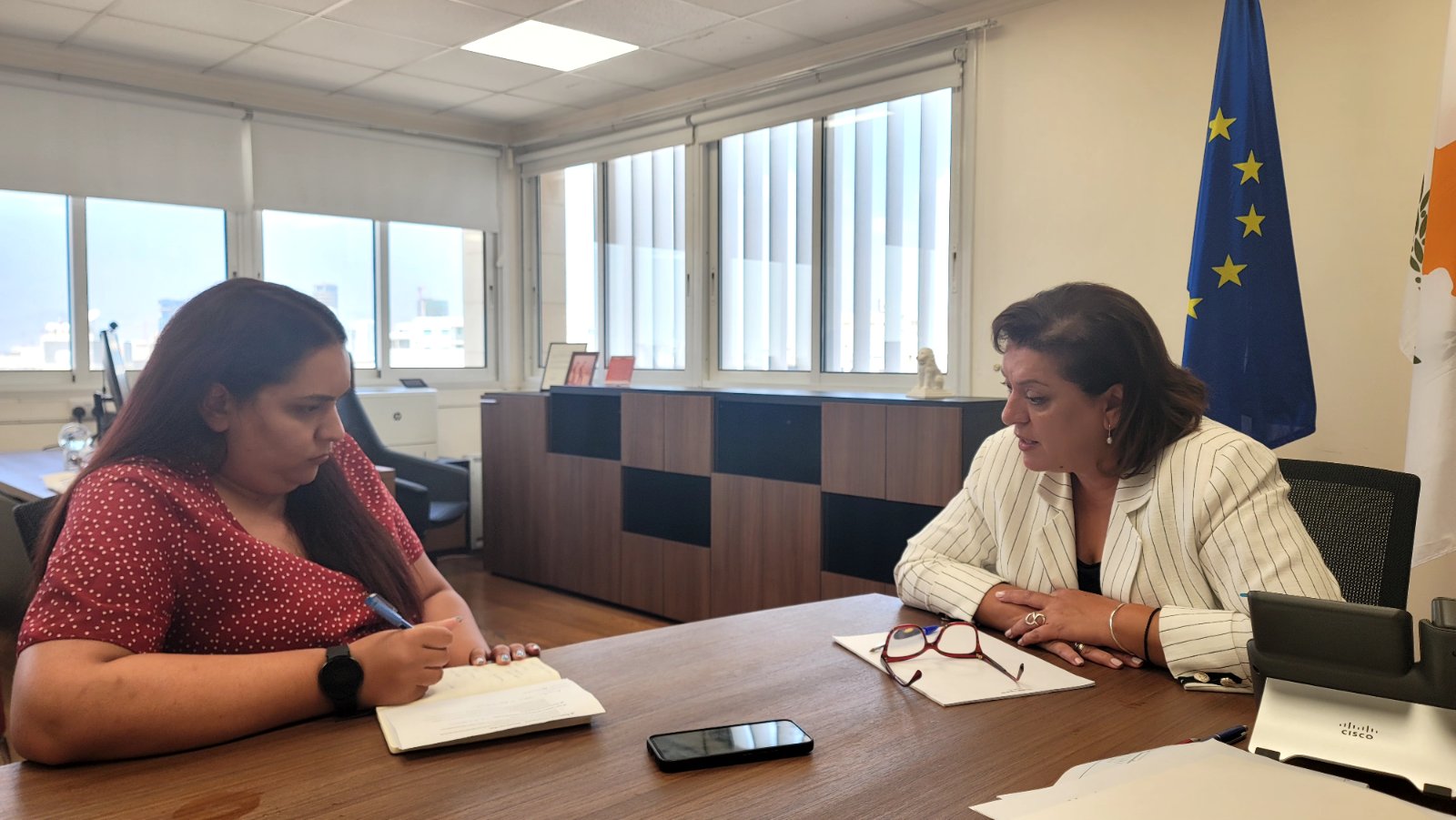
The Education Minister, Athena Michailidou, has set out no fewer than thirteen priorities for the new school year. In an interview with Politis, she explains why this year is a milestone for Cyprus’ education system. From changing the teacher evaluation model and abolishing the appointments list, to upgrading special education, trimming curricula and piloting a Technical Lower Secondary, the agenda is full. The minister is optimistic that the year ahead can be one of genuine reform, a year in which everything is brought into order.
Minister, we are days away from the first bell. Are schools ready to welcome pupils?
Yes. Preparations began early. On staffing, we started in March, mapped needs and sent them to the Education Service Commission, which has covered a large part of them. There are always small issues, such as teachers declining an appointment, but they are manageable. This year, at schools facing gaps, we worked with the ESC to fill them. Any issues that arise we discuss and resolve.
Teacher evaluation
Beyond staffing, what are your priorities for the new school year?
This is a very important year. It is the year we assess innovative programmes. We reinforce good practices in schools and improve practices that were ineffective and have been in place for decades.
Which practices do you mean?
Teacher evaluation. This is the year final decisions must be taken. We need a new evaluation system. We are nearing the end of consultations with the teaching unions. It appears the unions have not changed their positions. The ministry is willing to make changes, but the organisations’ demands remain the same. We will therefore go to parliament with certain adjustments, without altering the philosophy of our proposal.
So, the ministry has moved, but the unions have not, and you will again submit a proposal that is not fully agreed?
Reaching full agreement with every stakeholder is impossible. Our goal is to submit something that is academically sound and representative. We listened to the unions, we made changes, but the core remains. In the coming days we will send the final proposal for legal vetting, so that before the end of September it is tabled in parliament and voted through by November.
Can it be passed by November?
It must be passed by November, otherwise we face issues with the Recovery and Resilience Facility and a large penalty. Despite differences, we must all rise above them for the good of the children. We have built in safeguards and a five-year transition, with union participation in the Monitoring Committee, so that any mistakes can be corrected along the way.
One concern for teachers is the head teacher’s role in evaluation. POED and OELMEK suggest removing it. Your response?
The head teacher has a dual role, supporting the teacher day to day and contributing to the final evaluation. Formative evaluation helps the daily work, while in the summative evaluation we propose the head teacher has a 20 per cent weight, given their daily contact with the teacher. The ministry will make small adjustments.
You will also need to discuss phasing out the appointments list.
It is a chapter that must close this year. We have received opinions from the Legal Service and will continue consultations with them and with the unions, to ensure there are available candidates when the list is abolished.
Will the list definitely be abolished, given some voices want it retained?
That is what the law provides. Scenarios will be discussed with the Legal Service and unions to ensure a sufficient pool of teachers for appointment.
Technical Lower Secondary
Beyond employment issues, what else is new this year?
The Special Education bill will be tabled before December 2025 and will bring us closer to an inclusive school. We are taking small, careful steps that will allow children in special education to have better conditions within mainstream schools. I am not referring to special schools, which we are upgrading anyway. We want better conditions and opportunities in mainstream settings, better diagnostic tools and improved district committees.
In parallel, we continue to reduce teaching load. Over the past two years we have reduced syllabuses by around 20 per cent in primary and general secondary across almost all subjects, and now we are moving in a targeted way in certain areas such as History. We are also improving curricula, advancing changes to the all-day school, which for the first time has a defined curriculum, and introducing further innovations.
Such as the Technical Lower Secondary?
Yes, that is one of them. The aim is to familiarise pupils early, from the first year of lower secondary, with technical skills, creativity, new technologies and technical professions.
How will it operate?
The programme will run on a pilot basis in two schools, one in Nicosia and one in Limassol, with small cohorts. It is a pilot that needs space and time to be implemented and then scaled up. It will be a special-interest school operating in the afternoons. Another priority this year is to upgrade special-interest schools, namely Music, Sports, STEM and Interdisciplinary Learning.
That is a lot of priorities, Minister…
This is a very important year because we are preparing changes that should have happened years ago, such as the new evaluation scheme, and others driven by technology, the labour market and society. We are extending counselling and careers guidance from primary level, doubling the number of participating schools. We will emphasise literacy in Mathematics and Greek, introduce financial literacy in primary and expand it in lower secondary, and we will strengthen Citizenship Education.
You mentioned technology. Are you concerned about artificial intelligence in schools?
AI is already in schools and pupils are using such tools. The issue is control. We must train teachers first, then pupils, in correct and ethically sound use. This year we will deepen teacher training, in cooperation with the Deputy Ministry of Innovation and a team of experts.
Last year mobile phones were banned without penalties. What about this year?
We will apply stricter rules, use only for educational purposes. The aim is for children to understand boundaries and to develop creative habits such as play and conversation during breaks, while also enhancing safety in school.
How will you ensure that?
By safety we mean all actions that build self-esteem, psychological resilience, the ability to say no, online safety, safety at school and personal safety, including sex education. These outline the safe school. What concerns us, and why we are investing in this area, is that pupils facing any problem at school or at home know they can turn to their teacher, their form tutor, or the school counsellor, who is there to help.
Last year you aimed to open an alternative school for disruptive pupils in Nicosia. When will Limassol’s be ready?
The alternative school continues in Nicosia and our goal is to start in Limassol as well. We are preparing the site in Limassol, the list of pupils has been drawn up, and we aim to finalise pending matters so the alternative school in Limassol district begins operating in January 2026. Pupils who attended last year in Nicosia are returning to their schools, with good exam results, and will continue to be monitored by the Educational Psychology Service.
Air conditioning
In September 2023, the President pledged air conditioning in all public schools within three years. Will you meet the deadline by next September?
Although there were initial difficulties, the installation is now progressing smoothly. By the end of October, all schools in the Famagusta district will be fully equipped. There is strong progress in other districts too, such as Nicosia. We won the bet with the Pancyprian exams, as all upper secondary schools used as exam centres last year had air conditioning. Almost all kindergartens have air conditioning with the help of parents’ associations. We will complete installations in remaining upper secondary classrooms. We have requested the rollout plan for primary and lower secondary for the coming period so we can implement it. Funding has already been secured.
Finally, what message would you like to send to parents, pupils and teachers?
I wish everyone a good, calm and peaceful school year, so that we can all create. Let us make space for our children to create in partnership with their teachers. I am very optimistic about this year.