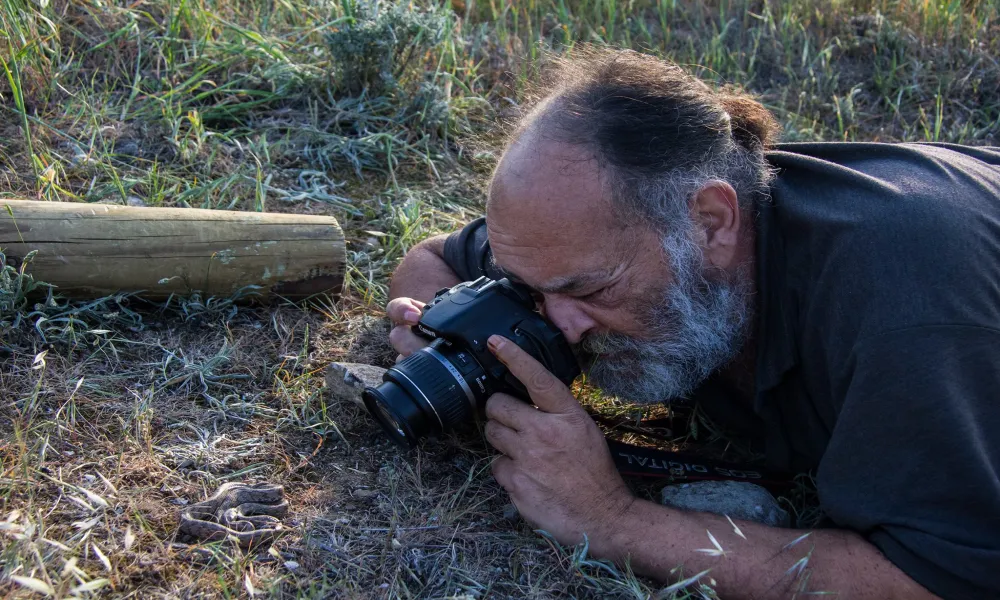
It is the autumn of 2009. Naturalist and researcher of Cypriot biodiversity Giorgos Constantinou is wandering one afternoon along a dirt track in the coastal area of the community of Xylophagou. Suddenly he stops: something protruding from the edge of the road catches his eye - at a point where an old cut had been made to form the road, some 5–6 metres above sea level. It was a fossilised elephant tooth. Excited at having found something hundreds of thousands of years old, he began carrying out investigations at the same spot - research that lasted for months. In the end it became clear that the area was full of elephant bones, as well as bones of dwarf hippopotamuses. Constantinou also discovered the remains of birds of prey, a genet, a freshwater turtle and a tortoise.
From the outset he was convinced that these finds did not belong to the well-known dwarf elephant Palaeoloxodon cypriotes, discovered in 1903 by the British palaeontologist Dorothea Bate. This species was dwarf-sized, around 600 kilos, much larger than the 200-kilo Palaeoloxodon cypriotes. The most indisputable indication was a large tusk he located in the same area. Confident about his discovery, he decided to approach academics to obtain scientific confirmation of his conclusions. At that time, the Cyprus Association for the Protection of Natural Heritage and Biodiversity, of which he was president, was receiving certain grants that enabled him to bring a palaeontologist from abroad to Cyprus. He first contacted a palaeontologist at the University of Patras, telling him he had made a discovery. He persistently urged him to come to Cyprus, being certain of the importance of the finds. In 2011, the palaeontologist arrived, funded by the Association, and examined every bone one by one. He sent measurements of the bones and the tusk to the Natural History Museum in London. The scientists there announced: “This is a new species for science!”
Subsequently, scientists from the Natural History Museum in London and Yale University came to Cyprus and confirmed that the finds represented a new species of elephant. Constantinou had also informed the Geological Survey Department of the Republic of Cyprus from the very beginning. The first official announcement of the discovery was made at an international palaeontology conference, the 9th Annual Meeting of the European Association of Vertebrate Palaeontologists (EAVP), held in Heraklion, Crete (14–19 June 2011). His name was included and published in the conference proceedings.
'Into the depths of Cypriot earth'
Fascinating stories such as that of the discovery of the new species, Palaeoloxodon xylophagouensis, which fills the evolutionary gap between the large elephants that reached Cyprus from mainland Europe and the small dwarf elephant Palaeoloxodon cypriotes, can now be enjoyed by readers of Constantinou’s new bilingual (Greek and English) book, The Prehistoric Mammals of Cyprus. Following his first book, The Birds of Cyprus, published in both Greek and English, the naturalist “guides” us into the depths of Cypriot earth, where prehistoric animals and their fossils form an unknown yet captivating aspect of the island’s natural heritage. As with his previous work, the photographic and informational material on the prehistoric fossils he brought to light is extensive.
“Long before the arrival of humans, the island was home to species unique in the world, such as the pygmy hippopotamus and the dwarf elephant, which disappeared forever, leaving behind only their bones and traces,” Constantinou told Politis. “From Aetokremmos, where hippopotamus remains were found, to Akanthou and other significant locations, every find reveals another piece of the puzzle of prehistoric life.” He emphasised that fossils are not merely stones - they are stories frozen in time, allowing us to understand the island’s lost fauna. “The book presents the most important animals that lived in prehistoric Cyprus, the places where their traces were discovered, and other valuable fossils that shed light on the past. At the same time, it stresses the timeless message that nature is fragile and that protecting biodiversity is a duty for all of us,” he added.
Reptiles and amphibians of Cyprus
A second book, released alongside the one on fossils, concerns once again the “depths” of the earth—this time the diversity of reptiles. The bilingual (Greek and English) Reptiles and Amphibians of Cyprus brings readers close to the world of snakes, lizards and turtles, from the island’s coastal regions to the peaks of Troodos and Pentadaktylos. It includes all reptiles and amphibians found in Cyprus, with detailed descriptions, biological, distributional and ecological information, rich photographic material and personal observations from many years of field research.
“In the pages of my book, I have captured a journey of exploration into the remarkable world of Cyprus’s reptiles and amphibians - aiming not only to highlight their uniqueness and ecological value, but also to cultivate respect and understanding for these often-misunderstood creatures. Each species carries its own natural history and plays an important role in the fragile ecosystems of our island,” the author notes.
Through the book, he invites every reader to get to know Cyprus’s reptiles and amphibians not with fear or prejudice, but with admiration and an open mind - just as he himself felt during the countless hours he devoted to observing them. Even when a coiled blunt-nosed viper (Macrovipera lebetina lebetina) he was filming on the trunk of a tree became irritated by his presence, raised itself and delivered a lightning-fast strike to the lens of his camera.
“With my personal observations, field photographs and scientific information, I attempt to present a world that is fascinating, mysterious and vital for nature’s balance. Spending countless hours in the Cypriot countryside - exploring gorges, forests, salt lakes and rivers - I was fortunate enough to encounter up close all the known reptile species of our island, from the tiny lizards basking on rocks to the legendary Cypriot viper, symbol of the strength and wild beauty of our nature,” he says.
The work is the result of many years of observation, research and love for nature. “It is the first book in Greek and English dedicated exclusively to the reptiles and amphibians of Cyprus, and aspires to serve as a useful guide for naturalists, researchers, educators and any citizen wishing to learn more about the island’s herpetofauna. It is, to date, the most comprehensive work ever published on the subject, as much has changed in our knowledge of Cyprus’ reptile species,” he stresses.
Anyone interested in acquiring Giorgos Constantinou’s two new books, The Prehistoric Mammals of Cyprus and Reptiles and Amphibians of Cyprus, as well as his earlier title The Birds of Cyprus, may contact the author on 96376823 or at fanigeorge@hotmail.com.