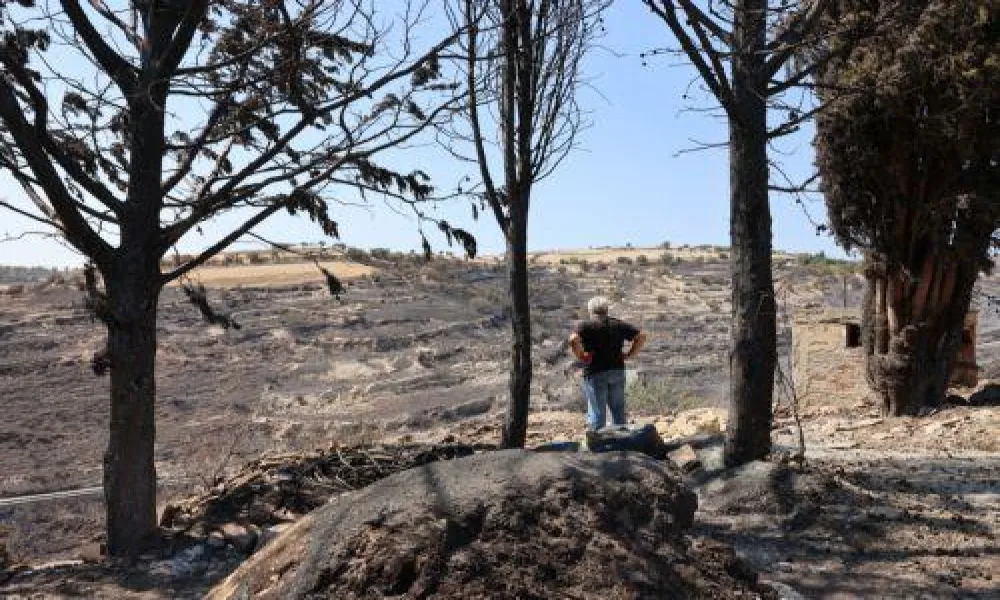
The fragile landscape of the Limassol mountains, devastated by last summer’s wildfire that scorched 116 square kilometres, is now the focus of urgent anti-flood and anti-erosion measures. “The difficult and painstaking work of flood protection is fully underway,” Agriculture Minister Maria Panayiotou told Politis. The Water Development Department has mapped all high-risk areas and is implementing the planned interventions. According to the minister, the project is in its first implementation phase, with 16 of the 21 critical points already completed. Works include the installation of gabions, a process planned and designed since summer to ensure timely delivery.
She added that even in the few cases where private properties may be affected by potential storms, residents have already been informed. “Prevention and preparedness are our priority,” she said, noting that the remaining works will be completed by the end of the month.
Reforestation plan
Although the state forest was not affected by the fire, damage within the communities was extensive: parks, small woodlands, roadside slopes and ecclesiastical grounds were fully or partially destroyed.
The Forestry Department has prepared a restoration and greening plan for the burnt areas, aiming to revive vegetation and create resilient, sustainable green spaces across 18 affected communities.
Immediately after the blaze was extinguished in August 2025, Forestry officers visited the fire-stricken villages - Agios Amvrosios, Agios Georgios, Agios Therapon, Alassa, Arsos, Vasa, Vouni, Kissousa, Koilani, Kyvides, Lofou, Mallia, Monagri, Omodos, Pachna, Potamiou, Sylikou and Souni–Zanatzia. Local authorities proposed plots for replanting, and from 1 September 2025 officers visited each site to record needs, irrigation requirements and suitable species.
10,000 trees
The Forestry Department’s plan begins with tree-planting undertaken by the department itself. A total of 73 planting sites have been selected across communities, parks and road networks. More than 10,000 saplings will be planted with full irrigation systems installed and maintained by the Department.
Each community will also receive 500 saplings, with 9,000 plants in total made available to residents and volunteers. The Souni–Zanatzia community will receive an additional 500 plants to replace burnt trees in parks and green areas.
The government has also allocated €10,000 to each community - €180,000 in total - for clearing burnt shrubs, removing debris and pruning in community, ecclesiastical and state-owned plots, as well as along roads and village entrances.
Three-year programme
The Forestry Department’s restoration plan spans three years with an estimated total cost of €687,000:
-
2025: Purchase of plants and start of planting – €108,000
-
2026: Planting, pruning and maintenance – €456,000
-
2027: Maintenance and replacement of plants – €123,000
The aim is to plant more than 20,000 trees, one of the most extensive greening programmes ever undertaken in the Limassol mountains. Planting is expected to begin in November and finish by February 2026, weather permitting. All works will be carried out via service contracts under the coordination of the Troodos Forest District.
Drought adds pressure
Forestry Department Director Savvas Iezekiel told Politis that a wide tree-planting programme is already underway in and around affected residential zones. “By the end of November, we expect to have all 20,000 plants,” he said, noting that dangerous trees are also being removed from public roads and private properties. But he stressed the dependency on rainfall: “Without rain we cannot plant - it wouldn’t be sustainable for new trees.”
From the Vouni community council, mukhtar Matthaios Protopapas described harsh and suffocating conditions. “The big problem is that we haven’t had any rain. Even the trees we have planted are at risk of drying out,” he said, calling it a daily struggle for survival.
Despite the difficulties, the community continues its own replanting effort: “We planted 150 trees this weekend and will plant another 150 next week. We are racing against time,” he said. The damage to Vouni, he noted, is immeasurable: “The whole village burned. Even the cemetery. Nothing was left untouched.” Government funds have been provided for clean-ups and initial interventions, but, he added, “this will take time.” Financial support has also been given for agriculture, but here too the weather is a barrier: “Without water, we cannot move forward,” he concluded.