You’re at the traffic lights, red, at Eleftherias Square in Nicosia, in the right-turn lane toward Evagorou Street. You’ve driven the same route for thirty years; before that, your mother drove it with you in the passenger seat.
The light turns green. As you begin to move, a young delivery rider suddenly shoots in from the left, wedging himself between cars to turn right as well. He cuts in front of you—and you hit him.
The young man is no more than twenty years old. He falls and screams, “My legs, my legs,” in English. This is what you fear every day from the moment you get into your car: hitting one of these children.
You go into shock, get out of the car, and run toward him. Your day goes to hell—and more importantly, his day.
You have to manage the shock, coordinate, communicate with insurance, check whether he is insured, and whether he is driving something legally considered a motor vehicle. Most importantly, you have to handle the fact that you almost killed a person, whether you are at fault or not.
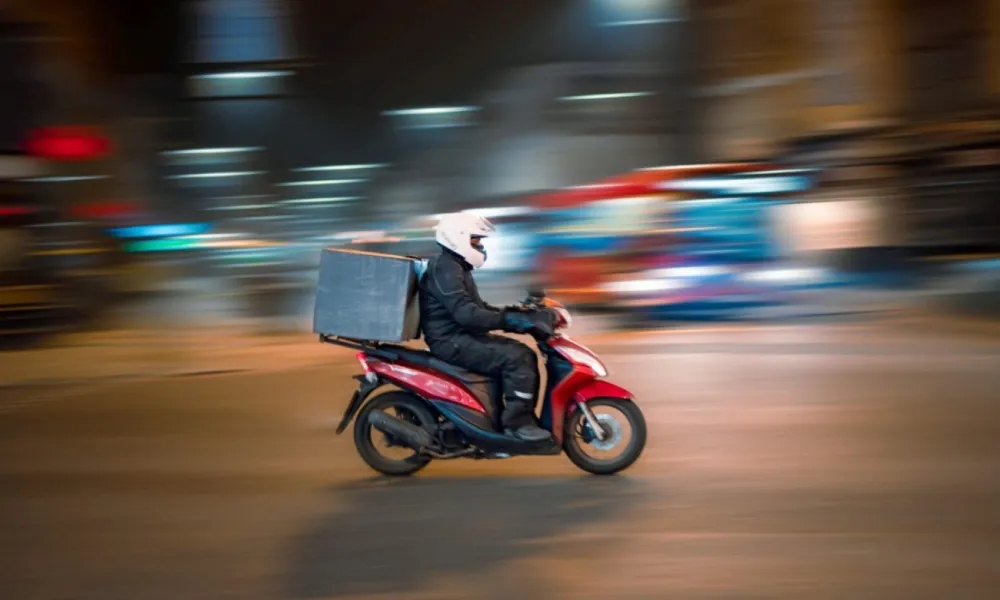
The delivery boys - riding all kinds of two-wheelers, most of them coming from abroad - staff a system of loopholes, flooding roads mainly at night as young drivers with questionable road culture. It is a system that puts their lives in danger and leaves car drivers exposed.
Who is to blame?
Regardless of the various theories about who the elephant in the room is, the situation on the road is now known to everyone and widely recognised as problematic.
The issue is serious, affecting daily life on streets and pavements. Politis opens the chapters to understand why a system cannot be properly regulated - a system that concerns human lives first and foremost, while also offering an excellent service to the economy and the market.
The home-delivery boom
Home delivery and courier services have multiplied in recent years in Cyprus, mainly due to the familiarity brought by e-commerce and digital services during the lockdown.
However, in 2025, it remains true that many of the two-wheelers used for professional delivery - even though used for business purposes - do not fall under the legal definition of a vehicle.
Addressing the need for regulation, Andreas Athanasiadis, General Director of the Cyprus Association of Insurance Companies (SAEK), explained to Politis that the situation on the roads involves the Police, the Department of Road Transport, and civil society.
“Our only contribution to this discussion can be expertise regarding the general picture as it emerges from road accidents,” he said.

He explained that there is a specific legal definition for what constitutes a motor vehicle, outlining the history of how this new situation developed on Cypriot roads.
Initially, when the need arose to regulate electric scooters and possibly insure them, the authorities decided the best way forward was to address the issue under the Bicycle Law and add specifications.
“This happened when Yiannis Karousos was head of the Ministry of Transport, and it was one of the last issues discussed in 2020 before the lockdown,” he said.
Shortly after, a European directive regulated mobility and provided a definition of a motor vehicle. According to EU legislation, a motor vehicle is a vehicle with an engine, and to fall under traffic law, it must be able to move at more than approximately 25 km/h and weigh more than 15 kg.
Another development in recent years is the transition from a learner’s license to a motorcycle license, which now costs over €200 and requires examinations.
As a result, roads have been flooded with electric bicycles used for professional purposes and home deliveries. These do not qualify as motor vehicles. They may exceed 25 km/h and weigh around 15 kg, but they do not have an engine.
Therefore, a motorcycle license and insurance are not required, since only motorized vehicles need insurance.
Chaos
Within this regulatory loophole lies a paradox. While legislation was meant to protect young and inexperienced drivers - given their rapid increase, traffic congestion, and rising accident rates - the profitable delivery market continues its dangerous routes using electric bicycles.
In other words: two steps forward, three steps back.
Athanasiadis said there are twenty companies that insure motor vehicles, but several are not interested in expanding market share, as motorized vehicles are a difficult and less profitable sector.
He cited the history of quad bikes, explaining that some companies completely stopped insuring them due to high payouts and negative returns.
At the same time, he noted that - as with scooters and other new two-wheelers on the road - even if they currently do not require insurance, the risks (such as accident frequency and complications) are not yet fully clear.
Many people do not know that electric scooters must travel on bike lanes or certain pedestrian paths - not sidewalks or roads with speed limits under 30 km/h. Moreover, municipalities must define where a scooter (or Personal Mobility Device, as referred to in the law) can operate, such as whether it can travel through public squares.
All of this is complicated and clearly not being followed.
What is certain, Athanasiadis emphasized, is that “insurance does not apply in cases of illegal use. So even if a scooter were insured, there would be no compensation.”
Regarding professional use - which leaves drivers exposed - Athanasiadis said policyholders must declare the true facts about usage, as insurance is based on the principle of good faith.
He highlighted a crucial aspect of the issue:
“We think that if we insure all these people with electric bicycles and scooters, we will solve the problem. We will not. The problem is that young people aged 20–25 are dying. Often, if they are at fault, they may get injured but will flee. And bicycles or electric scooters do not carry identifiers.”
He stressed how exposed car drivers remain. Whether at fault or not, being involved in an accident where someone’s life is at risk is extremely traumatic. Additionally, repair costs - especially for parts - have risen dramatically.
“Now a single headlight can cost €1,800. A bumper that is just scratched must be replaced. Damages have increased. An uninsured child working in delivery certainly cannot afford this and will often flee,” Athanasiadis said, concluding:
“The roads are chaos.”
Road culture
A motorcycle license instructor, wishing to remain anonymous, also expressed concern to Politis about the safety of young delivery riders.
He explained that two-wheelers require skill and responsibility for safe driving, but the nature of the job - combined with youth and different cultural backgrounds - creates additional risks.
When someone drives in a country they are unfamiliar with, risks increase due to lack of knowledge of the road network, signs, and local traffic rules. Differences in road layout, speed limits, intersection types, or signage can cause confusion, especially when language or symbols differ.
“Additionally, driving in an unfamiliar environment can increase stress and reduce concentration. These factors are natural and not related to the driver’s origin, but to the fact that they are driving in an unfamiliar environment,” the instructor said.