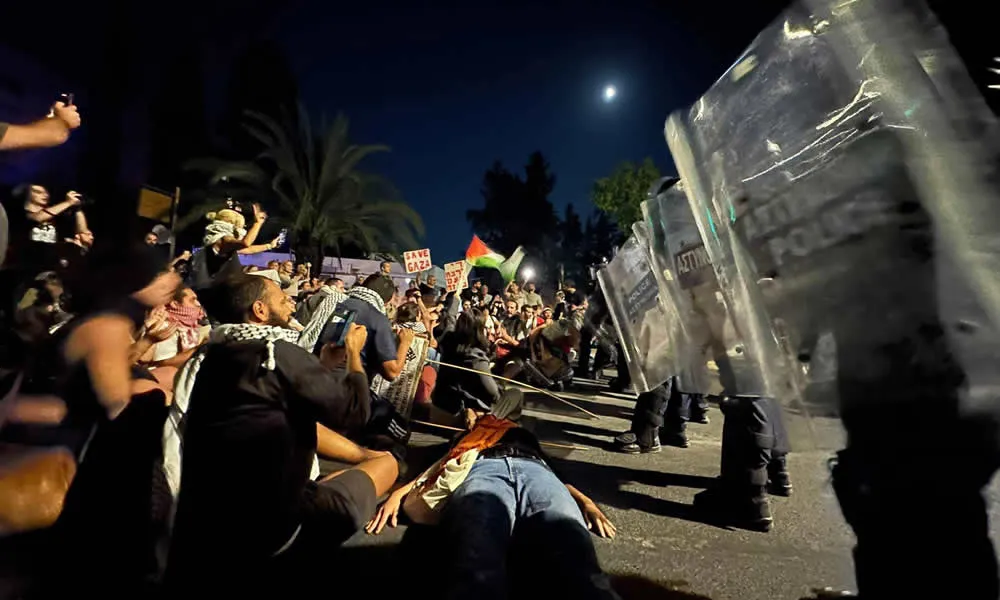

This week’s scenes outside the Ministry of Foreign Affairs in Nicosia were not of a clash of legitimate authority and thugs. They were an act of state violence, blatant and unprovoked, and we must call it for what it is: police brutality against citizens exercising their democratic right to protest.
People gathered, peacefully, to condemn the detention of the solidarity flotilla to Gaza and to voice their outrage against injustice. There was no siege, no riot, no burning barricades. Just citizens demanding dignity, demanding accountability, demanding basic decency. Yet the response was shockingly disproportionate: pushbacks, forceful shoves, pepper spray used at point-blank range.
Let us be crystal clear: this was not the overzealous act of an overworked patrol. This was a calculated, aggressive show of force when none was required. When peaceful protest is met not with dialogue but with violence, the state ceases to be the protector, it becomes the oppressor.
The police, in their response, offered a familiar and hollow refrain: “We used proportional force.” They claimed officers were pushed, that warnings were given, that they had to restore order. But the videos tell a different story: people being slammed, faces pepper-sprayed from an arm’s length assertion of control rather than de-escalation. The justification rings hollow to anyone who has watched the footage.
The danger here is not only to that protest, or to that handful of injured citizens. The danger is to our democracy itself. When citizens cannot voice dissent without fear of being attacked, when the State’s monopoly on force becomes a weapon of intimidation, then we have crossed into authoritarian terrain.
Inequality that shapes who gets opportunities and who is left behind, foreign policy that decides which alliances we make and whose suffering we acknowledge, geopolitical outrage that fills headlines but too often bypasses the lived reality of ordinary people; all of these matter. But none of it matters if we cannot speak. The real question is: how are we, as citizens, allowed to be involved in the conversation? How can people express their views, their solidarity, their anger or their hope, if public opinion is to be met with force? Perhaps those in power need to tell us, because supporting activists who risked their lives to sail to Gaza with food and medicine is not subversion. It is, at the very least, an act of humanity.
Batons silence moments, not movements.