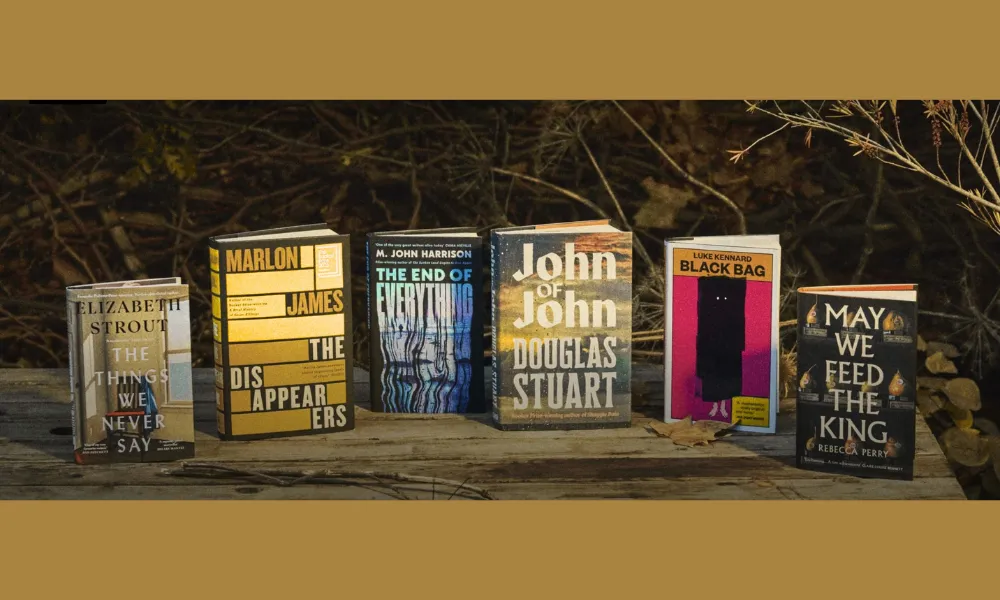

Six novels remain in contention for the 2026 Booker Prize, narrowed down from 163 submissions, with a Pulitzer Prize winner, an 81-year-old science fiction writer and a first-time novelist among the contenders.
Two of the shortlisted authors have already won the prize, and a second victory for either would make them only the fifth writer in its history to win twice.
The six shortlisted novels
"The End of Everything" by M. John Harrison
"The Disappearers" by Marlon James
"Black Bag" by Luke Kennard
"May We Feed the King" by Rebecca Perry
"The Things We Never Say" by Elizabeth Strout
"John of John" by Douglas Stuart
Elizabeth Strout returns to the shortlist
Elizabeth Strout, who won the Pulitzer Prize in 2009 for "Olive Kitteridge", is shortlisted for the Booker for the second time. Her new novel leaves behind the familiar characters of her earlier books and follows a history teacher at a high school in Massachusetts. Behind his seemingly quiet life lie loneliness, a family secret and a changing America, set against the backdrop of the 2024 presidential election.
Queer themes run through the selection
The strongest queer thread in this year's shortlist runs through the novels by James and Stuart.
At 640 pages, "The Disappearers" is the longest novel on the list. It returns to Jamaica in the late 1980s, during the AIDS crisis. Eight gay men in Kingston are rehearsing John Herbert's "Fortune and Men's Eyes" when they are subjected to a violent homophobic attack in which one of them is killed. The novel follows the survivors over several years, tracing the trauma, anger and desire for revenge left in the attack's wake.
James has explained that the novel was inspired by an account of a violent attack that circulated as a rumour in Jamaica but was never confirmed. The book therefore does not present a documented historical event, but uses the rumour as the starting point for a work of fiction about queer life, violence and survival.
In "John of John", Stuart moves away from the Glasgow of his previous books to the Isle of Harris in the Outer Hebrides. Twenty-two-year-old John-Calum MacLeod, known as Cal, returns penniless to his family home and finds himself once again facing his father, John, a crofter, weaver and prominent member of the strict local Presbyterian community. Father and son are both gay, but neither can speak to the other about it. Cal hides his sexuality from his father, while John has for years kept a secret relationship of his own. The novel explores faith, family, shame and lives lived in silence.
Three of the four shortlisted novels written by men, "The Disappearers", "John of John" and "Black Bag", deal in very different ways with masculinity and male sexuality. Judge Patricia Lockwood summed it up jokingly: "All these books are gay."
The oldest and the newest voices
At 81, M. John Harrison is the oldest author on this year's shortlist. The British science fiction writer and literary critic is in contention for the Booker for the first time with "The End of Everything". Set in a post-apocalyptic Britain, the novel follows a man who lives by collecting whatever the sea washes up on the Kent coast and who discovers a strange, constantly shifting creature. The book moves between dystopia, mystery, satire and road novel.
If Harrison wins, he will become the oldest winner in the history of the Booker, surpassing Margaret Atwood, who was 79 when she shared the prize in 2019.
Rebecca Perry is the only debut novelist on the shortlist. Already known as a poet, she has won the Waterstones Debut Fiction Prize with "May We Feed the King". The story moves between the present day and a medieval court, following a curator of historic sites who recreates rooms and meals from the past and becomes increasingly obsessed with a near-forgotten king.
A campus satire inspired by a real experiment
Poet and novelist Luke Kennard completes the shortlist with "Black Bag", an absurd campus satire inspired by a real social psychology experiment conducted at Oregon State University in the 1960s. In the novel, a struggling actor is paid by a psychology professor to attend university lectures inside a large black leather bag, so that the students' reactions can be recorded.
The judging panel and prize
The five-member judging panel is chaired by Mary Beard. She is joined by poet and author Raymond Antrobus, Jarvis Cocker of Pulp, author Patricia Lockwood and journalist and critic Rebecca Liu. The shortlist covers an unusually wide range, from dystopia and contemporary social fiction to historical writing and campus satire, with family, identity, shame, loneliness and survival as common threads.
The winner of the 2026 Booker Prize will be announced on 9 November at a ceremony in London and will receive £50,000. Each of the other shortlisted authors will receive £2,500.
With information from the Booker Prize, The Guardian and The New York Times