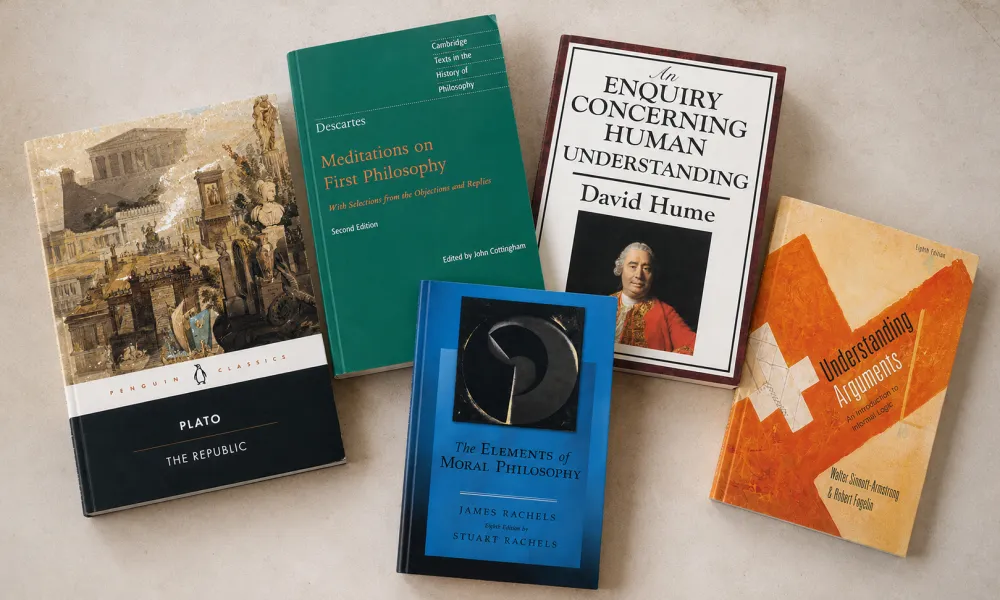

Philosophy often appears inaccessible because many of its best-known works are dense, lengthy or written for readers already familiar with the subject. Yet a carefully chosen starting point can make its central questions about knowledge, morality, reality and human existence far easier to approach. The five books below combine accessibility with lasting intellectual value, offering beginners a practical route into philosophy.
The Republic by Plato
Although The Republic is often associated with political philosophy, it begins with a more personal question: what is justice, and why should anyone choose to live justly? Through a series of conversations led by Socrates, Plato examines whether justice has value in itself or whether people pursue it only for the rewards and reputation it can bring.
The discussion gradually expands from the individual to the structure of an ideal city. Plato considers political authority, education, knowledge, human motivation and the relationship between reason and desire. By comparing the organisation of the city with the different parts of the human soul, he argues that justice depends on each part performing its proper role.
For beginners, the book is valuable not only for its ideas but also for the way those ideas are examined. Definitions are proposed, challenged and revised, while familiar assumptions are tested through arguments, analogies and imagined situations.
The best-known example is the Allegory of the Cave, which describes people who mistake shadows for reality because they have never experienced anything else. Plato uses the allegory to explore the difference between appearance and understanding, as well as the role of education in helping people move from ignorance towards knowledge.
At ten books, The Republic can appear intimidating, but it does not need to be read in one attempt. Books I and II introduce the central debate about justice, Book IV connects justice in society with justice in the individual, and Book VII contains the Allegory of the Cave and Plato’s account of philosophical education. Together, these sections provide a manageable entry point into the text.
Meditations on First Philosophy by René Descartes
René Descartes begins Meditations on First Philosophy by questioning almost everything he believes he knows. His aim is not to remain trapped in doubt, but to discover whether any belief can survive the most rigorous possible scrutiny and provide a secure foundation for knowledge.
The opening meditation introduces several of philosophy’s most influential sceptical arguments. Descartes asks whether the senses can be trusted, whether waking experience can always be distinguished from dreaming and whether even apparently certain beliefs might be mistaken. By stripping away assumptions that could conceivably be false, he searches for something that cannot be doubted.
His first point of certainty is the act of thinking itself. Even if every belief is false, the fact that doubt is taking place confirms the existence of a thinking subject. From this starting point, Descartes explores the nature of the mind, the existence of the external world and the relationship between mental and physical reality.
The book is divided into six relatively short meditations, but the arguments become increasingly demanding. Beginners should pay particular attention to the First Meditation, which establishes the method of doubt, and the Second Meditation, which develops Descartes’ account of the thinking self. These sections provide a clear introduction to scepticism, certainty and the philosophical study of knowledge.
An Enquiry Concerning Human Understanding by David Hume
David Hume’s An Enquiry Concerning Human Understanding examines how people form beliefs about the world and how far those beliefs can be justified. Rather than beginning with abstract speculation, Hume looks closely at the way the mind works, asking what knowledge can genuinely be traced back to experience.
One of the book’s central distinctions is between relations of ideas and matters of fact. Relations of ideas include truths that can be established through reasoning alone, such as mathematics. Matters of fact concern the world around us and depend on observation and experience. Hume argues that our beliefs about cause and effect belong to this second category.
This leads to his famous problem of induction. People assume that the future will resemble the past, that the sun will rise tomorrow and that familiar causes will continue to produce familiar effects. Yet Hume argues that this expectation cannot be proved by reason alone. It is based on habit: after repeatedly observing one event follow another, the mind comes to expect the same pattern to continue.
The book is especially valuable for beginners because it shows how philosophy can challenge assumptions that appear completely ordinary. Hume does not simply ask whether particular beliefs are true. He asks what gives us the right to hold them in the first place.
Readers may find the sections on causation, induction and miracles the most rewarding. Together, they offer a clear introduction to empiricism, scepticism and the limits of human knowledge.
The Elements of Moral Philosophy by James Rachels
James Rachels’ The Elements of Moral Philosophy offers an accessible introduction to ethics by asking what makes an action right or wrong and whether moral judgements can be supported by reason. Rather than defending a single theory, the book presents several competing approaches and examines the strengths and weaknesses of each.
Among the questions it explores are whether morality depends on culture, whether people should always act in their own interests and whether the consequences of an action are more important than the intentions behind it. It also introduces major ethical frameworks, including utilitarianism, duty-based ethics, social contract theory and virtue ethics.
The book’s main strength is its use of clear examples and practical moral problems. Abstract ideas are connected to situations involving punishment, personal responsibility, equality, promises and the treatment of others. Each theory is presented as an argument that can be examined, challenged and compared with alternatives.
For beginners, this makes the book a useful map of moral philosophy. It shows that ethical disagreement is not simply a clash of personal opinions, but often reflects deeper differences over what morality is for, what people owe one another and which principles should guide human behaviour.
Readers do not need to accept any one theory by the end. The value of the book lies in learning how to compare moral arguments, identify their assumptions and decide which objections they can withstand.
Understanding Arguments by Walter Sinnott-Armstrong and Robert Fogelin
Philosophy is not only about encountering influential ideas. It also requires the ability to recognise, reconstruct and evaluate the arguments used to support them. Understanding Arguments introduces these skills in a practical and accessible way, making it an ideal companion to the primary texts on this list.
The book explains how arguments are structured, how conclusions are supported by premises and how to distinguish reasoning from explanation, rhetoric or unsupported assertion. It also examines common forms of deductive and inductive reasoning, showing why some arguments succeed while others fail.
Particular attention is given to hidden assumptions, ambiguous language and common fallacies. Readers learn how apparently persuasive claims can depend on weak evidence, irrelevant premises or misleading comparisons. These tools are useful not only when reading philosophy, but also when assessing political speeches, news reports, advertising and everyday disagreements.
For beginners, the book provides a method for approaching difficult texts. Instead of trying to understand every sentence at once, readers can identify the central claim, trace the reasoning behind it and ask whether the conclusion follows from the evidence provided.
Some chapters are more technical than others, so the book does not need to be read from cover to cover before moving on. The early sections on argument structure, deductive reasoning and fallacies offer the most useful starting point and provide a foundation for reading the other books on this list more critically.
How to approach the reading list
These five books offer different ways into philosophy. Plato introduces the practice of questioning accepted ideas, Descartes examines whether certainty is possible, Hume tests the limits of experience and reason, Rachels maps the main approaches to ethics, and Sinnott-Armstrong and Fogelin provide the tools needed to evaluate arguments.
They do not need to be read in strict order or completed quickly. A useful approach is to begin with the book that raises the most interesting questions, take notes on the main claims and objections, and return to difficult passages rather than trying to understand everything at once. Philosophy becomes more accessible when it is treated not as a body of information to memorise, but as a continuing process of asking better questions and examining the reasons behind possible answers.