
Cypriot director Alexandra Matthaiou is heading to Cannes with her short film Free Eliza (Notes on an Anatomical Imperfection), which will have its world premiere at the Directors’ Fortnight – a section long associated with bold, independent cinematic voices.
The film is a co‑production between Cyprus, Greece and France and is among the nine short films selected for this year’s programme.
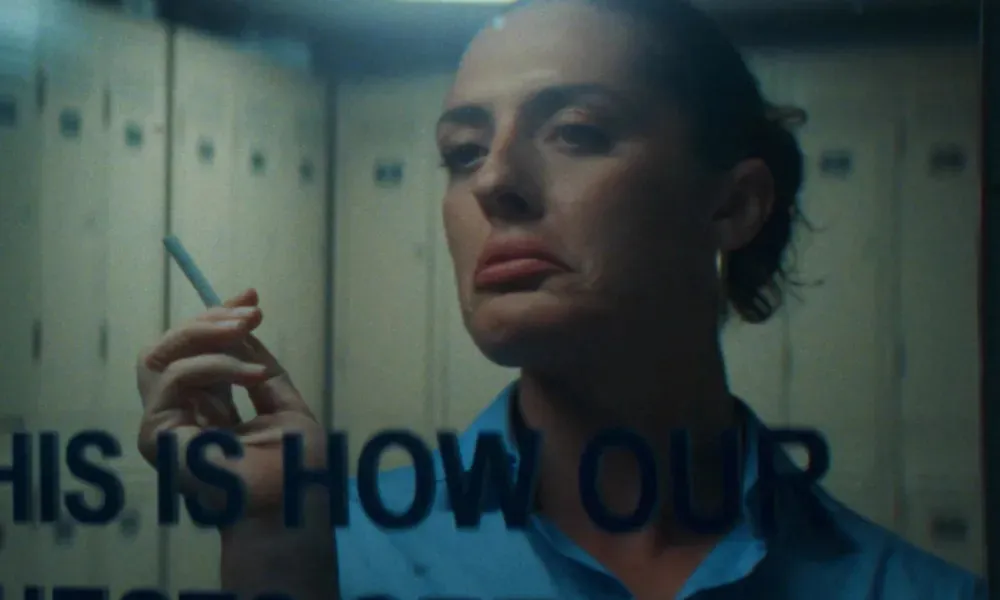
Eliza, the film’s protagonist, works at a luxury hotel. Due to an anatomical condition, she is unable to smile. In a world dominated by enforced positivity, this becomes a serious problem. Eliza must either defend her difference or adapt to the expectations imposed on her.
Filming for Matthaiou’s third short film lasted four days and took place at the very hotel that inspired the story. We met the director a few days before her departure for Cannes.
‘It was a rather funny starting point for this film. I was staying at the same hotel as a jury member for the Cyprus Short Film Festival. One morning at breakfast, I noticed a young woman working there who had the saddest expression I had ever seen. I remember writing it down because it struck me so strongly. Why? Because it was in absolute contrast to the palm trees, the pools, the happy tourists. I am very preoccupied with the issue of toxic positivity, because I see it everywhere – especially in environments like hotels, where as an employee you are almost not allowed to be anything other than happy.’
She explained that in such spaces, nothing is permitted to be wrong, because the role of staff is to take care of guests, leaving their own daily struggles outside the frame. ‘That is how I began developing the idea,’ she said.
Constructing Eliza
How did Matthaiou build the world of this character and how does she herself see Eliza?
‘For me, Eliza is a heroine who also deceives the audience’s own prejudices. When you see her condition, it is easy to assume she is unhappy or depressed. Gradually, the film dismantles that assumption. We discover that her inner world, her way of seeing things, and her ability to dream – even if she does not achieve everything – are so rich that they make her unapologetically strong.’
She added that while the film initially appears to be about the presence or absence of a smile, on a deeper level it is about people who deviate from what is considered socially acceptable.
This, she noted, is inseparable from the collaboration with actress Grigoria Metheniti, who plays Eliza. ‘She gave the character her form. It is not just the script, and it is not just me,’ Matthaiou said.
A familiar figure
Is Eliza a character we encounter around us? The Cypriot director believes so.
‘We have seen many similar stories: people working in environments that oppress them. Eliza is not entirely different, but there is a grey area. She actually enjoys aspects of her job. What troubles her deeply is the social pressure to be something other than what she is. The irony is that she may be happier than those around her, who wear smiles and assume they are more “normal”.’
Eliza’s anatomical condition functions as an ironic comment on performative happiness and toxic positivity, and on society’s response to difference.
‘It is funny that I made this film, because I am someone who smiles a lot by nature. Growing up, I realised that smiling can be a weapon – it makes you seem less threatening, and perhaps allows you to achieve things more easily. But I believe we should approach with tenderness people who cannot bridge social interaction with a smile. I do not consider that a disability at all.’
Asked about Eliza’s dream job, Matthaiou laughed.
‘She would clearly be Lady Gaga – a superstar performer. She longs to be in the spotlight.’
Looking ahead
Following the success of her previous short A Summer Place – which won the Drama Queer Award and an honorary mention for female performance at the Drama Short Film Festival, as well as multiple international awards – Matthaiou once again turns her gaze to a female protagonist unlike any other.
She says she is deeply interested in the female experience and in illuminating unexplored areas of female psychology.
‘I apologise to the men I love, but I find female characters infinitely more interesting. I resist what has been recorded as female stereotypes – woman as archetype, as object of desire, as femme fatale. I want to focus on more authentic women, infused with something surreal and paradoxical, because that is how I see the world.’
At the same time, the director is preparing her first feature‑length film. Does Cannes open the way for better distribution and future prospects?
‘I am incredibly happy that the film premieres in Cannes. It is a festival that lives in our hearts. You dream of it, but you do not believe it will happen. The timing is good, as I am developing my feature film. Things remain difficult, but it helps people notice you. I could not imagine a more fitting section than Directors’ Fortnight for Eliza.’
Free Eliza (Notes on an Anatomical Imperfection) is produced by This Is The Girl Films, in co‑production with the Deputy Ministry of Culture of the Republic of Cyprus, Onassis Culture, Homemade Films, Everybodies and La Cellule Productions.
The film will be screened on 21 and 22 May as part of the 58th Directors’ Fortnight (Quinzaine des Cinéastes). The 79th Cannes Film Festival runs from 12 to 23 May.
Source: euronews.gr