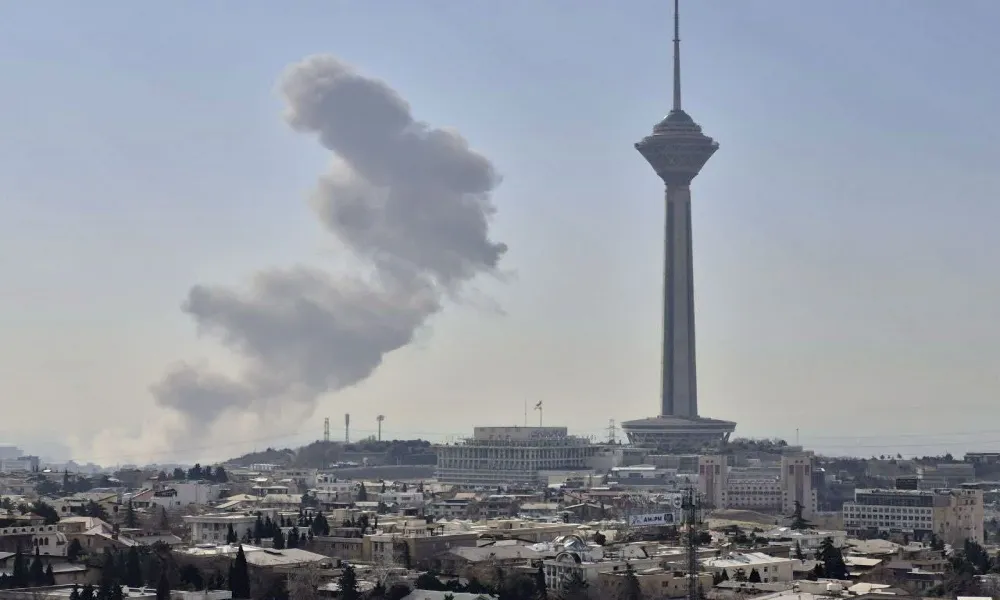
One month after the United States and Israel launched strikes against Iran, the war in the Middle East is entering a second month without any indication of a ceasefire. Analysts say the conflict is increasingly shaping global energy markets and political calculations in Washington.
According to Reuters, United States President Donald Trump now faces a narrow set of options: pursue a potentially fragile agreement or escalate militarily and risk a prolonged conflict that could define his presidency.
War enters its second month
The conflict began on 28 February with large scale air strikes by the United States and Israel on targets in Iran. Since then, hostilities have expanded across the region, with Israel and Iran continuing to exchange air and missile attacks.
A journalist from Agence France-Presse reported hearing around ten powerful explosions in Tehran and seeing smoke rising from the eastern part of the Iranian capital. Shortly afterwards, the Israeli military confirmed it was striking targets in the city.
In Israel, a 52-year-old man was killed and two others injured in an Iranian strike on Tel Aviv, according to emergency services, after the military issued alerts about incoming missiles.
Concerns over cluster munitions
Miki David, head of the Israeli military’s Home Front Command, said in a video posted on social media that a missile containing cluster munitions caused significant damage to a residential building.
He explained that the munition penetrated the roof of the building, passed through one floor and exploded on another.
Cluster weapons disperse dozens of smaller submunitions over a wide area. Many of these fail to detonate immediately, creating long term risks for civilians. Although a 2008 international convention sought to ban such weapons, Iran, Israel and the United States are not signatories.
Global economic impact
The war has already disrupted oil and gas exports from the region, raising concerns about global energy supplies and pushing prices higher. Governments in dozens of countries have introduced measures in recent days aimed at mitigating the economic impact of rising energy costs.
Reuters notes that the surge in global energy prices has also added political pressure on the Trump administration, while opinion polls indicate declining approval ratings for the president’s handling of the conflict.
Analysts say the key question now is whether Washington will attempt to reduce tensions or intensify military operations.
Civilian toll in Tehran
For civilians in Iran, the conflict continues to have a direct impact. Residents of Tehran report living with nightly air strikes and growing uncertainty.
Ensieh, a 46-year-old dentist in the capital, said she feels hope fading day by day. “We are trapped between three powers that have gone mad,” she said. “The war has taken a part of me.”
Conflict spreads to Lebanon
The situation has also deteriorated in Lebanon, which was drawn into the war on 2 March when Hezbollah launched rockets at Israel following the killing of Iran’s Supreme Leader, Ali Khamenei.
Israel’s air force has continued bombing southern Lebanon, the Bekaa Valley and the southern suburbs of Beirut, areas considered strongholds of Hezbollah. Lebanese media reported several casualties.
Hezbollah said its fighters fired anti-aircraft missiles at an Israeli fighter jet over Beirut and engaged in close combat with Israeli forces in the south after Israeli troops advanced deeper into Lebanese territory in an effort to expand what Israel describes as a neutral zone along the Litani River.
According to the most recent official figures released yesterday, at least 1,142 people have been killed in Lebanon and more than one million have been internally displaced.
Sources: Reuters, AFP, LIfo.gr