
At least 39 people have been killed in a major rail disaster in southern Spain, according to the latest figures reported by Spanish media, as authorities warn the death toll may yet rise amid what officials describe as an exceptionally violent collision between two high-speed trains.
Updated death toll and passengers on board
Spain’s daily El Mundo reported that at least 39 people lost their lives in the crash. Spanish media said more than 300 passengers were travelling on the Iryo high-speed train, while over 100 people were on board the second train operated by Spain’s national rail company, Renfe.
The accident occurred on Sunday in southern Spain and involved two high-speed trains.
Scenes of destruction at the crash site
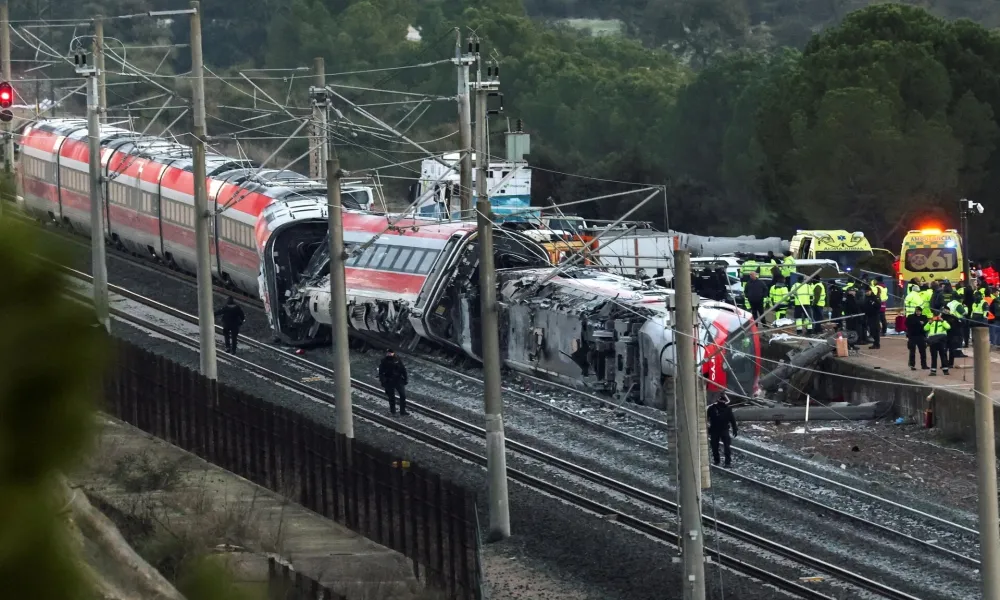
Footage broadcast by Spanish public television showed the two trains derailed, surrounded by emergency crews and ambulances, as rescue teams worked to assist dozens of victims.
Spain’s Transport Minister Óscar Puente warned via X that “the collision was horrific” and that there was a risk the casualty count could increase further, citing “deeply concerning information” from the scene.
He said the force of the impact caused the first two carriages of the Renfe train to derail, stressing that the immediate priority was locating victims.
Rescue operations and trapped passengers
Earlier, emergency services reported passengers trapped inside the wreckage. Puente later said that all those requiring medical assistance had been evacuated from the trains.
Francisco Carmona, head of the Córdoba fire brigade, told public broadcaster TVE that the metal structure of the carriages had been severely deformed, with passengers trapped inside.
“Everything has been completely destroyed,” he said, adding that rescuers were forced to move bodies in order to reach survivors.
How the collision happened
According to Puente, the rear carriages of the Iryo train, travelling from Málaga to Madrid, derailed near Adamuz, around 200 kilometres north of Málaga. The derailed carriages were then struck by a Renfe train travelling in the opposite direction towards Huelva on nearby tracks.
At Madrid’s Atocha station, psychological support teams were deployed to assist families of the victims, according to the president of the Madrid region, Isabel Díaz Ayuso.
Survivor accounts
Passengers described scenes of panic and chaos. Lucas Meriaco, who was travelling on the Iryo train, told broadcaster La Sexta that the experience felt like “a horror film”.
“There was an extremely violent impact at the rear and I thought the whole train was going to collapse,” he said, adding that many passengers were injured by shattered glass.
A journalist from Spain’s public radio RNE, who was also on board one of the trains, told TVE the impact felt like an earthquake. Passengers used emergency hammers to break windows and escape from the carriages, he said.
National and international reaction
Spanish Prime Minister Pedro Sánchez said he was closely monitoring developments and that the central government was working alongside all relevant authorities at the scene.
“No words can ease such profound pain, but I want you to know that the entire country stands with you in this extremely difficult moment,” Sánchez wrote on X, offering his condolences to the families and loved ones of the victims.
Spain’s royal family also expressed its deep concern over the “serious accident” and extended its condolences to the families affected.
French President Emmanuel Macron described the crash as a tragedy and pledged France’s support to Spain, saying his thoughts were with the victims, their families and the Spanish people.
Investigations into the cause of the derailment and collision are ongoing.