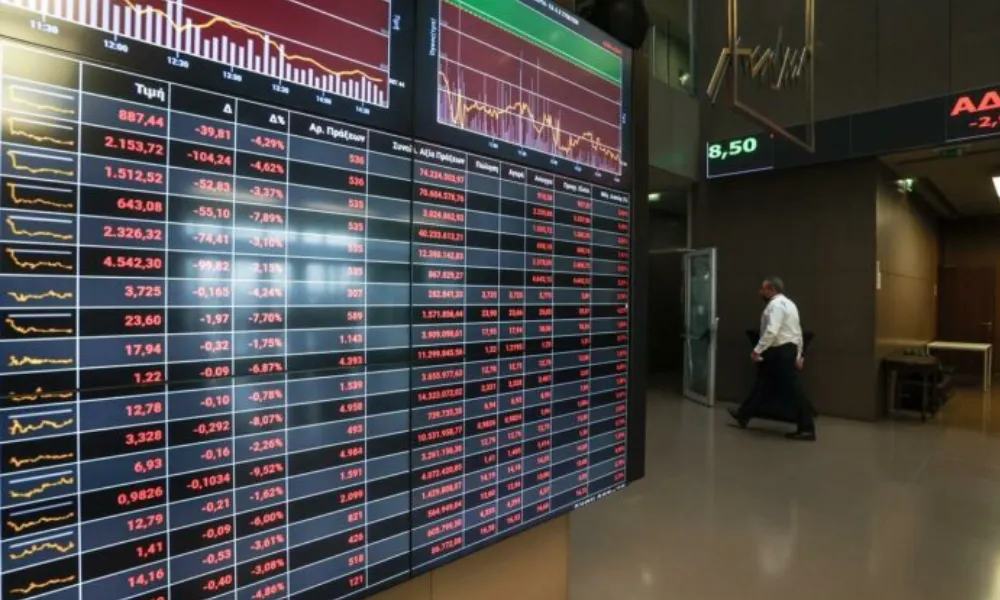

European markets opened the week in negative territory following large-scale United States and Israeli strikes on Iran over the weekend. Oil prices surged, gold advanced and airline stocks came under significant pressure as investors reassessed geopolitical risk.
European indices under pressure
The pan-European Stoxx 600 opened down 1.4%. London’s FTSE 100 fell 0.9%, Germany’s DAX dropped 2.3%, France’s CAC 40 declined 2.4% and Italy’s FTSE MIB lost 1.7%.
Global markets reacted to rapid developments over the weekend. The strikes resulted in the death of Iran’s Supreme Leader, Ayatollah Ali Khamenei, while the United States and Israel called on Iranian citizens to act against the regime.
Iran launched retaliatory strikes against US bases in the Middle East. Three American service members were killed during the operation.
Oil surge and focus on the Strait of Hormuz
Crude oil prices jumped by more than 8% amid concerns over potential supply disruption. US futures fell sharply on Monday morning, while Asia-Pacific markets also recorded notable losses.
Oil traders are closely monitoring the Strait of Hormuz, a critical global energy transit point. Although the waterway has not been officially closed, tanker traffic has slowed significantly as war risk insurance premiums rise and shipping companies suspend routes, according to a note by JPMorgan.
The bank stated that markets are witnessing an “immediate repricing of geopolitical risk rather than a gradual adjustment based on fundamentals”.
JPMorgan warned that if disruptions persist for more than three weeks, Gulf producers could exhaust storage capacity and be forced to curb output. In that scenario, Brent crude could rise to between 100 and 120 dollars per barrel.
In Asia, energy shares rallied. Australia’s Woodside Energy and Santos gained more than 6%, while in Tokyo Inpex rose 6.08% and Japan Petroleum nearly 12%.
Gold mining companies, particularly in Australia, also advanced by more than 4%, including Northern Star Resources and Evolution Mining.
Airline stocks record sharp losses
Airline shares posted the steepest declines across markets, with major Asian carriers trading lower.
According to aviation data provider Cirium, more than 50% of global flights bound for the Middle East had been cancelled by 6:30am Singapore time. The company noted that the figure may be higher, as some airlines had not yet updated schedules to reflect cancellations.
Australia’s Qantas fell 5%, despite no direct impact on its routes. Japan’s ANA and Japan Airlines each declined by more than 5%. Nikkei reported that Japan Airlines cancelled its Tokyo–Doha flight on Saturday.
Singapore Airlines dropped 4.74%, while Taiwan’s Eva Air fell 4.47%.
Defence stocks edge higher
Defence sector shares moved higher, though gains were more moderate. With South Korean markets closed for a public holiday, regional trading volumes were limited.
In Japan, Mitsubishi Heavy Industries and IHI rose by more than 3%, while Singapore’s ST Engineering advanced 4%.
Analysts at Franklin Templeton said on Monday that they favour energy, shipping, insurance and defence stocks in the short term, while remaining cautious on cyclical sectors exposed to fuel costs, such as airlines.
Safe-haven demand supports gold
Gold, traditionally viewed as a safe-haven asset, strengthened amid heightened geopolitical uncertainty and falling bond yields.
Spot gold rose 1.89%, while futures gained 1.77%.
“There is a clear tactical shift towards precious metals, particularly in an environment marked by geopolitical tension and concerns over currency weakness,” said Kurt Hemker, chief executive of Gold Token SA.
Bitcoin recovered from earlier losses and rose 1.5% to around 66,675 dollars, although it remains well below its October high of approximately 126,000 dollars.
Hemker added that gold’s rise reflects demand for stability and balance sheet protection, while weakness in cryptocurrencies is more closely linked to limited liquidity and investor fatigue.
In currency markets, the dollar index strengthened by around 0.61%. The Swiss franc rose 0.1% to 0.7681 against the dollar.
In contrast, the Japanese yen weakened by 0.57% against the dollar. According to Matthew Ryan, head of market strategy at Ebury, the move may reflect Japan’s status as a net oil importer and the currency’s reduced appeal in recent risk-off episodes.
Source: newmoney.gr