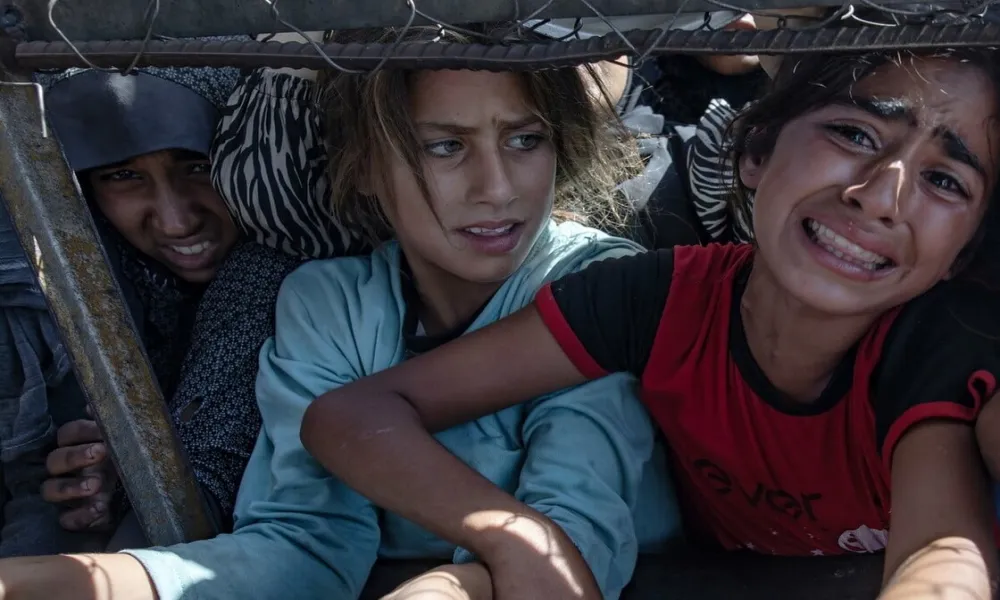

Tens of thousands of Gaza’s youngest are now acutely malnourished, with rates rising and falling in direct response to restrictions on humanitarian aid, according to a landmark study published in The Lancet and led by the UN Relief and Works Agency for Palestine Refugees (UNRWA).
The longitudinal study, titled “Assessment of malnutrition in preschool-aged children by mid-upper arm circumference in the Gaza Strip (January 2024–August 2025)”, is the first month-by-month analysis of child nutrition during the war. Drawing on nearly 220,000 screenings of children aged 6–59 months conducted at 16 UNRWA health centres and 78 medical points across Gaza’s five governorates, researchers used mid-upper arm circumference (MUAC) -a standard emergency nutrition measure- to assess wasting, a life-threatening condition in which a child becomes dangerously thin for their height.
Ceasefire relief followed by renewed collapse
The results are stark. The study found that acute malnutrition, or wasting, rose from 4.7% in January 2024 to 14.3% by January 2025 after months of aid restrictions. During a six-week ceasefire in early 2025, when humanitarian access briefly improved, the rate fell to 5.5%, only to surge again to 15.8% by mid-August 2025 amid renewed siege conditions. UNRWA estimates that 54,600 children are acutely malnourished, including about 12,800 who are severely malnourished and in urgent need of therapeutic food or hospital care.
Area differences were extreme: in Rafah, wasting spiked from 7.1% in April 2024 to 31.5% in January 2025, while in Gaza City the rate rose six-fold between March and August 2025, reaching 28.8%.
According to AFP, which also reported on the study, nearly one in six children in Gaza are now acutely malnourished after two years of war that has caused severe food shortages. The news agency cited UNRWA’s findings that acute malnutrition increased steadily following an Israeli blockade on humanitarian aid between March and May 2025. AFP further noted that Israel has rejected the UN’s famine declaration in parts of Gaza, though the United Nations and The Lancet researchers consider the data credible.
The Integrated Food Security Phase Classification (IPC) confirmed famine in Gaza City on August 15, 2025, with the rest of the Strip facing critical or near-famine conditions. The Lancet paper “reinforces” that finding by documenting how malnutrition evolved during the war as access to food, water, fuel and medicines fluctuated.
“Without a lasting cessation of conflict and unimpeded, competent international assistance, further deterioration in early childhood nutrition with increased mortality is inevitable,” said Dr Akihiro Seita, UNRWA’s Director of Health and senior author of the study, in a statement cited by ReliefWeb and EurekAlert!.
Lead scientist Dr Masako Horino said that before October 2023, Palestine refugee families in Gaza were food-insecure but their children were “only marginally underweight” thanks to regular access to food aid, support that has been severely restricted since the war began. “Following two years of war and severe restrictions in humanitarian aid, tens of thousands of preschool-aged children in the Gaza Strip are now suffering from preventable acute malnutrition and face an increased risk of mortality,” she told Middle East Eye.
Reporting by Middle East Eye underscored that the 20-month surveillance period revealed a clear correlation between aid restrictions and child wasting, with a brief improvement during the January-March 2025 ceasefire when more aid entered Gaza. The outlet also quoted public health experts warning that children’s future health and even the next generation’s life expectancy could be permanently harmed.
Experts warn of lifelong impact
In a linked Lancet Comment, independent experts Zulfiqar A. Bhutta (Aga Khan University), Jessica Fanzo (Columbia University) and Paul H. Wise (Stanford University) argued that the data “strongly suggest that restrictions on food and assistance have resulted in severe malnutrition,” warning of the long-term effects of starvation and deprivation, from increased risk of chronic disease to reduced lifespan.
ReliefWeb reported that UNRWA health staff in Gaza conducted the screenings under extreme conditions, often inside schools converted into shelters and tents housing displaced families. More than 370 UNRWA employees, including 21 health workers, have been killed since the war began, and many agency facilities have been destroyed.
The study, carried out with assistance from the Johns Hopkins Bloomberg School of Public Health, covered roughly two-thirds of Gaza’s estimated 346,000 children under five. During the 20-month observation period, deliveries of food, fuel, and medicine were consistently below pre-war levels due to restrictions imposed by Israeli authorities.
When aid flowed, malnutrition declined. When it was cut off, rates spiked. By August 2025, acute malnutrition in Gaza City had reached nearly 30%, providing what The Lancet calls “the clearest evidence yet” of how Gaza’s youngest children are bearing the brunt of the humanitarian collapse.
Sources: The Lancet, UNRWA, ReliefWeb, EurekAlert!, AFP-JIJI, Middle East Eye.