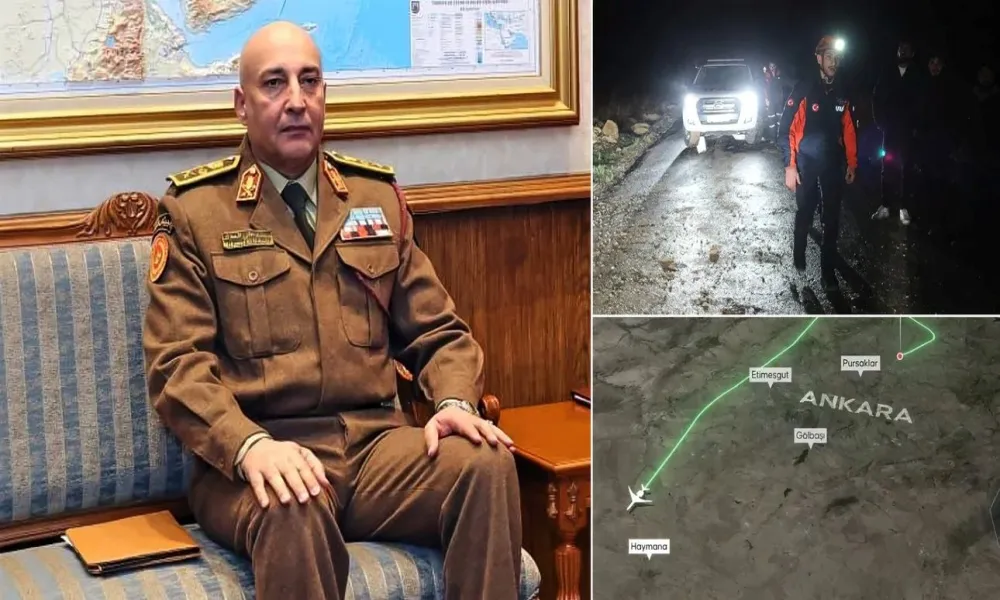
A major political and military shock has followed the death of Libya’s Chief of General Staff, Lieutenant General Mohamed Ali Ahmed al-Haddad, who was killed in an aircraft crash near Ankara shortly after take-off.
Turkey’s Ankara Chief Public Prosecutor’s Office has launched a formal investigation into the incident, while the Libyan government has announced it will dispatch a specialised delegation to Turkey to take part in determining the causes of the crash.
The crash near Ankara
The accident occurred on Tuesday evening, when a Dassault Falcon 50 private jet departed from Esenboğa Airport in Ankara, bound for Tripoli. According to Turkish authorities, all those on board were killed, including four senior Libyan military officials and three crew members.
The aircraft reportedly took off at 20:10 local time (17:10 GMT). Approximately 40 minutes later, contact with air traffic control was lost. Prior to the loss of communication, the crew had requested an emergency landing due to a technical issue and had been instructed to return to Ankara airport. During its descent, however, the aircraft disappeared from radar.
The wreckage was later located near the village of Kesikkavak, in the Haymana district of Ankara province. Security camera footage broadcast by Turkish television networks showed the night sky briefly illuminated by a powerful explosion at the time of the crash.
Preliminary findings
According to statements by Turkish officials cited by Al Jazeera, initial findings rule out sabotage, with a technical or electrical malfunction identified as the most likely cause of the accident.
The aircraft was reportedly leased and registered in Malta. Libyan authorities have stated that full details regarding its maintenance history have not yet been disclosed.
Victims of the crash
In addition to Lieutenant General al-Haddad, those killed include:
- Al-Fitouri Garibil, Commander of Libya’s Ground Forces
- Brigadier Mahmoud al-Qattawi, head of the Military Industrial Authority
- Mohamed al-Asawi Diab, adviser to the Chief of General Staff
- Mohamed Omar Ahmed Mahjoubi, military photographer
National mourning in Libya
Libya’s Government of National Unity (GNU) declared three days of national mourning, with flags flown at half-mast and all official events suspended.
Prime Minister Abdul Hamid Dbeibeh described al-Haddad’s death as “a great loss for the nation and the armed forces”, praising his service and sense of national responsibility.
Condolences were also expressed by political rivals of the Tripoli-based government, including eastern Libya’s strongman Khalifa Haftar and the Benghazi-based parliament, highlighting the broad respect al-Haddad commanded across Libya’s divided political landscape.
A central figure in Libya’s unification efforts
Mohamed Ali Ahmed al-Haddad had served as Chief of the General Staff since August 2020 and was regarded as a key figure in UN-backed efforts to reunify Libya’s armed forces, following years of fragmentation after the 2011 overthrow of Muammar Gaddafi.
Born in 1967 in Misrata, al-Haddad graduated from Libya’s Military Academy in 1987 and took part in the 2011 civil conflict, joining revolutionary forces opposing the Gaddafi regime. In the post-war period, he held several senior military positions before being appointed Chief of Staff under the GNU.
Analysts describe him as a senior officer with extensive experience, who resisted pressure from armed groups in western Libya and consistently promoted dialogue and reconciliation with the eastern authorities. His strategy focused on integrating militias into a unified military structure and rebuilding state control over the armed forces.
Libya–Turkey relations in focus
The Libyan military delegation had been in Ankara for high-level defence talks aimed at strengthening bilateral military cooperation. Earlier that day, al-Haddad and senior officers had met with Turkey’s Chief of General Staff and Defence Minister Yasar Guler.
The crash occurred just one day after Turkey’s parliament approved a presidential decree extending the deployment of Turkish troops in Libya by a further 24 months, from January 2, 2026. Turkey remains a key ally of the Tripoli-based government, providing military and economic support while also attempting to maintain channels of communication with eastern Libya under its “One Libya” policy.
The sudden death of al-Haddad is expected to have significant implications for Libya’s internal balance and regional dynamics, at a time when the country remains politically and militarily fragile.