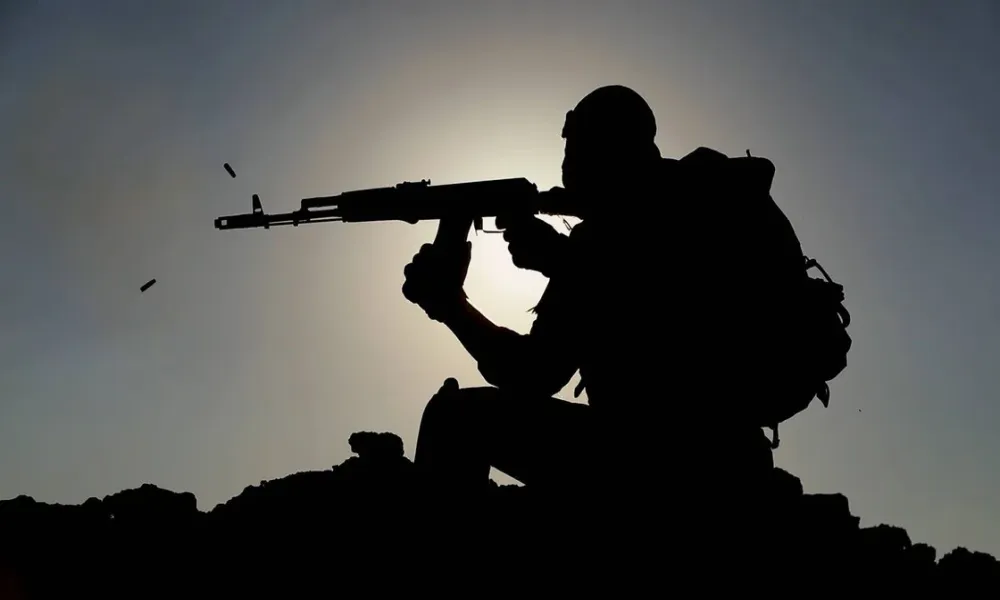
Iran’s Islamic Revolutionary Guard Corps (IRGC) was created in the early months after the 1979 Islamic Revolution to protect the new political system and counter threats from within and outside the country. It remains a parallel military force to Iran’s regular armed forces, with its own command structure and broad responsibilities.
How the IRGC was created
The IRGC was established shortly after the 1979 revolution, by decree of Ayatollah Ruhollah Khomeini, as a force designed to safeguard the revolutionary system and act as a counterweight to the regular military.
Its continued existence and core mission are also reflected in Iran’s post-revolution constitution. Article 150 states that the IRGC “shall remain in existence” to continue its role of guarding “the Revolution and its achievements”, while also noting that the division of responsibilities with other armed forces is determined by law.
Relationship with Iran’s regular armed forces
Iran’s regular military is often referred to as the Artesh, while the IRGC is a separate force within the state security system. Reuters describes the IRGC as distinct from the regular armed forces, with its own army, navy and air units, and an intelligence wing.
Analysts widely describe the IRGC as designed, in part, to protect the clerical ruling system and revolutionary values, and it answers to Iran’s Supreme Leader.
Size and main branches
There is no single publicly verified figure for IRGC personnel. Reuters has cited estimates of around 125,000 members, organised across ground, naval and air units.
One detailed open-source assessment also uses a 125,000 figure in comparing the IRGC’s size to the regular military.
Basij: the volunteer force under the IRGC
A major component of the IRGC is the Basij, a volunteer paramilitary force frequently associated with internal security roles.
The Basij was decreed in 1979 and subsequently organised as a paramilitary volunteer militia within the IRGC, with roles that include internal security and mobilisation.
Reuters describes the Basij as a volunteer paramilitary force that is often used in domestic crackdowns on protests.
Quds Force and overseas operations
The IRGC’s external operations arm is widely known as the Quds Force. Encyclopaedia Britannica describes it as part of the IRGC and links its development to Iran’s security and influence abroad.
Reuters has also described the Quds Force as an extension of the IRGC responsible for foreign operations and support to regional allies.
Missiles and air power: an important distinction
Reporting often refers to IRGC “air units”, but it is important to distinguish between:
- The IRGC Aerospace Force, which is widely described as central to Iran’s strategic missile capability.
- Iran’s regular air force (IRIAF), which operates manned fighter aircraft including types such as the F-14 and MiG-29, according to publicly available inventories.
Beyond the battlefield: political and economic influence
Beyond its military role, Reuters has reported that the IRGC has significant political influence and oversees a large economic footprint, with interests spanning sectors including construction, telecommunications and energy.
Source: Reuters, Constitution of the Islamic Republic of Iran (official text), Australian Government, Encyclopaedia Britannica.