
By Charalambos Ellinas
The renewed effort to complete the natural gas import terminal at Vasilikos is entering a critical phase. Eight companies have expressed interest in the tender launched by the Natural Gas Infrastructure Company (ETYFA), with an estimated value of €180 million. The management of the Cyprus Natural Gas Public Company (DEFA) appears satisfied and says that the problems of the past have been taken into account.
The response is positive, but it does not guarantee success. The real question is which companies will be selected for the next round. It is also how many have the required experience, and how many will stay in the tender once they fully understand the technical, financial and legal risks.
Cyprus cannot afford to repeat the failure of the previous contract.
The prequalification criteria
According to the documents for tender E.013-2026, candidates must have an average annual turnover of at least €300 million over the past three years.
They must also have experience in two natural gas EPC projects over the past decade, one worth more than €100 million. They also need experience in two marine projects, one worth more than €50 million. There are further requirements for design experience and compliance with European safety standards.
The criteria appear relatively low for the size and complexity of the project. Excluding the Prometheas, the project will cost around €300 million. Yet the benchmark set was the execution of projects worth between €50 million and €100 million.
This may allow companies with no specialised experience in building and operating LNG terminals to take part. Experience in natural gas projects may relate to pipelines or other facilities.
In addition, a reference project is considered complete once it is at least 80% implemented, without necessarily having entered operation. In consortia, the lead member needs to meet on its own only one of the two core construction experience requirements, in natural gas projects or in marine works. These criteria broaden competition, but they do not ensure the contractor is suitable.
Not an ordinary project
The new contractor will not take over a clean site with completed designs and new equipment. It will take on the unfinished facilities of the previous consortium, with significant outstanding technical issues.
Technip carried out an assessment after the previous contract was terminated. It identified problems with the technical documentation and the condition of materials, and found that parts of the design need to be reviewed.
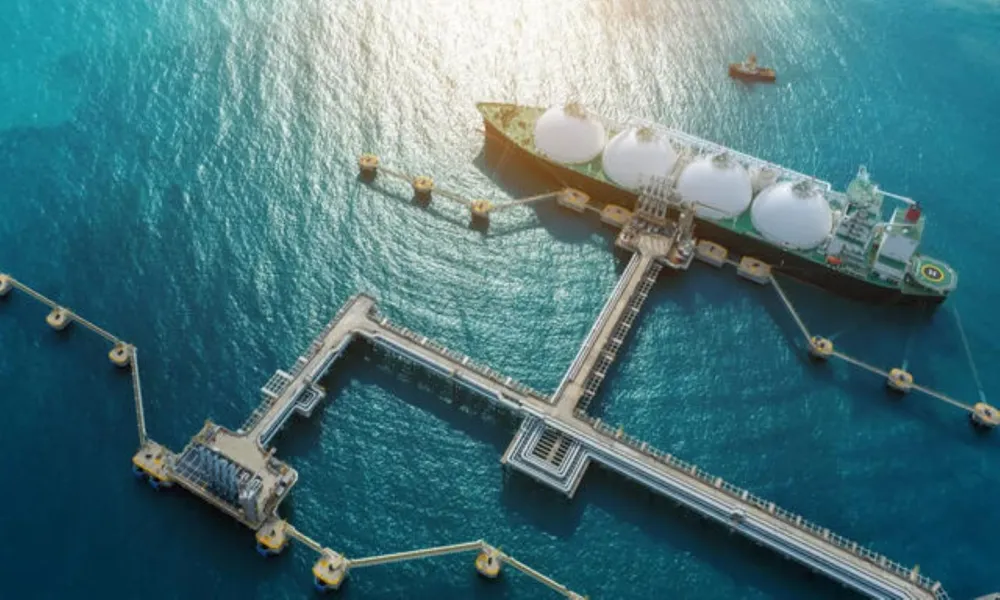
The new contractor will need to inspect existing structures, confirm that equipment is fit for purpose and deal with deterioration. It will also need to fill gaps in technical data and update safety studies. Compatibility between the onshore facilities, the jetty and the floating storage and regasification unit Prometheas must also be ensured.
The contractor will have to deliver a single, safe and operational terminal, not simply complete construction works. Experience in projects of this kind matters more than a company’s turnover.
Who can take it on?
The interested parties include at least three companies with substantial international experience in large energy or marine projects. Other companies may also have the required capabilities, particularly through suitable consortia.
However, formally meeting the minimum criteria is not the same as proven ability to complete a troubled terminal that can receive and regasify LNG. For genuine competition, it is important that at least three strong, technically credible candidates remain until the final stage. Otherwise, ETYFA may end up with several prequalified contractors but limited real choices.
The next phase
DEFA aims to complete prequalification by the end of 2026 and to award the contract before summer 2027. Works are expected to begin in the second half of 2027.
In the next phase, companies will receive the detailed technical specifications and contractual terms. That is when it will become clear which ones are willing to take on the project.
Serious international contractors are unlikely to accept unlimited liability for unknown defects or deficiencies left by a previous contractor. If ETYFA transfers excessive and unquantifiable risks to the contractor, the strongest firms may react in one of three ways. They may demand contractual protection, build significant additional costs into their bids, or withdraw. This could lead to less competition, higher prices and new disputes.
ETYFA must keep safety and quality requirements non-negotiable, but allocate the risks of the existing facilities realistically.
Scoring requires transparency
The award will be based on the best price-quality ratio. This is an appropriate approach for complex projects, but it leaves room for subjective judgement if the criteria are not specific. The detailed weightings for technical and financial scoring have not yet been made public.
Real technical competence, LNG experience, the quality of the project team and the credibility of the completion plan must carry substantial weight. The selection of an unrealistically low bid, which could later lead to claims for additional payments and extra time, must also be avoided. Past experience demands full documentation of every score and every exclusion decision.
Who will supervise the project?
A critical issue is the role of Technip Energies, which took on project management services in 2025. Technip contributed to the assessment of the facilities and the preparation of the new tender.
However, its exact role in the technical evaluation of bids has not been publicly clarified. Nor has it been made clear whether its contract includes full construction supervision, certification of works and operational testing.
ETYFA’s evaluation committee is responsible for the process and submits its report to the board of directors. It needs, however, strong, independent technical support, both in selecting the contractor and in executing the contract. Following the termination of Hill International’s involvement, these responsibilities must be clarified before a new contract is awarded.
Costs continue to rise
According to published estimates, around €300 million has already been spent without an operational terminal. With the €180 million of the new tender, the total approaches €480 million.
This is not a final projection. It does not necessarily include additional works, financing costs, future expenditure on the Prometheas or the consequences of the international arbitration.
On 12 October, the Minister of Finance confirmed that Vasilikos is included among the state’s fiscal risks. He cited state guarantees, guarantees from the previous consortium and the outcome of the arbitration. Meanwhile, the continued absence of natural gas is placing a burden on electricity generation and consumers.
Timeline to gas-fired power
Even if the contract is awarded before summer 2027 and no problems arise, the projected construction period is two years. Testing, certification, commissioning and connection to the Electricity Authority of Cyprus (EAC) will follow. The actual use of natural gas in power generation can therefore hardly be considered secured before 2030.
What measures is the government taking to ensure electricity adequacy until then?
Cyprus needs the terminal, but not another problematic contract. Success will not be measured by the eight expressions of interest, the speed of the award or a low price. It will be measured by the selection of a capable contractor, independent supervision and control of the final cost. Above all, it will be measured by when natural gas is delivered to the EAC. That is the real lesson from the failure of the previous contract.
Charalambos Ellinas is a Senior Fellow at the Atlantic Council’s Global Energy Center.