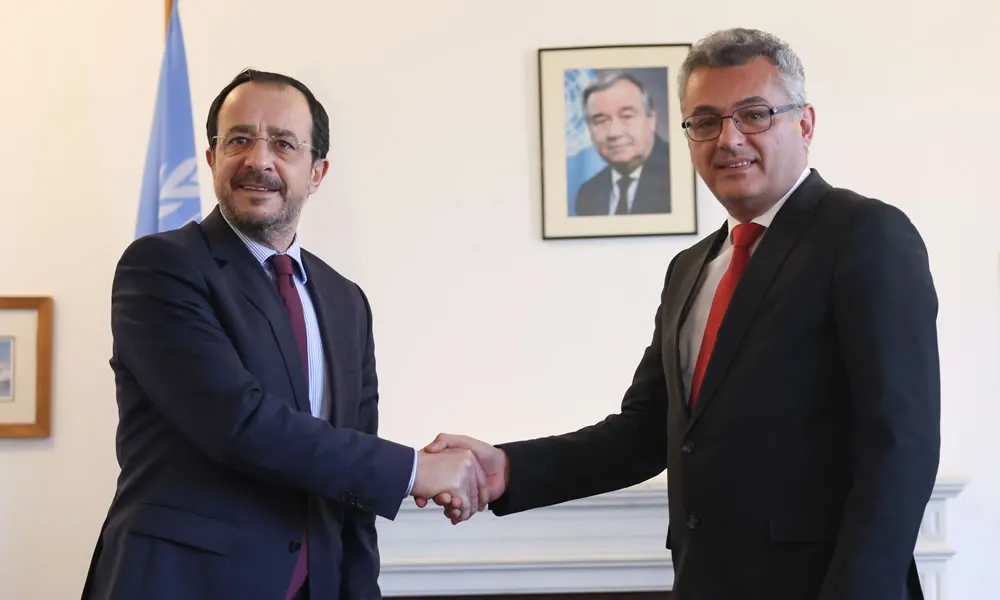

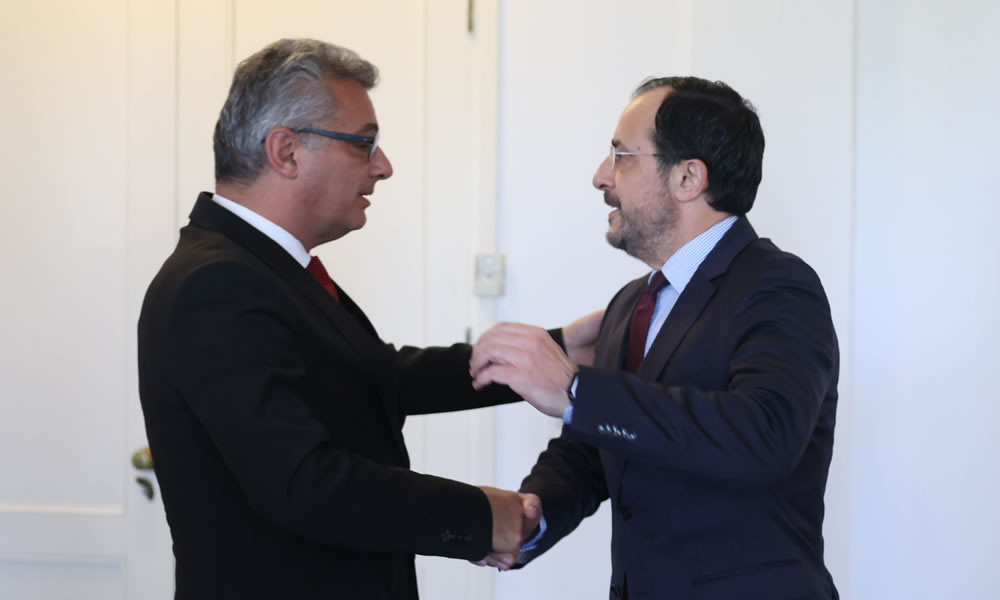
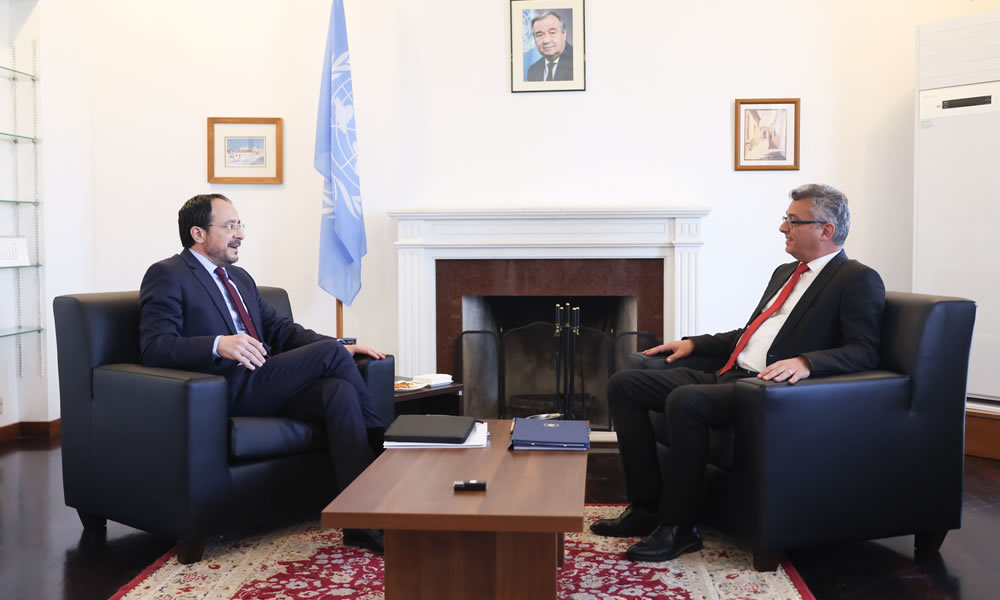
The two leaders met for just under two hours on Friday, agreeing to a series of low-level confidence-building measures (CBMs) but no new checkpoints. For around half the meeting, the two leaders were alone, before being joined by their respective negotiators. They agreed to meet again in the near future.
Speaking after the meeting President Nikos Christodoulides said the goal is to convene an expanded conference this summer that will announce the resumption of negotiations.
He argued that a lot of the tensions taking place in the buffer zone lately and with regard to the recent cancellation of Greek Cypriot and Armenian religious services in the north boil down to some not being happy about the prospect of positive momentum in the peace talks.
The President appeared to suggest this was not the work of his counterpart in the talks, Turkish Cypriot leader Tufan Erhürman, but rather others – a likely reference to the ruling coalition in the north led by the National Unity Party (UBP).
The recent cancellations of religious services in the north come on the back of the failure in March to organise an annual trip to the Hala Sultan Tekke by Turkish Cypriots due to a disagreement between the two sides on the procedure that needs to be followed.
To drive home his point that some are playing the role of disrupter, President Christodoulides pointed out there is a pre-election campaign underway in the Turkish Cypriot community, indicating some parties would not view a ‘5+1’ meeting to announce peace negotiations after a nine-year vacuum as a positive development.
According to Politis’ sources, the next ‘parliamentary’ elections in the north are due in January 2027, though there is now talk of early elections being held end of September or early October. Should the Republican Turkish Party (CTP) harness the overwhelming support shown for their candidate in the Turkish Cypriot leadership elections last October, while capitalising on the widespread discontent with the incumbent UBP-led coalition, then pro-federal solution forces could soon dominate across the board in the north.
Four measures agreed
According to a UN statement released on Friday evening, the two leaders had a “productive discussion” in a “positive atmosphere” at the residence of the UN Special Representative. They exchanged views on substance and the way forward and reiterated their appreciation for the UN Secretary-General’s sustained commitment to the Cyprus issue.
They agreed on a framework for the establishment of a consultative body for civil society engagement. This was one of the CBMs raised back in July 2025 at the last ‘5+1’ meeting in New York between the two leaders and three guarantor powers under UNSG Antonio Guterres’ auspices. Christodoulides noted it was first proposed in 2007 by then President Tassos Papadopoulos.
Agreement on the “framework” means the two sides have reached a common understanding on how this Track 2 consultative body will be represented – in terms of age, gender, profession, origin, personal capacity – and the role it will have, e.g. informal consultations dealing with specific areas of interest to society, such as professional bodies, education, health, the economy, etc.
According to Erhürman on his return north, the process would operate within the framework of the technical committees. The aim, he added, was to create a structure that would allow civil society to contribute more effectively to efforts towards a settlement.
The leaders also agreed to work on preparing a plan for the conduct of religious services throughout the island for an initial six-month period, to be renewed on expiry. Speaking on his return to the Presidential Palace, Christodoulides said the aim is to avoid obstacles that some impose on holding religious services by agreeing in advance specifically where and when they will take place.
A third agreement was to continue to work towards a coordinated response to tackle foot-and-mouth disease (FMD) on the island.
“It’s an issue we discussed extensively,” said Christodoulides, adding that “the Turkish Cypriot side needs to implement certain specific measures to address this challenge”.
According to Politis’ sources, the Technical Subcommittee on Veterinary Matters is already engaged on the matter, and the effort will continue to convince Turkish Cypriots to implement EU protocol on FMD, otherwise any progress to eradicate the disease will be at constant risk of regression if Turkish Cypriot farms – some situated only a few kilometres away from Greek Cypriot farms – are not following the same protocols. The key issue here is EU involvement to provide a strong counterbalance in the form of compensation to the measures that need to be adopted.
The final measure agreed by the leaders was to establish a subcommittee under the Technical Committee on Economic and Commercial Matters for the discussion of issues related to the designation of Turkish Cypriot products, including halloumi, already designated by the Cyprus Republic with EU approval as products with Protected Designation of Origin (PDO) and Protected Geographical Indication (PGI).
Sources explained that the aim here is to explore which Turkish Cypriot products can also meet the PDO/PGI criteria and how to have them certified, again with EU involvement.
On the convergences achieved, Erhürman said they may appear minor, but they were important for improving intercommunal communication and trust, adding that strengthening the effectiveness of the technical committees could have a direct impact on daily life.
Regarding the opening of checkpoints – considered by UN Personal Envoy María Ángela Holguín as a substantive CBM that could help unlock the door to a new ‘5+1’ – no progress was made.
Erhürman underlined the importance of opening new crossing points, saying the issue has taken on symbolic significance over time. Progress in this area could help unlock the broader process, he said, acknowledging that no breakthrough had been achieved on crossings so far.
“We have not reached the point we would like on new crossing points, but on other issues we are in a position to take certain steps,” he said.
On substance
Christodoulides said he had spoken on Wednesday with Holguín, noting that the UN Secretary-General’s effort to convene an expanded meeting that could announce a resumption of talks was being “further strengthened” through meetings with all involved parties.
Asked whether Holguín was “re-entering the game” more actively, Christodoulides said she had “always been a key player” on behalf of the UNSG.
After the meeting, the President said we are seeing Guterres’ increased interest in practice, with the creation of a positive climate on issues of substance. Regarding his discussion with Erhürman, he said there was a “positive approach” to the issue. An informal goal is to have an expanded meeting in the summer, he said.
Christodoulides said it was “troubling” that some were trying to create problems on this. He also referred to recent provocations by the Turkish occupation army.
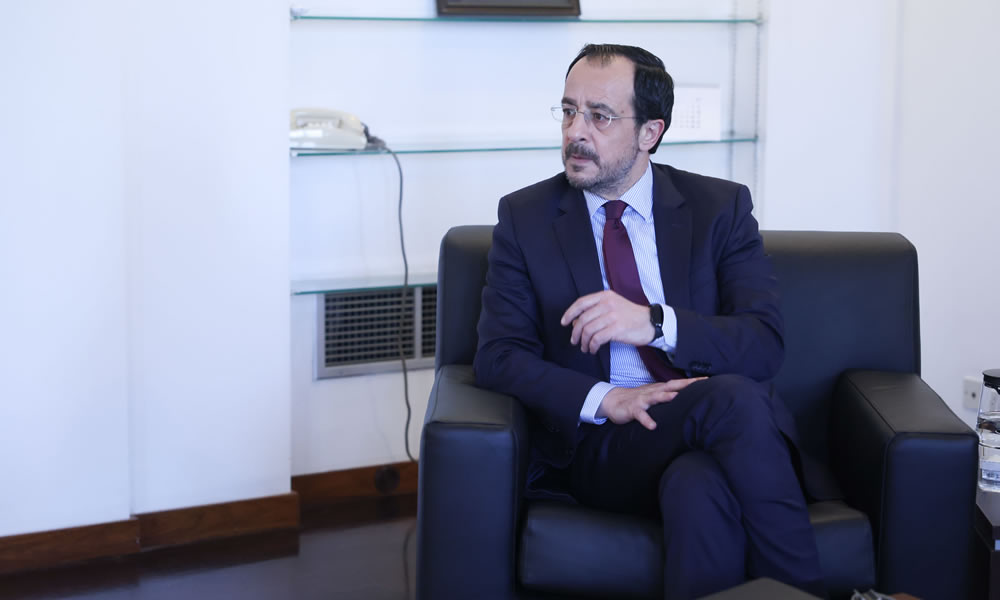
For his part, Erhürman described the talks as productive and positive. The two leaders need to demonstrate their capacity to produce solutions that ease daily life and strengthen communication between the two communities, he said.
According to Greek Cypriot sources, in terms of substance, the sides reconfirmed their commitment to the UNSG’s initiative. They were now waiting for Holguín to return to the region to put meat on the bones of the UNSG’s effort to resume negotiations.
The meeting between the leaders was described as “very friendly and productive”. Acknowledging the initial gap in trust between them, the source said that their relationship was heading in the right direction. They warned that trust takes time to be built but can also be easily lost and needs to be safeguarded.
Asked whether the leaders came closer to a common understanding on how to get back to negotiations, a Turkish Cypriot source said the leaders maintained their positions regarding how formal talks can start.