


There is a powerful symbolism in Antonio Guterres' upcoming visit to Cyprus. The Portuguese diplomat was elected UN Secretary-General in 2016 and took office on 1 January 2017, at a moment when the Cyprus problem stood at one of the most advanced stages in its history. Days later, the Geneva conference took place, and by the summer of that year he found himself at Crans-Montana, attempting to steer the negotiations toward a strategic agreement.
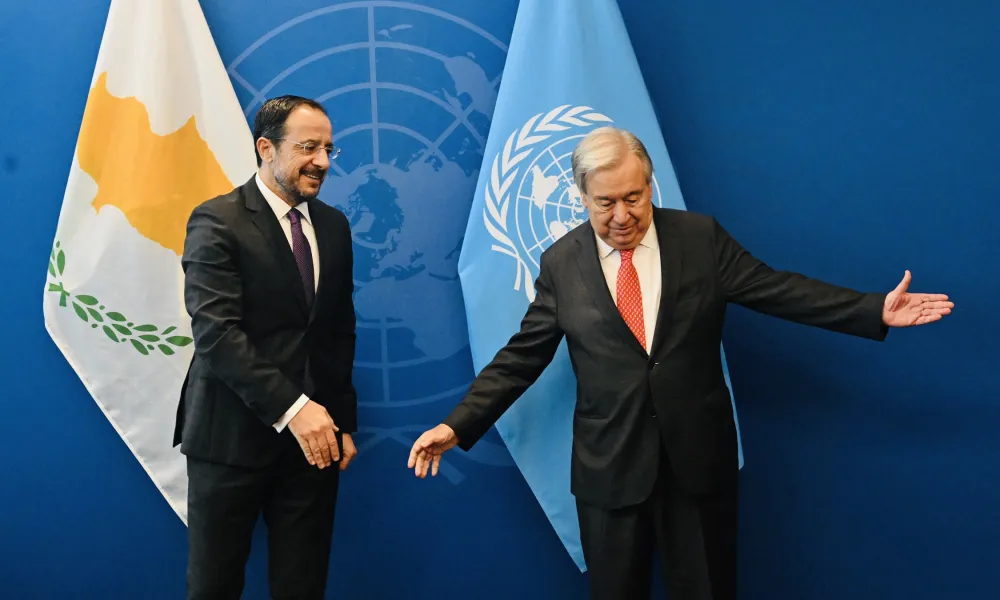
Now, as his second and final term draws to a close on 31 December 2026, Guterres returns to the island for talks from 27 to 29 July. It is the first visit by a UN Secretary-General to Cyprus in 16 years and a move that can hardly be dismissed as merely ceremonial. The circle appears to be closing where it essentially began.
From Crans-Montana to the absolute vacuum
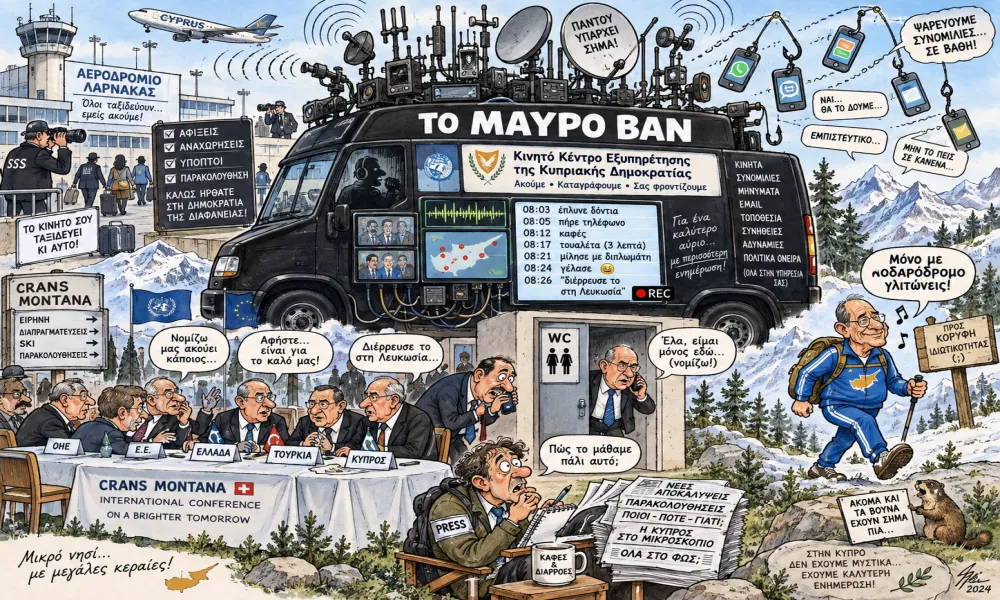
In 2017, Guterres did not confine himself to the role of observer. He put forward his now-familiar six-point framework, touching on the toughest chapters of the Cyprus problem, including security and guarantees, troops, territory, property, political equality and effective participation. The collapse of the conference on 7 July was not simply a failure of the two communities and the guarantor powers. It also represented the loss of a rare moment when every core issue had been placed on the table simultaneously.
After Crans-Montana, Guterres tried to salvage what remained. He assigned Jane Holl Lute to explore the possibility of drafting terms of reference, so that talks could resume from where they had stopped rather than from scratch. In November 2019, in Berlin, Nicos Anastasiades and Mustafa Akıncı reaffirmed before him their commitment to a bizonal, bicommunal federation, to the 2014 Joint Declaration, to previous convergences and to the Guterres framework.
The picture changed dramatically after the election of Ersin Tatar to the leadership of the Turkish Cypriots in 2020. With Ankara's backing, the Turkish side made recognition of so-called "sovereign equality" a precondition and began openly promoting a two-state solution. At the informal "5+1" meeting in Geneva in April 2021, Guterres admitted that no common ground had been found. Even so, he refused to declare the process dead, saying he would continue seeking common ground.
The return through small steps
The next serious move came in 2024, with the appointment of María Ángela Holguín as personal envoy. Her first mission failed to identify common ground for the launch of formal negotiations. However, the informal dinner Guterres convened in New York in October of the same year opened the way for a broader meeting involving the guarantor powers.
In Geneva, in March 2025, the first tangible progress in years was recorded. Not on the major chapters of a settlement, but on confidence-building measures providing for new crossing points, demining, and cooperation on youth, environmental and energy issues. Very little of this was actually implemented. A further informal meeting followed in New York in July 2025, with Guterres insisting that trust had to be built step by step.
The major political shift came in October 2025, when Tufan Erhürman defeated Tatar and revived, from the Turkish Cypriot side, the discussion of a federal solution. His election did not automatically change Turkey's official policy, nor did it erase the differences over guarantees, troops, political equality and the functionality of the state. It did, however, restore something that had been missing for five years, a Turkish Cypriot leader who says he is ready to negotiate within the United Nations framework.
Why Guterres insists on federation
Guterres' commitment to a bizonal, bicommunal federation is not merely a personal political stance. The Secretary-General is bound by Security Council resolutions, which continue to define federation with political equality as the basis for a solution. He has no authority to recognise two states or to alter the negotiating basis on his own. As recently as January 2026, the Security Council explicitly reaffirmed that a solution must rest on a bizonal, bicommunal federation.
His successor will inherit the same institutional framework. That does not mean, however, that they will show the same persistence. A new Secretary-General might treat the Cyprus problem as a lower priority, confine themselves to managing the buffer zone and the technical committees, or invest less personal political capital in the issue.
The Secretary-General is, after all, appointed by the General Assembly on the recommendation of the Security Council. This means that the personality, priorities and balance of power among the five permanent members will inevitably shape how the next UN chief approaches the Cyprus problem. The real danger lies not so much in a formal abandonment of federation as in its gradual hollowing out through the endless management of partition.
The last chance?
Guterres' visit can indeed be read as a message to Cypriots that the present window may be the last in which an active UN leadership, a Greek Cypriot leader who says he is ready to resume talks, a Turkish Cypriot leader returning to the federal basis, and a European Union attempting a more active role, all coincide.
It is not, of course, the "last chance" in any strict historical sense. Diplomacy rarely offers a single, absolute closing window. But it may well be this generation's last serious opportunity to achieve federal reunification before partition acquires still deeper permanence, through new facts on the ground, further demographic and economic divergence, the estrangement of younger generations and the entrenchment of two separate political realities.
Guterres cannot solve the Cyprus problem alone. Before he departs, however, he can force everyone to answer clearly the fundamental question of whether they still want a shared federal state or have resigned themselves to the permanence of division. If his visit succeeds in turning the current momentum into an agreed process with a clear basis, timetable and political horizon, then the cycle that opened in 2017 may not close with yet another failure.
If, on the other hand, this opportunity is also lost, his successor will inherit not simply an unresolved problem, but a conflict whose agreed basis for a solution risks existing more in resolutions than in political reality. And then Guterres' visit will be remembered not as the beginning of the final effort, but as the last warning before the definitive entrenchment of partition.