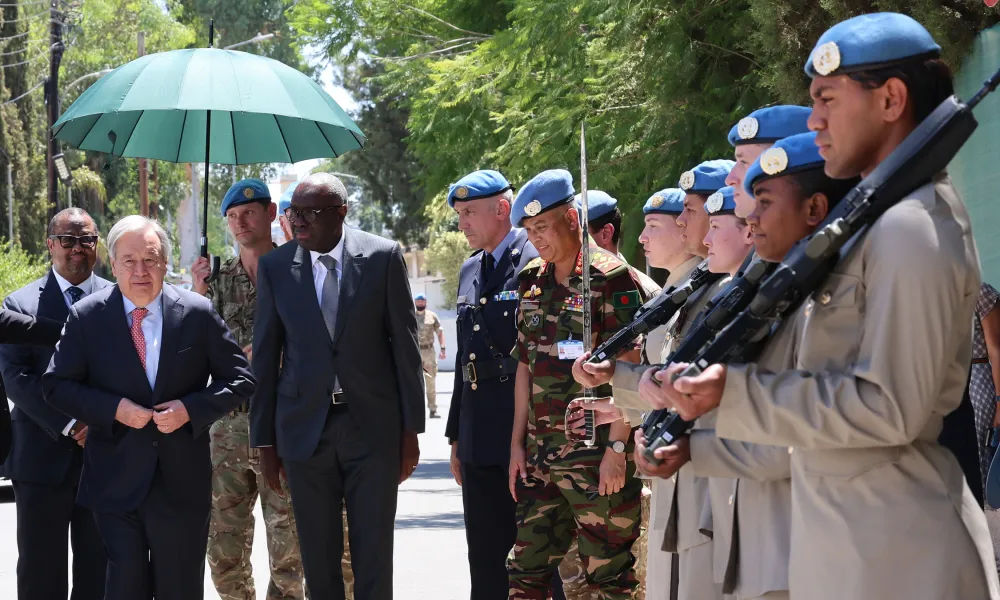

Antonio Guterres's visit to Cyprus was not a routine stop, nor yet another ceremonial reaffirmation of the United Nations' commitment to the Cyprus issue. The UN Secretary-General came to the island to test whether a roadmap could be established before the end of his term that would lead back to meaningful negotiations. His clearest articulation of the broader concern driving his efforts came after the July 29 meeting. A settlement in Cyprus, he said, is “absolutely crucial not only to preserve the interests and the peace of the Cyprus people but also as a factor of stability in what is becoming a dangerously unstable region.” The message therefore went beyond the familiar diplomatic language of reunification. It was also a warning, and perhaps even an exercise in political pressure.
The official purpose of his visit was clear. Guterres met with Nikos Christodoulides and Tufan Erhürman in an effort to prepare a new ‘5+1’ meeting involving Greece, Turkey and the United Kingdom. The visit was the first by a UN Secretary-General to Cyprus in sixteen years and took place while talks have remained effectively frozen since 2017. Guterres wants to leave behind a process that can continue under his successor, even if he harbours no illusions that a solution is just around the corner.
Security
Why, then, did he so strongly link the Cyprus issue to regional security? Because Cyprus is not merely close to the region's flashpoints; it is embedded in the geography, infrastructure and strategic balances of the Eastern Mediterranean. It lies roughly 207 kilometres from Lebanon and 340 kilometres from Israel. British Sovereign Base Areas operate on the island, with Akrotiri serving as a forward platform for operations in the Middle East. At Vasiliko, a US helicopter facility and a naval installation for French and Greek warships are under construction, while Paphos airport can host American, French and Greek aircraft. Cyprus' territory and airspace are periodically used by Israel for military exercises.
In the northern part of the island, Turkey maintains around 40,000 troops, operates a drone base, stations naval assets in the ports of Famagusta and Kyrenia, and occasionally deploys F-16 fighter jets there. In March, an Iranian unmanned aircraft struck an area near British personnel at the Base, demonstrating that geographical proximity is not a theoretical risk but a real operational exposure.
This was likely what Guterres had in mind. Not necessarily intelligence pointing to a specific imminent attack, but rather the accumulation of risks: a possible conflict with Iran, instability in Lebanon and Syria, tensions between Israel and Turkey, migration pressures, threats to maritime traffic, energy insecurity, drones, ballistic missiles and hybrid operations. In such an environment, a divided island with foreign troops, a buffer zone, two separate administrations and competing guarantor powers has more points of friction and fewer mechanisms for a unified response.
Western architecture
Cyprus has entered the equation because it already plays a role in the West's regional architecture. It is a member state of the European Union, has upgraded cooperation with the United States, maintains close ties with Israel and Greece, and serves as a hub for civilian evacuations and humanitarian support operations through the ‘Estia’ plan.
At the same time, it participates in the Eastern Mediterranean's energy planning, from the East Mediterranean Gas Forum to projects involving the production and transport of natural gas and electricity to Europe, as well as the India-Middle East-Europe Economic Corridor (IMEC). Its significance, therefore, is not purely military. It is also energy-related, diplomatic, humanitarian and economic.
Care is needed, however, when speaking of a "Western strategy." There is not necessarily a single, fully coordinated plan in which everyone follows the same line. There are, however, converging interests. The United States seeks to limit Iranian military influence and protect allies and sea lanes. The European Union wants energy diversification, control of migration flows and a stronger presence in the Mediterranean. Britain aims to preserve the operational value of its Bases. Israel seeks strategic depth and secure regional partnerships. Within this broader picture, Russia and China are indeed part of the background, though not in the same way as Iran.
The Guterres logic
A crucial distinction must be made here. Guterres is not a representative of Western strategy, nor is the UN mission intended to integrate Cyprus into an anti-Iranian or anti-Russian front. His logic is different: the more regional conflicts multiply, the more dangerous every unresolved dispute becomes, because it can be exploited, internationalised or turned into a battleground for rival powers.
His reference to regional instability should therefore be read primarily as an argument in favour of resolving the Cyprus issue, rather than as the unveiling of some secret geopolitical plan.
Iran represents a direct military and regional challenge. Russia remains the West's principal adversary within the European security system and seeks to maintain influence in Syria, energy markets and the Eastern Mediterranean. China operates primarily through investment, port infrastructure, trade, technology and economic influence. Cyprus, therefore, is not merely an outpost against a single adversary. It is a small but useful link in Western efforts to maintain access, influence and resilience in a region where multiple powers compete.
The Christodoulides contradiction
Within this Western equation, Nikos Christodoulides believes he has made a significant contribution. Yet he cannot escape a major contradiction: Turkey cannot be bypassed.
However much certain analysts in Greece, Cyprus or Israel may prefer to imagine a regional architecture without Ankara, reality is different. Turkey is a guarantor power in Cyprus, maintains troops in the northern part of the island, controls the Straits, possesses one of NATO's largest military forces, and occupies a critical position linking the Black Sea, the Caucasus, the Middle East and Europe. NATO itself describes Turkey as a key actor on its southeastern flank.
This does not mean that Turkey aligns with the West on every issue. On the contrary, it maintains relations with Russia, pursues an autonomous foreign policy, clashes with Israel, disputes maritime boundaries and continues to advocate a two-state solution in Cyprus. Yet it is precisely this autonomy that makes Turkey even more significant. The West cannot design the region's security architecture while ignoring Ankara, but neither can it assume Turkish compliance as a given.
The reality
So how much truth lies behind Guterres's remarks? Quite a lot.
Cyprus risks being drawn into wider conflicts not because it has officially chosen to become part of a war, but because its geography, the Bases, its alliances, energy infrastructure and regional relationships make it part of the strategic landscape. As its strategic value grows, so does its exposure.
Guterres therefore did not come merely to "unfreeze" the Cyprus issue. He came to deliver a broader message: that in an Eastern Mediterranean undergoing strategic realignment, with Greece, Israel and Turkey locked in intense competition, the Cyprus question is no longer simply an old unresolved dispute. It has become a security vacuum affecting the entire Near and Middle East. As long as that vacuum remains, the island will be both a valuable hub and a vulnerable link.
How can that security vacuum be closed? Through a settlement of the Cyprus issue, but on one serious condition: Cyprus can no longer remain part of the problem and must become part of the solution.
The President of the Republic articulates this position correctly in theory. In practice, however, he is doing precisely the opposite.