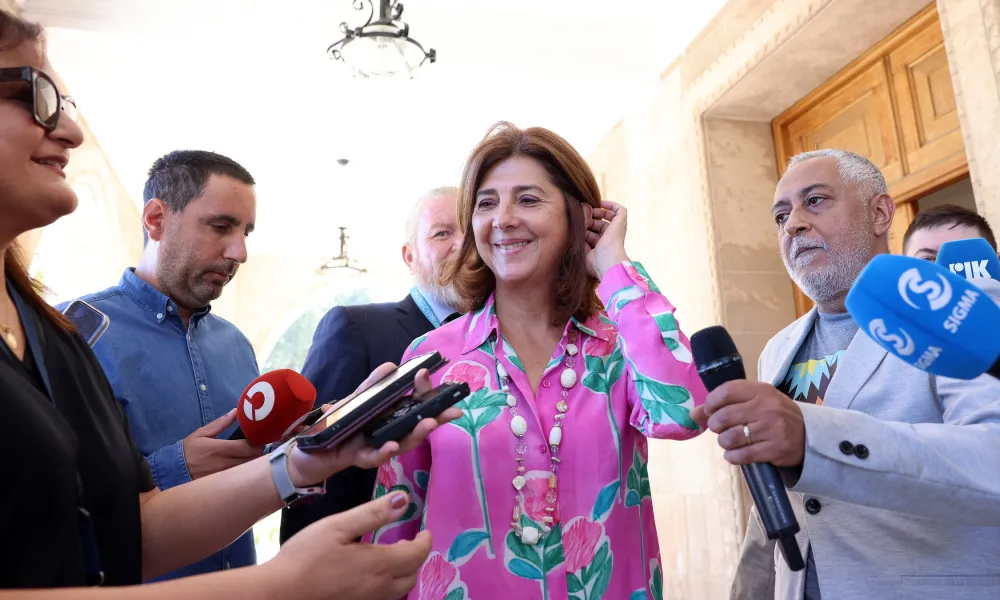
United Nations Secretary-General António Guterres wants any renewed Cyprus negotiations to proceed within a clearly defined, time-bound framework, with agreed rules, accountability and a genuine commitment to reach a final settlement rather than enter another indefinite negotiating cycle, his Personal Envoy for Cyprus María Ángela Holguín has said.
In an extensive interview with ANKA Review on Aug. 7, Holguín provided one of the clearest accounts yet of how the United Nations is preparing for a possible new phase in the Cyprus process, placing particular emphasis on methodology, accumulated negotiating convergences, practical confidence-building measures and the need for the parties to understand both the rules and intended destination of a future negotiation before it formally begins. She confirmed that the UN has been working for months on a document bringing together convergences recorded during previous negotiations and said those understandings should be preserved as a common floor rather than reopened individually.
Holguín also said Guterres was unwilling to convene another expanded meeting involving the two Cypriot sides and the three guarantor powers without sufficient preparation on confidence-building measures, methodology and substance. Defining success in more ambitious terms than merely resuming negotiations, she said: “For me, success means establishing a time-bound political negotiation process with accountability and true commitment to reach the very end, the final agreement.”
Her remarks also carried a warning against the widespread assumption that the absence of an agreement would simply preserve current conditions on the island. “People tend to think that if nothing happens, things will remain as they are now. I have my doubts,” Holguín said, adding: “I believe that division, indifference and distant realities are shaping the future of Cyprus, and not necessarily in the ways most Cypriots would like them to be.”
A framework before negotiations
Asked whether the UN’s approach had evolved after decades of intermittent negotiations and whether Guterres was now seeking to define a clearer endgame rather than embark on another open-ended process, Holguín said the Secretary-General had remained committed throughout his tenure to improving the chances of a Cyprus agreement. “The Secretary General António Guterres, for ten years, has shown diligence and determination to enhance the possibilities for Cypriots to reach an agreement. The search for options has not stopped,” she said.
But she made equally clear that the United Nations could not substitute itself for the two communities in making the political choices required for a settlement. “However, it is for the Cypriots to engage with the proposals and to build their future together,” she said. The experience of earlier rounds, she added, showed the dangers of entering another negotiating process without sufficient structure: “After years of intermittent, open-ended talks, a process without clear sequencing, concrete proposals or accountability risks another failure.”
Holguín said the UN was adapting its own approach to the conditions it had encountered, but argued that the outlook of the Cypriot parties also needed to evolve. “As much as we are adapting to the conditions we have found, in all honesty, what needs to evolve is the Cypriots’ approach related on their understanding of the realities and the mechanisms at their disposal to transform them,” she said.
She said a clearer negotiating structure could make it easier for both sides to enter a future process because they would know the basic rules beforehand and have a better understanding of where negotiations were intended to lead. “I am certain that when the parties see a concrete negotiation framework on the table, including parameters, substance and methodology, and when they have a sense of the final outcome, it will be feasible and easier to enter the negotiation with previously established rules,” Holguín said. “I am deeply convinced that this can be achieved as long as both sides are willing to commit and to start. It is certainly not as difficult as it may appear.”
Substance discussed despite public differences
Although the publicly stated positions of the Turkish Cypriot and Greek Cypriot leaderships remain apart, Holguín said those positions did not necessarily reflect the full content of the discussions she was holding with the two leaders. She said her contacts had revealed a willingness to engage with the principal substantive chapters of a Cyprus settlement.
“At the working level, and in my direct conversations with both leaders, I have identified their willingness to discuss the issues of substance for a solution: governance, property, territory, security, guarantees and EU involvement, all in a way not seen since the end of Crans-Montana,” Holguín said.
She said she had actively encouraged face-to-face contacts between the two leaders and welcomed signs that their discussions were beginning to move towards their broader political objectives. “I have promoted face-to-face meetings between the two leaders; I am glad to see that they have slowly started discussing their main objectives and visions for the future,” she said.
Her consultations had also gone beyond the political leaderships. “I have also listened, over many months, to civil society, business communities and young people on both sides,” Holguín said. “I see a willingness for a settlement that strengthens the sense of security, ends the isolation and the decades-long divide.”
Holguín cautioned against judging the state of the process solely through public statements addressed to domestic audiences. “Rhetoric addressed to domestic audiences is not the same thing as the actual state of the conversation,” she said, while adding that private discussion would not by itself be sufficient. “However, political will is needed to move forward, and to move from talk to action.”
Methodology moves to centre stage
Holguín said the United Nations was not approaching the Cyprus problem as though its substantive elements had never been negotiated. The main chapters of the dispute have been discussed repeatedly over decades and, while the parties did not reach a comprehensive settlement, she said they had accumulated understandings that could provide a basis for a renewed process.
“I have constantly repeated that the status quo does not mean frozen realities on the ground. It is unrealistic to negotiate with the mindset of five or even two decades ago, as if nothing new had happened,” Holguín said. “In past negotiations, the parties addressed all the issues of interest. Although they did not agree, they reached some understandings that could now form a new base to restart negotiations. Therefore, all parties know what the substance is.”
That is why the immediate focus has increasingly shifted towards establishing the framework within which those substantive issues would be negotiated. “Now, we are working in methodology, to allow them to start negotiations with an established framework,” she said.
Holguín told ANKA Review that the Secretary-General did not want to hold another expanded meeting simply for the sake of convening one or without sufficient preparation to give it a realistic prospect of advancing the process. “The Secretary-General has been explicit that he does not want to convene another expanded meeting without adequate preparation on confidence-building, methodology and substance, precisely because a poorly established process is itself a risk,” she said.
The United Nations was therefore seeking to establish the basis of the next stage before bringing all parties together again. “We are proposing a way forward, with clarity and transparency,” Holguín said. She added that the parties would have to engage with determination not only to negotiate but eventually to take the political decisions necessary to complete an agreement: “Now it is crucial for all parties to accept to work together and to engage with determination and intent in finding a solution and, when the time comes, taking the decision to consolidate the agreement.”
UN compiling previous convergences
One of Holguín’s main disclosures concerned the body of negotiating convergences accumulated during earlier rounds and how the UN intends to handle them in a future process. She confirmed that the Good Offices Mission has been compiling a document based on its own records rather than treating every previously narrowed difference as an issue to be negotiated again from the beginning.
“The previous convergences are an asset, not a starting point to be renegotiated line by line,” Holguín said. “Reopening them individually would waste time we do not have and would risk unpicking progress that took years to build. So, the UN’s approach is to preserve them faithfully as the common floor for any future negotiation.”
She nevertheless stressed that the term “convergence” should not be confused with a concluded agreement. “It is important to keep in mind that a convergence does not necessarily mean agreement. Rather, it means that both parties have come closer together in their understanding of some issues,” she said.
Cyprus negotiations have traditionally operated according to the principle that nothing is agreed until everything is agreed, and Holguín said the existing convergences therefore had no independent binding status. “In this context, those convergences do not carry independent, binding weight on their own. Their real political weight is realized only within a comprehensive settlement,” she said.
The UN nevertheless considers them useful as a record of areas where the parties had already narrowed their differences. “During the last few months, we have been working on a convergences document based on UN records that could be useful for a future negotiation,” Holguín said.
Confidence-building measures move beyond symbolism
Holguín also placed considerable emphasis on confidence-building measures, presenting them as more than gestures intended simply to improve the atmosphere between the two communities. She said individual measures could serve as practical tests of whether cooperation works and whether the habits required by a future political arrangement can begin to develop before a comprehensive settlement is reached.
“A crossing point, a technical committee on youth, a child citizenship, a demining project, a renewable-energy initiative in the buffer zone: each of these, beyond its immediate value, tests whether cooperation actually works in practice and builds the behaviors that a future arrangement would depend on,” she said.
Holguín said practical experience was particularly important in overcoming fears surrounding both closer cooperation and a possible settlement. “The only way to defeat fear regarding a situation, including a solution in the case of Cyprus, is to experience and implement the measures that change conditions on the ground; this way, it is possible to realize that they do not negatively impact peoples’ daily lives,” she said.
The UN does not envisage a strict sequence under which confidence-building measures would have to be completed before political negotiations could begin. Instead, Holguín said, the different tracks should progress simultaneously and reinforce one another.
“The Secretary-General message is that all should advance in parallel to unlock the possibility of having a 5+1 meeting,” she said. “UN approach has been to try to advance practical cooperation, confidence-building and political talks in parallel, each reinforcing the others, rather than treating political negotiation in isolation to the daily coexistence between the two sides.”
She was particularly explicit, however, that progress on CBMs was required before Guterres would convene another expanded meeting. “The confidence-building measures are a sine qua non condition to convene an enlarged meeting,” Holguín said, adding: “I believe that any negotiation has the potential to reach a successful outcome when reality of the people on the ground is taken into consideration.”
Agreement in principle, difficulty in implementation
Recent contacts have generated competing claims over whether one side accepted particular confidence-building proposals while the other rejected or qualified them. Holguín declined to describe the discussions in those terms, saying the picture was more complicated.
“I don’t think it’s useful, or accurate, to frame this as one side accepting and the other rejecting,” she said. “My understanding is that on several measures, including some related to crossings and to cooperation in the buffer zone, there was broad conceptual agreement.”
The difficulty, according to Holguín, arose when conceptual agreement had to be translated into concrete steps. “In the case of Cyprus, the challenge has always been the implementation phase because the parties reject the option of giving something first without demanding immediate reciprocity. Future gains are not considered viable and sufficient,” she said.
That approach repeatedly produces stalemate, she said. “Therefore, the result is more stalling, blocking, paralysis, which are repeated over and over again.” Holguín added that she had no intention of conducting the UN effort through public attribution of responsibility: “My style is not to assign blame, although I see that in Cyprus, the question of who to blame is always on the menu. The attribution of blame tends to harden positions rather than resolve problems.”
Her preference, she said, was to concentrate on producing results and ensuring that agreed measures were actually put into effect. “I wish this time, with our renewed efforts, Cypriots will rather be focused on finding a solution and actually implementing it.”
Türkiye-EU ties could benefit Cyprus
Holguín also addressed the potential contribution of the European Union and the relationship between movement in Türkiye-EU relations and the Cyprus process. She was asked specifically about Türkiye’s argument that the EU’s most meaningful immediate contribution would be to implement its April 2004 commitment concerning the Turkish Cypriot community, including through direct trade, direct flights and direct contacts.
Holguín did not take a position on those individual proposals but said progress in relations between Türkiye and the European Union could benefit the Cyprus effort if the current UN initiative succeeded in bringing the parties back into negotiations. “If this new effort by the Secretary-General and myself leads to a positive result and we manage to engage all parties to restart negotiations with concrete settings; any step being taken by Türkiye and the European Union to enhance their already dynamic relations could be beneficial for the Cyprus issue,” she said.
She drew a clear institutional line between the UN-led Cyprus process and decisions concerning relations between Ankara and Brussels. “However, the United Nations will not be involved with this progress. The European Commission and its EU special representative Mr. Raffaele Fitto are fully in charge,” Holguín said.
Holguín was more explicit about the European Union’s role once a comprehensive settlement was achieved, saying European involvement would be essential to implementation, particularly on the Turkish Cypriot side. “Once an agreement is reached, the role of the EU is essential because Turkish Cypriots will need the full commitment of the EU to implement the Acquis Communautaire, which requires technical, political, economic and financial support,” she said.
‘Silent engagement’ across the divide
Holguín said some of the most encouraging signs she had encountered during her mission came not from formal negotiations but from everyday contacts between Turkish and Greek Cypriots. She argued that the Cyprus issue ultimately needed to be viewed through the interests and well-being of the two communities rather than primarily through electoral and political calculations.
“The day we all understand that the Cyprus issue has its true meaning in reference to the well-being of both communities and not in political and electoral spectrums, that day we will advance in our search for solutions,” she said. Holguín added that she had been “positively surprised by the silent engagement at the individual level of members of both communities.”
She cited the work of Greek and Turkish Cypriots in the technical committees as well as the large number of people who cross the divide in their daily lives. “For instance, the work of Greek Cypriots and Turkish Cypriots in the technical committees, the young professionals and workers that patiently use the crossings every day, despite the difficulties, restrictions and delays. These discrete Cypriots are the ones that keep the hope of coexistence alive,” Holguín said.
But she also pointed to widespread indifference and a lack of interest in developments on the other side of the buffer zone. “They are surrounded by a majority trend of indifference and lack of interest of what happens beyond the buffer zone,” she said. Holguín expressed the hope that greater intercommunal contact could gradually narrow that distance and “get Cypriots to recognize their unity, shared aims, aspirations and camaraderie, rather than their differences.”
‘If nothing happens’ does not mean nothing changes
Looking beyond the next possible expanded meeting, Holguín challenged the assumption that failure to resolve the Cyprus issue would simply leave the island in its present condition. “People tend to think that if nothing happens, things will remain as they are now. I have my doubts,” she said.
She said the continuation of division was itself shaping the island’s future. “I believe that division, indifference and distant realities are shaping the future of Cyprus, and not necessarily in the ways most Cypriots would like them to be,” Holguín said.
She also warned that a prolonged inability to resolve the main political challenge facing the island could eventually leave Cypriots confronting outcomes shaped by developments beyond their own control. “But when you lack the capacity to address and resolve the major challenges of your generation, other unexpected forces might take the decisions for you,” she said.
For Holguín, success therefore cannot be defined simply as convening another meeting or announcing the formal resumption of negotiations. “For me, success means establishing a time-bound political negotiation process with accountability and true commitment to reach the very end, the final agreement,” she said.
A choice that cannot be postponed indefinitely
Holguín said both leaders and the two communities would ultimately have to make a clear choice about the island’s political future. “At some point, both leaders and both communities will have to arrive at a moment of genuine strategic clarity, choosing consciously between a negotiated shared future and the uncertain and volatile long-term management of continued division,” she said. “I don’t believe that choice can be indefinitely postponed.”
She also warned that the political and diplomatic conditions surrounding the current initiative were unusual and could not be assumed to re-emerge if the present opportunity were lost. Holguín pointed to the convergence of several factors: a Turkish Cypriot leadership elected on a federal platform, the Secretary-General’s personal engagement, an envoy accepted by all parties, bilateral meetings between the two Cypriot leaders, active involvement by the guarantor powers and the European Union, and support from the Security Council.
“I want to reiterate, and I hope it will not be taken for granted, that the alignment we have right now, with a Turkish Cypriot leadership that ran and won on a federal platform, a Secretary-General personally invested, a personal envoy accepted by all parties, the two Cypriot leaders having bilateral meetings, active engagement from the guarantors and the European Union, and the support of the Security Council, is not something that reassembles easily,” Holguín said.
“I don’t think we should assume this window stays open regardless of what we do with it,” she told ANKA Review.