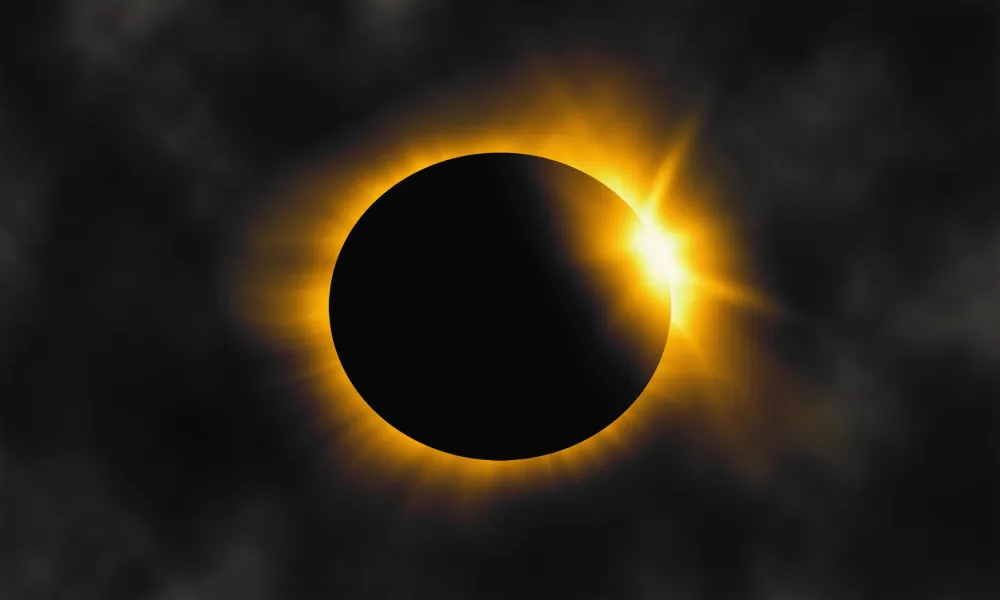

For the first time in more than a century, a total solar eclipse will cross mainland Spain, marking a landmark event for astronomers and skywatchers alike.
Spain's last total solar eclipse visible from the mainland occurred in 1912, just days before the sinking of the Titanic. Some experts argue the last truly complete eclipse spectacle was even earlier, in 1905, because the 1912 event was a hybrid eclipse that provided only a brief period of totality in Spain.
Totality will cross Spain, Iceland and Greenland
On 12 August, the alignment of the Sun, Moon and Earth will plunge parts of the Iberian Peninsula into darkness shortly before sunset. Sections of Greenland and Iceland will also fall within the path of totality.
The Moon's shadow, known as the umbra, will travel roughly 8,260 kilometres in about 90 minutes, mostly over the Atlantic Ocean. The eclipse will begin near the North Pole before moving southwards.
Maximum totality, lasting up to two minutes and 18 seconds, will occur off Iceland's western coast before the event ends over the Mediterranean Sea.
Millions to see a partial eclipse
Hundreds of millions of people outside the path of totality will still be able to observe a partial eclipse.
The event will be visible across much of Europe, West Africa, Canada, Alaska, Siberia and parts of the northern United States.
Observers in Dublin are expected to see around 94% of the Sun covered, while Oslo will experience about 83% coverage. Further west, Montreal will see roughly 18% coverage, compared with 9% in New York and 2% in Norfolk, Virginia.
Experts stress that certified eclipse glasses must be used whenever any part of the Sun remains visible.
Meteor shower and planetary parade on the same day
The eclipse coincides with two other major celestial events.
Before dawn, six planets will form an arc across the sky, while after nightfall the annual Perseid meteor shower is expected to reach its peak under favourable new moon conditions.
The combination is expected to make 12 August one of the most remarkable nights for skywatching in recent years.
Scientists preparing major observation campaigns
The European Space Agency (ESA) will host a live webcast from the Astrophysical Observatory of Javalambre in Spain and organise public events in León.
NASA, the Virtual Telescope Project and other organisations will also provide live coverage.
ESA Director of Science Carole Mundell described the eclipse as more than a scientific phenomenon.
"For me, it's not just a scientific moment. It's not just an incredible alignment of heavenly bodies. It's also a very human moment," she said.
Research balloons to study atmospheric effects
US university research teams will launch more than 60 high-altitude balloons from Spain and Iceland to study atmospheric changes during the eclipse.
The project, funded by NASA, will investigate how temporary darkness and temperature drops affect the atmosphere.
The campaign is ten times larger than the balloon programme carried out during the 2024 total solar eclipse across North America.
Project leader Angela Des Jardins of Montana State University said even a few minutes of darkness can have measurable effects on atmospheric conditions.
More eclipses on the horizon
Spain's run of extraordinary celestial events will continue in the coming years.
On 2 August 2027, southern Spain will experience an exceptionally long total solar eclipse lasting up to six minutes and 23 seconds, one of the longest of the century. The path will continue across Morocco, Algeria, Libya, Egypt, Saudi Arabia, Yemen and Somalia.
A further annular ("ring of fire") eclipse will occur on 26 January 2028, completing a rare three-year sequence of major eclipses visible from Spain.
Source: Euronews