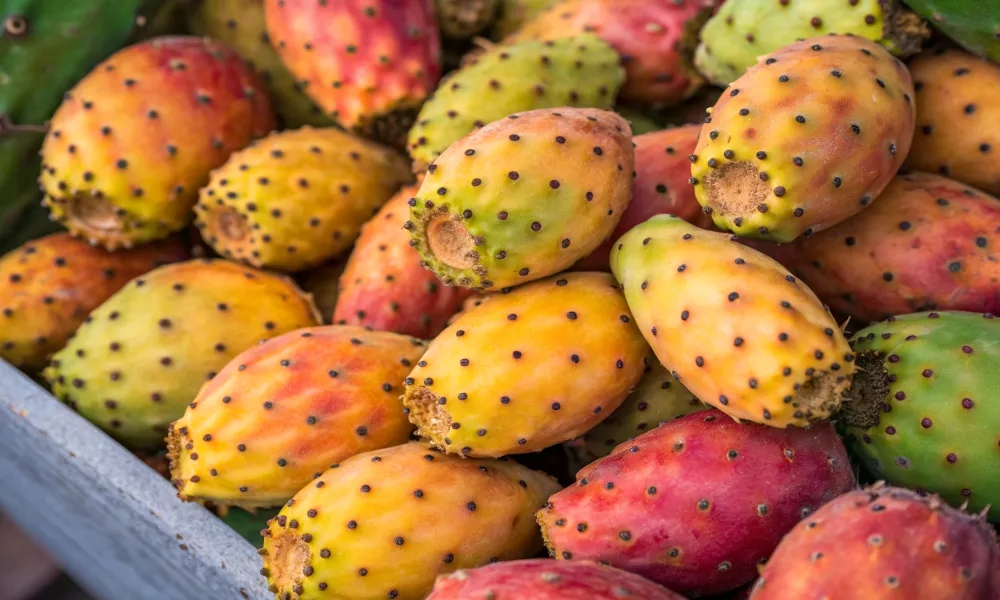

From the familiar yellow Cypriot variety to red, orange and the rarer white types, prickly pears are a well-known feature of the Cypriot countryside.
With their thick skin, almost invisible spines and refreshing seed-filled flesh, prickly pears are among the fruits most closely associated with summer in Cyprus.
For many, the sight of a prickly pear cactus growing beside a field or country road forms part of the island's landscape. Behind its distinctive exterior lies a fruit rich in water, fibre, vitamin C, magnesium and potassium, as well as plant pigments with antioxidant properties.
The prickly pear comes from the Opuntia ficus-indica cactus, a species originating in Mexico that later spread throughout the Mediterranean. In Cyprus, the fruit is most commonly known as papoutsosyko.
Prickly pear varieties in Cyprus
Several types of prickly pear can be found in Cyprus, differing mainly in colour, spines, fruit size and ripening period.
According to a classification attributed to the Department of Agriculture, four main types are recognised, although the names are based on local usage rather than an official varietal classification.
Cypriot or wild: The most widespread type in Cyprus, found both in organised plantations and as isolated plants in the countryside. When ripe, the fruit turns yellow. Both the plant and fruit carry numerous spines. Ripening begins around mid-July.
Red: Distinguished by their deep red colour both externally and in the flesh. They are less common than the Cypriot variety and ripen around the same time.
Orange: Similar to the red varieties, but with a characteristic orange-coloured fruit.
White or spineless: Much rarer in Cyprus. They ripen later, around September, and produce larger, pale greenish-white fruits with fewer seeds.
Ripening periods can vary depending on location, temperature and growing conditions.
More than 87% water
One of the fruit's defining characteristics is its high water content.
According to nutritional data corresponding to USDA figures, 100 grams of raw prickly pear contain around 87.6 grams of water and provide only 41 calories.
The same quantity contains approximately 9.6 grams of carbohydrates and very little fat.
This makes prickly pear a light and refreshing fruit for the warmer months, although it does not replace the need for adequate daily water intake.
A good source of fibre
Every 100 grams of prickly pear contains roughly 3.6 grams of dietary fibre.
Fibre is an important component of a balanced diet, contributing to normal digestive function and helping maintain a feeling of fullness.
Prickly pears also contain numerous small, hard seeds, which are typically consumed together with the flesh.
Magnesium, potassium and calcium
The fruit also stands out for its mineral content.
Per 100 grams, it contains approximately:
- 85 mg of magnesium
- 220 mg of potassium
- 56 mg of calcium
Magnesium plays a role in many body functions, including normal muscle and nervous system function, while potassium is an important electrolyte linked to muscle function and blood pressure regulation as part of a balanced diet.
Contains vitamin C
Prickly pears also provide vitamin C.
Every 100 grams contains approximately 14 mg of vitamin C.
Vitamin C contributes to the normal functioning of the immune system and helps protect cells from oxidative stress.
The colours are not accidental
Of particular scientific interest are the pigments found in prickly pears, especially the red and purple varieties.
These are mainly betalains, natural plant pigments with antioxidant properties.
Research has shown that the amount of these compounds varies depending on the fruit's colour and variety, with some darker-coloured varieties containing higher concentrations of specific betalains and phenolic compounds.
That does not mean prickly pear is a "medicine". Laboratory and clinical studies on bioactive compounds found in Opuntia are interesting, but they do not justify claims that consuming the fruit alone can prevent or treat disease.
Reviews of available studies have highlighted that findings relating to blood sugar and insulin vary considerably depending on which part of the plant and which product is being studied.
Just 41 calories per 100 grams
Compared with many sweet snacks, fresh prickly pear has a relatively low energy density.
Every 100 grams provides approximately:
- 41 calories
- 9.6 grams of carbohydrates
- 0.7 grams of protein
- 0.5 grams of fat
That does not mean it can be consumed without moderation. As with all fruits, portion size matters, particularly for people monitoring their carbohydrate intake.
The difficult part: peeling it
Anyone who has tried to peel prickly pears knows that the biggest challenge is not their taste but the tiny spines covering the skin.
These microscopic spines detach easily and can become embedded in the skin.
For that reason, the fruit should be handled and peeled with great care, ideally avoiding direct contact with bare hands.
After the skin has been removed, consumers should ensure that no spines remain on the fruit before eating it.
From the fridge to spoon sweets
The simplest way to enjoy prickly pears is fresh and well chilled, particularly on very hot summer days.
However, the fruit also has a place in traditional Cypriot cuisine.
It is used in jams and sweets, while official publications on traditional Cypriot desserts include recipes for prickly pear spoon sweet.
Prickly pear can also be used in juices, granitas, sorbets and other preparations, although added sugar can significantly alter the nutritional profile of such products.
A fruit tied to the Cypriot summer
It may require a little more effort to prepare, but the prickly pear remains one of the most characteristic fruits of the Cypriot summer.
With its high water content, fibre, magnesium, potassium and vitamin C, and only about 41 calories per 100 grams, it can easily form part of a balanced diet.
Perhaps it is precisely this contrast, the thorn-covered exterior and the sweet, refreshing flesh inside, that has made the prickly pear one of Cyprus' most recognisable and beloved summer fruits.