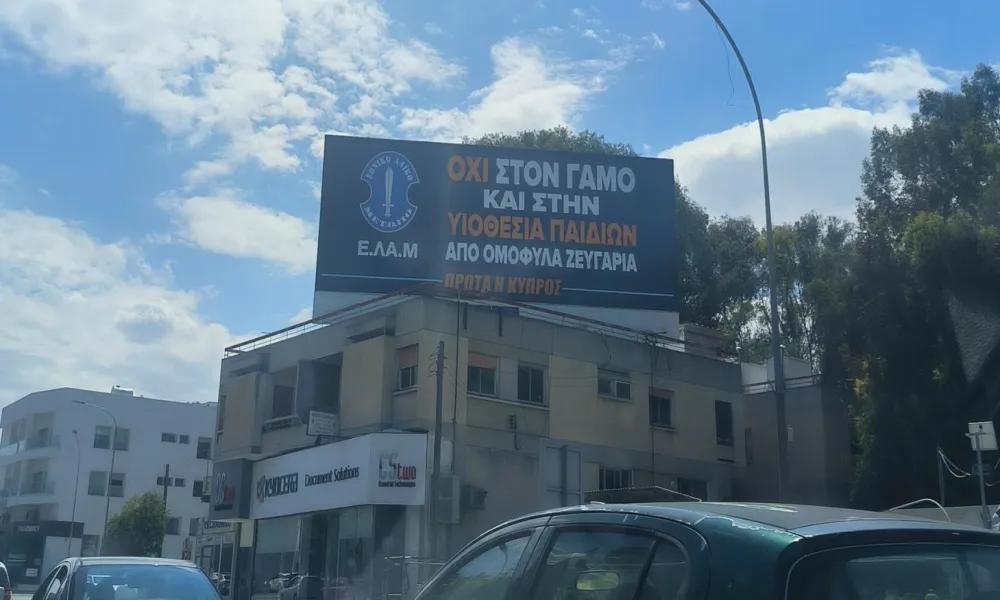

An election billboard erected by Elam in a central area of Strovolos, bearing the slogan "No to marriage and adoption of children by same-sex couples. Cyprus first," has ignited a sharp public debate about the boundaries of political speech, the protection of LGBTQ+ people and what responsibilities local authorities carry when they license campaign advertising.
The billboard, posted ahead of the 24 May parliamentary elections, sits along a route lined with at least six or seven schools, serving children from the age of three to eighteen. Accept LGBTQ+ Cyprus wrote to the Strovolos municipality on 7 May calling for the sign's removal, arguing that its content is incompatible with European Court of Human Rights case law and with the rights of children. The municipality responded the same day, saying the sign is lawfully licensed, meets all technical requirements and does not violate existing legislation, based on legal guidance it had obtained. It added that questions about the content of the advertisement "should concern the competent state institutions, and in no case the municipal authority."
"A vulnerable group is walking past it every day"
On Sigma TV on Friday, Stefanos Evangelides, secretary of Accept Cyprus and a human rights lawyer, set out the organisation's position plainly. The dispute, he said, is not about the political debate on same-sex marriage or adoption as such: it is about a specific billboard in a specific location.
"We know of a family with a four-year-old girl who attends primary school there, whose mothers are lesbians," he said. "We have reports from seventeen-year-old gay students who attend schools in the area and who feel intimidated right now." Evangelides argued that the sign targets and stigmatises members of the community in a space they cannot avoid, and that it sends a message to LGBTQ+ children that they are lesser citizens. He invoked European Court of Human Rights jurisprudence and the Convention on the Rights of the Child in support of Accept's position that the content crosses a legal line when directed at children in this way.
Evangelides also placed the billboard in a broader context he has been documenting for some time. According to data from the EU Agency for Fundamental Rights cited in a Politis article published in April, 48% of LGBTQ+ people in Cyprus reported experiencing discrimination in 2024. He has described an environment in which many people live double lives, afraid to report hate crimes to the police because they do not trust the institutions that are supposed to protect them. "There are people in Cyprus living double lives, who have not come out to their families, who are afraid to go to the police when they are victims of hate crimes," he said in an earlier interview with Politis. "They do not trust. They hide."
Hate speech based on sexual orientation has been criminalised in Cyprus since 2015, with penalties raised in October 2024 to up to five years in prison and a fine of €10,000. According to ILGA-Europe data, not a single conviction has been secured under these provisions to date.
Elam: "We are not negotiating this position"
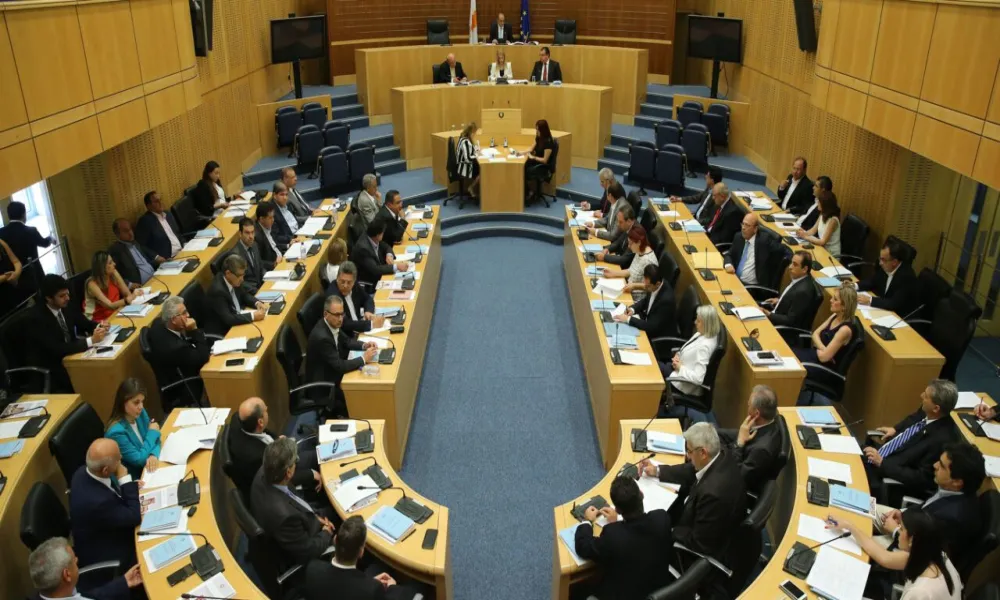
Linos Papayiannis, Elam MP and candidate, appeared alongside Evangelides in the Sigma TV exchange. The billboard, he said, reflects an established and non-negotiable party position, one that predates the election campaign and is grounded in Elam's core principles. He said the party has consistently opposed same-sex marriage and adoption, and that the sign is a straightforward statement of where the party stands on legislation currently before parliament, including a bill proposed by two MPs and a government bill that has not been withdrawn.
Papayiannis rejected the characterisation of the billboard as hate speech, arguing that stating a political position is not the same as expressing hatred toward a group. He also accused Accept Cyprus of double standards, claiming that Elam members and candidates have been targeted by name at public events and that the organisation has not responded to incidents he described as attacks on religious symbols during Pride events. "We express the voice of common sense," he said.
He did not, however, engage directly with the specific argument about the billboard's proximity to schools and its daily visibility to minors who may themselves be LGBTQ+ or who come from same-sex families.
A pattern that predates this election
The billboard controversy does not arise in isolation. Last Holy Saturday, LGBTQ+ pride flags and photographs of political figures were burned at bonfires in several locations across Cyprus. Nobody was charged. The Ministry of Justice subsequently submitted a bill regulating the bonfire tradition that focused on fireworks, timber and permits, with no reference to the hate incidents that had prompted public concern. Only Akel and Volt publicly condemned what had happened.
Elam, which traces its origins to an organisation that operated under the name "Golden Dawn: Cypriot Kernel," took 11.2% in the 2024 European elections and, according to current polling aggregates, is projected to finish third in the May vote. The party's ascent has been steady: from 0.88% in 2013, to 6% in the 2023 presidential election, to its first MEP seat in 2024. It now sits in the European Conservatives and Reformists group alongside Fratelli d'Italia and Vox.
Evangelides, who has tracked this trajectory closely, argues the rise is the product of a specific political failure. "The wrong strategy has been applied for some time at institutional level," he told Politis earlier. "It did not address the general insecurity of our times, or society's concerns, with real solutions. And so we arrived at a generalised anxiety, and minority individuals ended up becoming scapegoats." He draws a direct line between unaddressed economic and social grievances, including the housing crisis, migration pressures and class divisions, and the space that has opened up for far-right narratives targeting vulnerable groups.
The question the municipality passed on
The Strovolos municipality's response, while legally careful, was notable for what it chose not to address. Its statement confirmed that, as a licensing body, it evaluates technical specifications, dimensions and road safety, not content. It described the billboard's subject matter as "a position of a political party that is currently within the public sphere and of public interest," and stated that it "neither adopts nor rejects the positions of political parties." It closed by saying the issues raised "should concern the competent state institutions."
Which state institutions those might be, and whether any of them will act before 24 May, remains an open question.