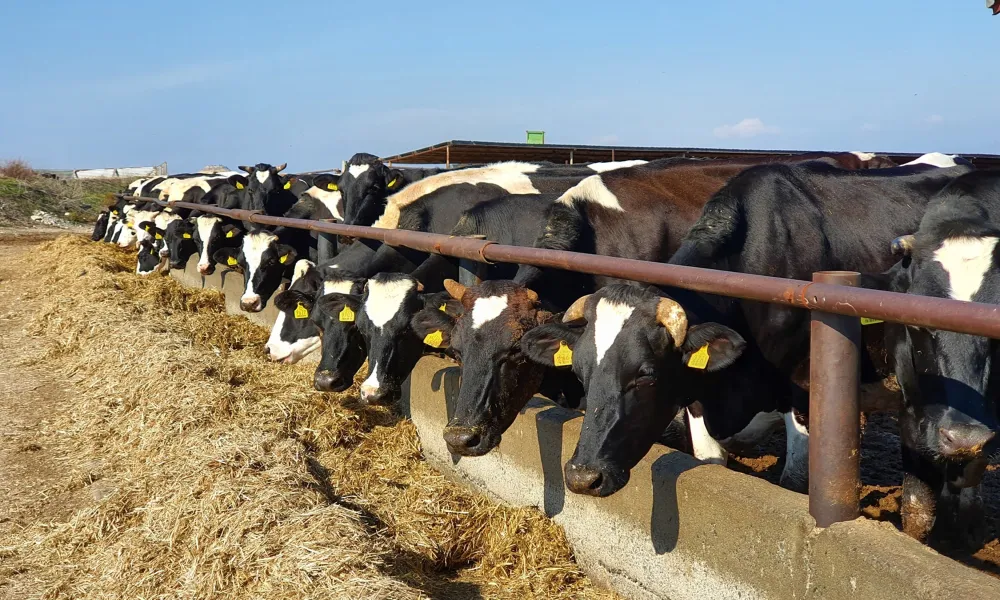

The Veterinary Services place the milestone for the reopening of livestock units affected by foot-and-mouth disease between November and December. By the end of September, department officials will have completed the procedures for destroying potentially infectious materials. This will be followed by the introduction of so-called “sentinel animals” for a period of around 40 days, during which they will be tested twice. If it is established that they have not contracted the disease, and provided that the area where a unit is located is clear of the virus, the Veterinary Services will give the green light for reopening. This means livestock farmers will be able to start purchasing animals from other units that have not been affected by foot-and-mouth disease.
It is essentially at this point that the “next chapter for Cypriot livestock farming” begins to take shape in operational terms. It will be a process of radical change for the sector, involving huge expenditure and bold political decisions. It is based on the study and recommendations of the Scientific Committee for the Reconstruction of Livestock Farming, chaired by Dr Stavros Malas. The recommendations cover a 12-year period and involve costs running into hundreds of millions of euros — far exceeding the total public support provided to the sector between 2014 and 2025, when just €91.5 million was allocated.
Decongestion costs
But how many of the 121 livestock farmers whose animals were compulsorily culled will resume operations before the end of the year? Certainly not all of them, according to one of the two reports submitted by the committee to the Presidential Palace last Thursday, concerning the reactivation of affected livestock units by livestock-farming area and location.
For the government, this is a sensitive issue, as voluntary exit schemes with substantial compensation will be required, along with resistance to external pressure. The report sets out clear siting specifications, including a mandatory minimum distance of 300 metres between the boundaries of independent livestock units, to prevent a recurrence of the rapid, domino-like spread of a virus between adjoining units.
According to the Malas study, 84 of the 121 infected units were located in livestock-farming areas where units were organised side by side. The livestock-farming zones made the problem caused by the presence of foot-and-mouth disease considerably worse.
The issue of decongestion — which, unlike the other measures extending over 12 years, requires an immediate government decision — is expected to be discussed extensively with the stakeholders in the coming days, so that decisions can be finalised following the Malas study.
Based on the Malas study, 360 potential sites on state land within agricultural areas have already been identified, along with 130 potential sites for large units within existing livestock-farming zones.
Prioritisation
Based on the siting criteria in the report, as well as statements currently being made by affected livestock farmers expressing a desire to resume operations, planning will be undertaken to determine who will restart once the “green light” is given, Dimitris Tsalta, head of the Department of Agricultural Sciences at the Cyprus University of Technology and a member of the Epidemiological Team managing the foot-and-mouth outbreak, told Politis.
If no active case of foot-and-mouth disease emerges by November, he explained, some livestock farmers will resume operations on a priority basis because they meet the required distance from other units. Those left behind will need more time before they can resume.
“At the same time, in overcrowded livestock-farming areas, farmers who have until now operated units with small numbers of animals — for example, between five and 50 — will have to merge with others,” he added.
He noted that the new regulations being prepared by the Department of Agriculture on the use of state land could provide a way forward. Such land has until now been made available in livestock-farming zones, partly with the tolerance of the state and partly because the regulations themselves had weaknesses in certain areas.
Without the necessary biosecurity measures being observed, plots allocated for livestock units had, for example, been turned into workshops with five to 10 goats kept in the back yard.
He also said that it appears not all affected livestock farmers are prepared to resume operations. There were many who engaged in livestock farming only occasionally, particularly older people. “So,” he noted, “the culling of their animals because of foot-and-mouth disease was a message to them that they could no longer continue this activity.”
Risk of a resurgence
All the above scenarios for resuming operations before the end of the year, of course, can only be implemented on the condition that no active virus re-emerges in the meantime. Until then, they will remain theoretical.
Dimitris Epaminondas, president of the Cyprus Veterinary Association and a member of the Epidemiological Team managing the foot-and-mouth outbreak, told Politis that a very important issue is ensuring that the virus does not reappear in autumn or winter, when the important “weapons” of sunshine and radiation intensity — which help reduce the spread of the virus — weaken.
“We must be prepared by the end of September,” he stressed, “because that is when temperatures begin to change.”
He said that the reopening of units in November would initially concern isolated areas, such as Pachna in Limassol, or areas with no unaffected units, such as Oroklini. This would be followed by areas that had experienced many recent cases, such as Dromolaxia.
The fact that 60% of units have still not been tested through sampling is very serious and does not currently allow for further easing of the measures, such as unrestricted grazing.
The north
At the same time, Epaminondas noted that the north remains an unpredictable factor in terms of the possible re-emergence of the virus.
The information being provided by the Turkish Cypriot side regarding an improved situation in the north has not changed, he said. “We carried out the first vaccination of the animals, but we were not informed about a booster vaccination,” he observed.
He also expressed concern that, although they had been invited, the Turkish Cypriot representatives did not attend the latest meeting of the Bi-communal Health Committee.
Leonidas Phylaktou, the committee’s co-chair, told Politis that the absence was probably not deliberate, adding that a new meeting would soon be held to allow the two sides to exchange information.
At a parliamentary session last July, MPs asked for an update on the request for EU involvement in tackling the virus in the north, through the uniform application of European protocols across the island. At the time, the Ministry of Agriculture said coordinated efforts were under way, through contacts with EU officials in Cyprus and Brussels, to exert the necessary pressure on the north.
The Green Line
A key factor in preventing the virus from entering from the north is also closing the surveillance gaps along the Green Line in order to combat smuggling.
“It is important that surveillance is carried out properly,” Epaminondas said.
Agriculture Minister Christos Senekis and Justice Minister Costas Fytiris recently held a meeting on the issue.
At this point, it is worth noting that findings by the Malas Scientific Team link the absence to date of a strategy for the meat industry with the arrival of foot-and-mouth disease.
The failure to properly develop the meat-production chain led to the emergence of a huge informal economy involving the north, with animals being moved and traded for meat consumption.
Given that livestock farming has so far been geared exclusively towards halloumi production, farmers had to find ways of disposing of surplus meat. The result was that they channelled it through illegal processes into the areas under Turkish Cypriot control.
Vaccinations
Progress with vaccinations has also made a significant contribution to the reopening of livestock units, according to Epaminondas.
He said the second dose is expected to be completed by the end of September. Coverage has exceeded 95% of the animal population.
The remaining 5% concerns around 350 units, mainly involving people who have refused vaccination, most of them in Paphos. Tsalta estimates that “the gap is closing”. It is only a matter of time before they are persuaded, he added.
“The fortunate thing,” Epaminondas said, “is that these units, which are very small — five to 15 animals — represent, collectively, a very small proportion of Cyprus’s animal population. Unfortunately, however, they are delaying the completion of the vaccination programme.”
Following the second vaccine dose, the so-called “booster dose” will begin for animals that have received the two initial doses.
The two reports submitted by the committee to the Presidential Palace last Thursday include radical changes, such as relocating livestock units, shifting towards the meat industry and focusing on animals that are more productive and more resilient to Cyprus’s hot climate.
Replenishment from within Cyprus
Alongside approval for reopening and the relocation of units, another issue requiring an immediate state decision — on which the government will soon be expected to provide clear direction — concerns the replacement of animals for units that reopen, as well as the replenishment of the entire livestock population lost over the coming years.
It is recalled that since 20 February, when the first case was detected, foot-and-mouth disease has dealt a heavy blow to the livestock sector and the economy.
Specifically, 52,632 infected sheep and goats were culled, representing 11.5% of the total population; 24,483 pigs, or 7.8%; and 3,018 cattle, or 3.5%.
A separate study led by Malas and submitted to the Presidential Palace recommends — and explains why it is feasible — replenishing the livestock population exclusively from the domestic market, with an emphasis on local breeds, which, among other things, are adapted to Cyprus’s hot climatic conditions.
According to Malas, a programme for the productive replacement of animals should begin next year, using modern breeding methods and advanced genetic analysis.
He believes the solution is not to import more productive animals from abroad, as the number that could be imported would be limited and would not be expected to make a significant difference.
Tsalta pointed out that it will take several years for animal numbers to return to their pre-crisis levels.
“Researchers and producers will have to work for several years, with a focus on animals that are more productive and more resistant to diseases and Cyprus’s climate, if Dr Malas’s proposal is implemented,” he said.
Regarding imports, he noted that there is not much availability abroad and that delays are likely.
Imports subject to conditions
However, according to Epaminondas, the state cannot halt trade and prohibit livestock farmers who wish to do so from bringing animals in from abroad.
He stressed that any imports should come from countries with an equivalent animal-disease status to Cyprus, so as to avoid introducing new diseases, as well as diseases from which Cyprus has managed to eradicate itself through years of hard work.
Every order, he stressed, will certainly be subject to approval by the Veterinary Services.
Easing of measures
Another issue requiring an immediate decision, which is not linked to the findings of the Malas Committee but to the epidemiological situation, concerns the easing of foot-and-mouth disease measures.
Livestock farmers are calling for unrestricted grazing to be allowed. One of the arguments put forward by those opposed to the current restrictions is that animal deaths have increased because of confinement.
The reactions are understandable, Epaminondas said, but he stressed that the fact that 60% of units have still not been tested through sampling is very serious and does not currently allow for further easing of the measures.
In his assessment, the Epidemiological Team will hold another discussion before next winter to determine whether further restrictions can be lifted.
The next status Cyprus hopes to obtain is that of a “foot-and-mouth disease-free country where vaccination is practised”.
According to the Epidemiological Team, vaccination of animals against foot-and-mouth disease will continue for several years — certainly throughout 2027 and 2028.
The meat export ban and international sanctions
Until Cyprus manages to secure an easing of the trade sanctions imposed on it, specifically regarding pork exports, it will need to regain its status as a “foot-and-mouth disease-free country”.
According to Epaminondas, however, this will take many years.
Both scientists noted that the ban on pork exports does not appear to be a major concern for the state and producers, because exports accounted for a relatively small share of turnover — around 15% — and producers mainly exported for reasons of market-price stability.
Moreover, they noted, there are markets in third countries, mainly in Africa and the Middle East, that accept meat imports from countries that are not free of foot-and-mouth disease.
This year, the state compensated pig farmers for surplus pork that they were unable to sell abroad, asking producers in the coming years to ensure that such surpluses do not arise through the regulation of births.
Fortunately for Cyprus, halloumi exports have not been affected because of the technology used in its production. The triple heat-treatment process is capable of destroying the virus.
The next status Cyprus hopes to obtain is that of a “foot-and-mouth disease-free country where vaccination is practised”.
However, as Epaminondas stressed, this status is recognised only by the World Organisation for Animal Health and not by the European Union. Under the EU’s strict legislation, a country can only be classified as either free of the disease without vaccination or infected.
Animal vaccination against foot-and-mouth disease will continue for several years, according to Tsalta. Certainly in 2027 and 2028, he said.
He added that, to continue the vaccination programme, the Veterinary Services are preparing a proposal which Agriculture Minister will submit to the Council of Ministers in due course, seeking continued provision of the vaccine and state support for the programme.
When Cyprus wishes to move to “foot-and-mouth disease-free country” status, all vaccinated animals will have to have been sent for slaughter for meat consumption, meaning their production cycle will have to be completed.
There is, however, another possibility, according to Tsalta: Cyprus may choose to remain under the status of a “foot-and-mouth disease-free country where vaccination is practised”, given that it does not export meat.