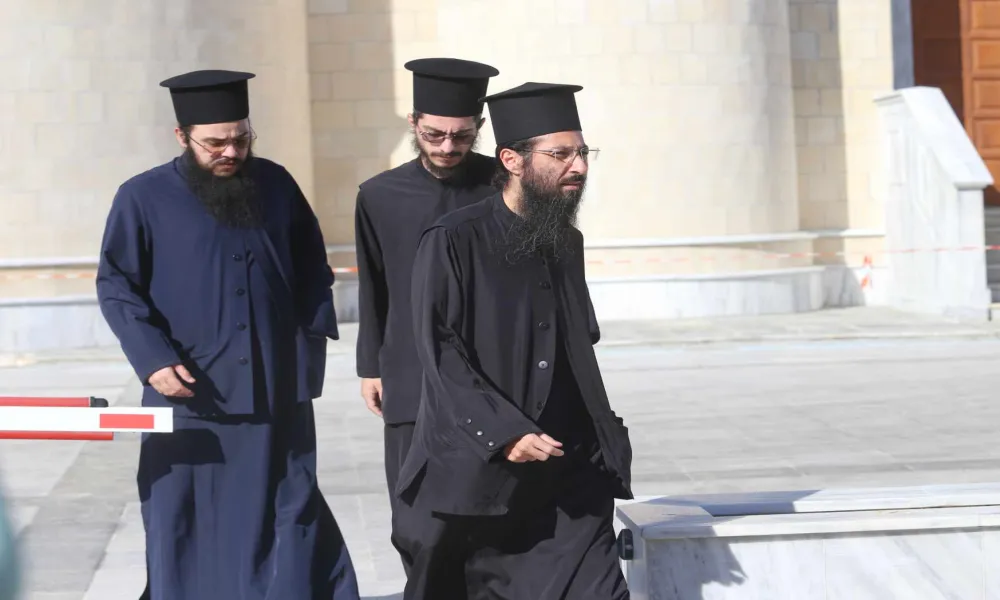

A former monk has told the Nicosia Criminal Court that he and other monks at the Osios Avvakoum Monastery were subjected to exhausting working conditions, restricted contact with their families and what he described as a system designed to enforce “blind obedience”.
Giving evidence for the prosecution on Wednesday, the witness described his time in the monastery, his daily work in its confectionery workshop and the spiritual guidance he said he received from abbot Nektarios.
The witness joined the monastery as a novice monk in March 2022, after interrupting hisstudies in physical education to pursue monastic life.
He told the court that from his first day, Nektarios, who was then a novice monk himself,made it clear that he should not have a mobile phone.
According to his testimony, he was required to ask for “blessing” before contacting his family and could only use another monk’s telephone.
He said contact with his family was generally limited to once a week.
'Demanding conditions'
The witness told the court that there was no fixed daily routine at the monastery involving regular Divine Liturgies, vespers, designated periods for personal prayer or rest.
He said there had initially been an attempt to hold vespers and matins every day for about a month, but that the services were generally attended only by himself and Fathers Timotheos and Isaiah.
Much of his evidence focused on the monastery’s confectionery workshop, where he worked from the time he joined the brotherhood until he left on 5 March 2024.
He said the workshop was initially located in the house where the monks lived inFterikoudi before being moved to Askas as production increased.
According to the witness, the monks regularly worked long hours, particularly aroundChristmas, Easter and the feast of Saint Avvakoum, as well as when they transported theCross of Saint Porphyrios and relics of saints to other parishes.
“Many times we worked non-stop from one morning until the next,” he told the court, according to his testimony.
He said that after working through the night, the monks did not necessarily return to the monastery to rest, but continued with cleaning duties and the collection and delivery of orders.
The witness also described difficult conditions inside the workshop, alleging extreme cold in winter and unbearable heat in summer, as well as the presence of mice.
He claimed that exhaustion sometimes left monks sleeping on chairs or on the floor. During the summer, he said, some slept on top of a freezer in an attempt to cool down.
Witness says three monks collapsed in workshop
The court heard that the witness, Father Porphyrios and Father Timotheos had all collapsed while working in the workshop.
According to his evidence, the incident occurred around midnight after they had been working continuously.
He said Father Porphyrios was the first to lose consciousness. As the other two attempted to revive him, they also collapsed.
The witness said Nektarios subsequently found the three men unconscious on the floor outside the workshop and took them to hospital, where they were given oxygen.
He further alleged that a gas leak was later discovered in one of the ovens and said themonks would often work while experiencing dizziness and a feeling that they were about to faint.
He also told the court that he himself had collapsed on the morning of Nektarios’s enthronement on 11 December 2022, which he attributed to exhaustion frompreparations and confectionery production.
Allegations of insults and obedience
The witness alleged that both Father Porphyrios and Father Nektarios shouted at the monks when mistakes were made at work.
He said he had heard them use terms including “useless” and “idiot”, as well as the phrase “I regret making you a monk”.
Despite recognising that he was working excessively, the witness said he did not complain because he believed that, as a monk, he was required to obey his spiritualelder.
He also made allegations concerning his confessions with Father Nektarios.
Claim that abbot pretended to be Saint Porphyrios
The witness alleged that during most of his confessions, Nektarios would change hisvoice while reciting the prayer of absolution and pretend, according to the witness, to beSaint Porphyrios.
The alleged “saint” would tell him to obey his spiritual elder, Father Nektarios, because he was a “holy man”, the witness said.
According to his testimony, Nektarios would then fall back into his chair and pretend tohave fainted. When he appeared to recover, he would act as though he did not remember what had happened.
The witness said he was told: “My son, these things are of God and you do not tell anyone.”
He said he initially believed the experiences were genuine and recorded them in a personal diary, including dates and the words he believed had been spoken to him by Saint Porphyrios.
“I now understand that all these things were lies,” the witness told the court, accordingto his evidence.
He claimed that, in his view, the purpose was to make Nektarios appear “holy” in his eyes and create a relationship of “blind obedience”.
The 'miraculous cross'
The witness also gave evidence about a wooden cross associated with Saint Porphyrios, which he said belonged to Nektarios and was kept in a metal case.
He said the cross was used by priests to bless or cross members of the public and that, on some occasions, it appeared to stick to their clothes or heads.
The witness said he initially believed this was a miracle.
According to his evidence, Nektarios told members of the public that the priest using the cross had previously gone three days without food or water.
The witness said, however, that he had never seen any of the monastery’s monks goeven one day without eating or drinking.
He said that on every occasion when he had personally used the cross, he had eaten the previous day.
The witness also said the cross “always smelled of myrrh” and that on some occasions he saw it apparently producing myrrh.
He told the court that he had never seen anyone place myrrh on the cross and therefore initially believed the phenomenon to be miraculous.
When he asked Nektarios why the cross appeared to stick to some people, the witness said he was told this could indicate that the person had a problem which the cross haddetected, that the problem had been healed, or that the cross was providing spiritual strength.
Questions over salary payments
The witness also gave evidence concerning his salary.
He said he had recently been informed by an accountant at the Holy Metropolis ofTamasos that documents held by the Central Ecclesiastical Fund contained a bank account designated for the payment of his salary as a member of the clergy.
According to his testimony, the documents and signatures contained in them were not his.
He further claimed that a review by the accounts department indicated that, from thetime of his ordination until the date in question, his salary had been paid into an account which, he was told, was held by Abbot Nektarios, Archimandrite Porphyrios and Hieromonk Avvakoum.
The witness said he was “shocked and disappointed”, as he had believed, based on information given to him by his father, that his salary was being used for charitable workand the needs of the monastery.
Asked by the prosecution whether he knew of other monasteries where services were held every day, the witness said he did.
He told the court that other monasteries held daily services “day and night”, while at Osios Avvakoum, he alleged, work in the workshop effectively became the monks’ first, second and third duties.
Ongoing trial
The hearing is due to continue on 14 September 2026 at 9.30am.
The case concerns monks Nektarios and Porphyrios, who face, among other charges, conspiracy to defraud, forgery and use of forged documents, theft by an agent, unlawful possession of property, money laundering, interference with judicial proceedings and filing a false tax return.
Both defendants deny any involvement and have pleaded not guilty to all charges against them. They remain free under the same restrictive conditions.