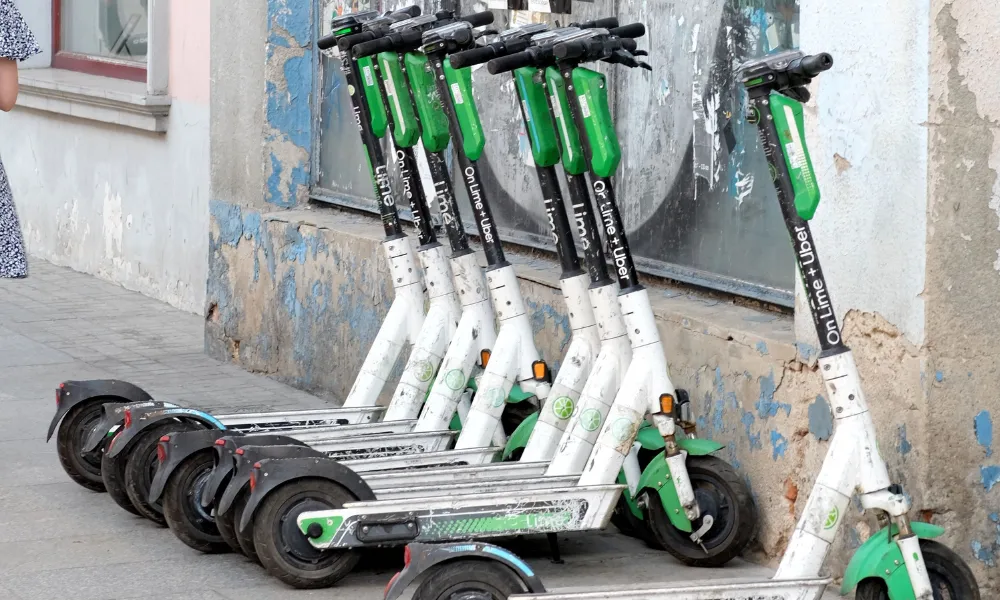

Cyprus MPs and government officials have raised concerns over the growing use of personal mobility devices, including e-scooters, and electric bicycles.
Police recorded 5,141 citations during the first eight months of 2026, while e-scooter collisions had resulted in two deaths and seven injuries by the end of July. Measures under consideration include impounding devices, introducing registration and insurance requirements, and improving infrastructure.
Citations rise sharply
Police figures presented to the House Transport Committee on Thursday showed a steep increase in citations involving e-scooter and electric bicycle users over the past three years. Most concerned the use of devices in areas where they are not permitted.
The number rose from 2,499 in 2024 to 2,766 in 2025, before reaching 5,141 between January and August 2026.
Two injuries, one of them serious, were recorded in 2024. The following year, 15 people were injured, including six seriously. By the end of July 2026, four serious injuries, three minor injuries and two deaths had been recorded. Both fatalities occurred in Limassol.
Most incidents were reported in Limassol, followed by Larnaca. Most of those injured were aged between 25 and 39, while five were under the age of 18.
Police point to missing infrastructure
A police representative told the committee that the problem would be better addressed by providing appropriate areas for the devices rather than creating a registration system.
Where a cycle lane ends abruptly, users should be directed towards alternative routes, the representative said, stressing the need for cooperation with local authorities.
Afroditi Kofterou, First Administrative Officer at the Transport Ministry, also called for better enforcement of the existing legislation. Police said they were prepared to strengthen enforcement, although trade union representatives cautioned against placing the entire burden on the force.
Registration, insurance and impoundment
Kofterou said the ministry was prepared to support amendments to the legislation. She added that the minister intended to examine whether the devices should be registered and insured, although the costs and benefits would first have to be assessed.
A proposed order allowing devices to be impounded when the law is breached has been under consultation since 26 August. Kofterou said further steps would be decided if the order is introduced.
Representing the Justice Ministry, Filippos Theodorou argued that authorities should allow time to assess whether the order is effective before evaluating the wider enforcement of the legislation. He said registration and insurance would offer limited practical benefit.
Michalis Sokratous, director of the Union of Cyprus Municipalities, expressed reservations about the order. He said it would be extremely difficult for municipalities to assume responsibility for impounding devices. Municipal traffic wardens are also unable to verify riders’ identities because users are not required to provide their details to municipal authorities.
Nikos Loizides, chair of the police branch of the Isotita trade union, took the opposite view. He argued that effective checks would only be possible if the devices were registered and insured. Otherwise, he said, their use should be prohibited.
Concerns over devices reaching 80 km/h
MPs and a representative of the Cyprus Chamber of Commerce and Industry also called for tighter controls on imports, warning that some devices can reach speeds of up to 80 km/h.
CCCI senior officer Zacharias Manitaras referred to a particular e-scooter brand that he said was being purchased by minors, including his 13-year-old son. The devices can reach 80 km/h, he said, arguing that their import should be prohibited.
Manitaras also endorsed the positions put forward by representatives of the Cyprus Employers and Industrialists Federation.
OEB representative Alexandros Papadopoulos said the state bore responsibility for the lack of appropriate infrastructure. When the legislation was adopted four years ago, he said, the transport minister at the time had given assurances that the necessary infrastructure was already in place.
Papadopoulos also called for a distinction between devices intended for private and public use. Zenonas Santis, representing Bolt, supported that position and said Bolt was the only licensed company providing e-scooter rental services in Nicosia.
MPs divided over possible ban
House Transport Committee chair and ELAM MP Sotiris Ioannou said the committee would await the implementation of the impoundment order before continuing its discussion in October.
Speaking after the meeting, Ioannou said municipalities had declared themselves unable to implement the order, while police were being asked to take on the responsibility despite their already extensive duties. He questioned whether either side would be able to respond effectively and asked who would bear responsibility in the event of another accident.
Ioannou said he was prepared to consider “more drastic measures” to tackle what he described as “lawlessness”.
DISY MP Charalambos Pazaros said he did not support abolishing or prohibiting the devices. He instead called for suitable infrastructure, proper enforcement and effective monitoring. He described the impoundment order as a step in the right direction, expressed support for legislative amendments and called for greater involvement by local authorities.
AKEL MP Valentinos Fakontis stressed the importance of the devices as an alternative form of transport but said inadequate supervision and enforcement were creating problems.
“The lack of appropriate infrastructure, the circulation of devices exceeding the permitted speed limit, in some cases reaching 60 km/h, indiscriminate parking and riding without the required markings and protective helmets create serious safety concerns,” he said.
Fakontis called for effective enforcement of the legal framework to protect public and road safety.
ELAM MP Andreas Papacharalambous said the devices should be prohibited on safety grounds until appropriate infrastructure is available.
DIKO MP Chrysanthos Savvides raised concerns over both the lack of infrastructure and difficulties enforcing the law. He called for a registration system and tighter import controls.
Savvides also announced that he would submit a legislative proposal establishing parental responsibility when minors use such devices and allowing the criminal prosecution of riders aged 15 and 16.
ALMA MP Irene Charalambides rejected a ban, arguing that the underlying problems were Cyprus’ road network and the lack of cycle lanes.
Direct Democracy MP Demetris Souglis called for stricter legislation and more systematic enforcement. He also proposed examining whether the use of the devices should be prohibited.
Source: CNA