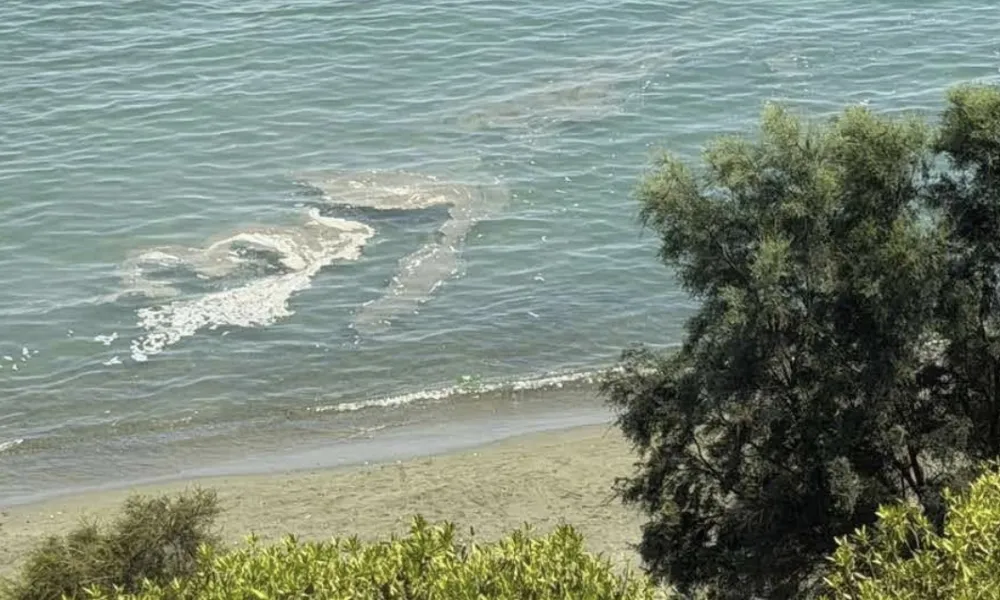

After days of revelations about marine pollution incidents and mounting pressure following new findings, Cyprus' Department of Environment has acknowledged that water samples collected in Limassol Bay showed elevated microbiological levels following the discharge of partially treated wastewater from the Limassol District Local Government Organisation's treatment plant at Moni.
The discharge occurred after a malfunction at the urban wastewater treatment facility in Moni.
The malfunction was confirmed by Limassol District Local Government Organisation Chairman Yiannis Tsolloftas, who insisted the incident involved a limited discharge and was unrelated to other pollution concerns. He repeatedly stated that Limassol's coastal waters remain of "excellent quality".
Meanwhile, the Department of Environment is continuing its investigation into a drainage pipeline that discharges into the sea near Dasoudi beach, about 100 metres from the shoreline. Officials are seeking to establish what was licensed, why it was licensed and how the project was implemented in practice. In the meantime, the pipeline appears to have been relocated to deeper waters, further away from swimmers.
Department issues statement
Following two days of public scrutiny and 10 days after the incident itself, the Department of Environment issued a statement acknowledging that "elevated microbiological load was detected only in samples taken near the Moni Station area".
The statement added that the affected samples were collected from areas "far from the five bathing water sites, where sampling results did not identify any microbiological contamination".
According to the department, it immediately investigated the incident, carried out additional inspections and implemented measures under water pollution control legislation.
In cooperation with the Department of Fisheries and Marine Research and the Health Ministry's health services, emergency sampling was conducted both in the Moni area and at five neighbouring bathing water sites: Kalymnos, Governor's Beach, Agios Georgios Alamanou, Aoratoi and Panagies.
"Overall, regarding the quality of bathing waters in the area, the results of both the emergency and routine sampling indicate that it was not affected and continues to be classified as excellent," the statement said.
The department also noted that an intensified water monitoring programme is being implemented in Limassol, Famagusta and Larnaca during 2026, exceeding the minimum legal requirements, with results published regularly on its website.
Tsolloftas rejects wider pollution claims
Tsolloftas strongly rejected suggestions that Limassol's sea is facing widespread pollution, arguing that official data show the waters remain suitable for swimming.
Speaking to Politis radio, he said: "The waters in Limassol Bay are of excellent quality, suitable for swimming and particularly clean."
He described as "completely wrong and damaging to claim that there is a widespread pollution problem in Limassol's sea", adding that "the picture we have from the continuous measurements of the Department of Environment and the State General Laboratory is clear".
Admission over moni discharge
Tsolloftas also addressed the malfunction at the Moni wastewater treatment plant, which occurred several weeks ago.
He acknowledged that "there was a discharge of secondary treated water" due to a specific technical failure.
"There is no way for untreated sewage from the Moni plant to end up in the sea," he said, clarifying that the discharge involved water that had undergone secondary treatment.
According to Tsolloftas, "the issue has largely been resolved and is being closely monitored by all competent authorities".
He added that water samples were taken from all bathing beaches in the area on the same day and that "no problem whatsoever was identified".
Referring to video footage published by Politis showing a pipeline discharging into the sea, Tsolloftas said it likely related to drainage from a construction project.
Such discharges are licensed by the Department of Environment and, "from what I know", normally require a pipeline extending about 500 metres into the sea.
"If, in this specific case, the licence conditions are not being followed, then there may be a violation of the terms and this should be investigated by the competent authorities," he said.
Mayors voice concern
The mayors of Limassol and Amathounta called for immediate and substantive state intervention over pollution incidents affecting Limassol's coastline, expressing frustration that despite meetings and inspections, clear answers remain elusive and the source of the problems is still largely unknown.
Limassol Mayor Yiannis Armeftis described the ongoing situation as deeply concerning and said that "the continuation of this situation can no longer be tolerated".
He said the issue could not be addressed in a fragmented manner because multiple agencies and organisations were involved, and coordination needed to move to a more effective operational level.
Armeftis renewed his proposal for a dedicated response unit equipped with personnel, drones, technology and monitoring equipment capable of quickly identifying pollution sources and assigning responsibility.
Amathounta Mayor Kyriakos Xydias also expressed dissatisfaction with the outcomes of a meeting held on Thursday, stating: "I was not satisfied with what I heard."
While welcoming the adoption of an action plan, he added that "it will be judged by its implementation".
Xydias also raised concerns about the drainage pipeline discharging near Dasoudi.
According to the mayor, the project has been licensed by the Department of Environment, but instead of directing water offshore, the pipeline runs eastward towards Dasoudi for about one kilometre.
"That needs an explanation," he said.
The two mayors called on the state to take a more active role, coordinate the relevant authorities and move beyond meetings and assessments towards concrete action to identify pollution sources and address the problem.
Citizen complaints
Deputy Shipping Ministry Director-General Theodoulos Mesimeris said incidents reported along Limassol's coastline should be assessed on the basis of factual evidence and the findings of ongoing investigations.
Speaking to Politis radio, he also addressed the drainage pipeline at the centre of the controversy, stressing that the project had been licensed.
"Let us clarify that this is not an admission but a fact. A permit has been issued for this specific project by the Department of Environment under specific conditions," he said.
Whether those conditions are being complied with remains under investigation by the Department of Environment, he added, stressing that the discharge involves drainage water rather than waste.
Mesimeris said the Deputy Shipping Ministry has a coordinating role rather than acting as a licensing or enforcement authority.
"We have received quite a few complaints from citizens," he said, noting that some incidents were small in scale while others could be linked to land-based facilities or illegal discharges.
He added that an action plan is being implemented and that forthcoming legislation is expected to grant the ministry authority to issue administrative fines.
"The objective is not only to impose penalties but primarily prevention and monitoring," he said.