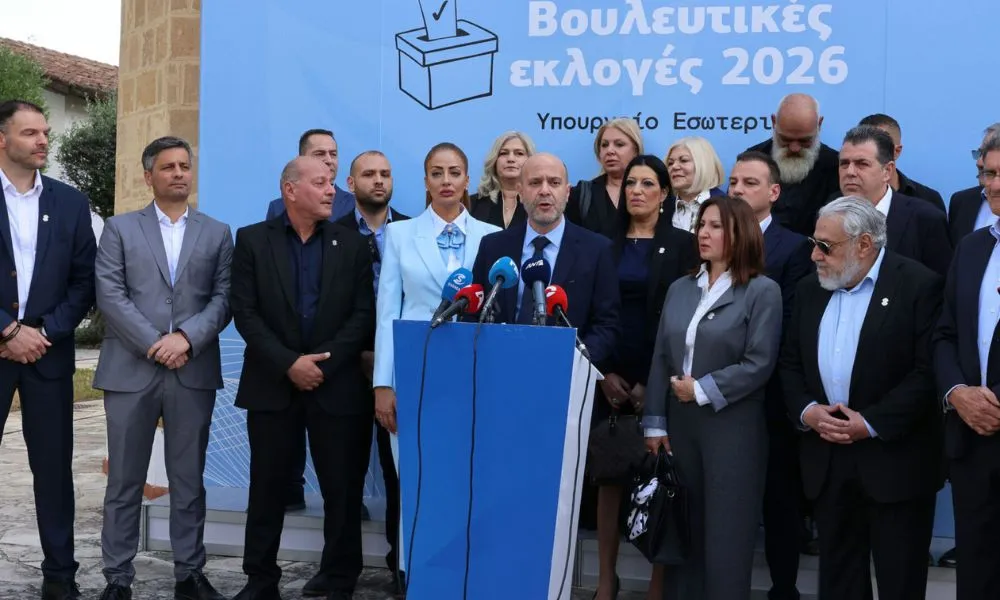
One week before the parliamentary elections in Cyprus on 24 May, President Nikos Christodoulides is watching the polls as he charts his course towards the 2028 presidential race. The surveys do not favour his re‑election plans. DIKO, the main party aligned with him, is losing ground, while his other partners – EDEK, DIPA and the Greens – risk being pushed out of parliament, with the exception of far‑right ELAM.
The stagnation of the traditional parties of the right (DISY) and the left (AKEL) at around 20% does not work in Christodoulides’ favour. After the parliamentary elections, both parties may be forced out of political inertia and could consider fielding their own presidential candidates if they wish to remain relevant as parties of power.
'One man show'
The era of non‑existent opposition is coming to an end. Christodoulides will no longer be able to deliver a daily 'one man show.' He will have to answer for weak domestic governance (65%), widespread public dissatisfaction (68%), unfulfilled promises on key issues (75%) and the perception that the country is heading in the wrong direction (80%). Turning deep grey into white will not be easy.
Although clearly unsettled, Christodoulides presents himself as detached. “The people’s problems have no ideological colour,” he said on 10 May, before unexpectedly bringing the long‑neglected Cyprus issue back into focus. In an interview on Alpha TV on 12 May, he stated that “by the end of 2026 we may be close to developments that could lead to a comprehensive settlement plan…”
Developments?
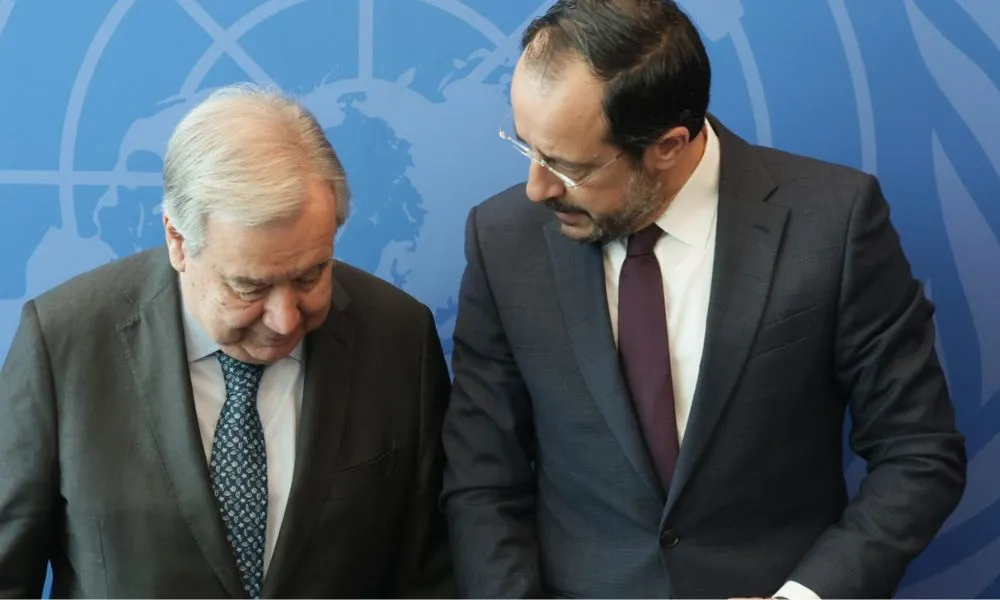
The scenario was not convincing. There is no such indication from UN Secretary‑General António Guterres, whom Christodoulides claims has “launched an initiative”, is conducting “back‑channel discussions” and has even received a “green light” from President Erdogan.
Christodoulides, however, insists that “we may be called upon to take difficult decisions…”
History suggests that references to developments in the Cyprus issue have been used by Cypriot presidents not to prepare public opinion, but to manage it. The most familiar pattern has been the promise of a solution in the next presidential term. That is how 52 years have passed.
Christodoulides appears to be constructing a narrative of developments regardless of whether they are supported by facts, at a time when the island faces multiple deadlocks. The only clear conclusion is that, first as a close aide to former president Nicos Anastasiades and now as president, he has spent a decade during Guterres’ tenure weakening the negotiating framework in order to maintain the current status quo – a conclusion drawn consistently from UN reports.
Darkness
Christodoulides has limited access even for political leaders and senior diplomats to the details of his approach to the Cyprus issue. He now claims that “back‑channel discussions” could lead to a settlement plan, while keeping the public in the dark and maintaining divisive rhetoric. Not a single crossing point has been opened to facilitate contact between ordinary people.
At the Presidential Palace, decisions appear to be taken within a small circle of trusted associates, with “solution scenarios” selectively leaked to supportive media outlets.
Over the past decade, Guterres sent one special adviser (Espen Barth Eide), two personal envoys (Jane Holl Lute and María Ángela Holguín) and three UN representatives stationed in Cyprus (Elizabeth Spehar, Colin Stewart and Colin Stewart’s predecessor). None has been able to determine clearly what Christodoulides seeks in order to reach a strategic agreement “from where Crans‑Montana left off.”
Guterres has reportedly been critical of the way Christodoulides manages public opinion and directs the media. In a letter dated 4 March, three UN experts accused him of divisive policies on issues such as peace education. Meanwhile, European Commission proposals for meaningful bicommunal cooperation and initiatives to bring the Turkish Cypriot community closer to the EU have remained frozen since 2017.
Linkages
In his Alpha TV interview, Christodoulides claimed that Erdogan had given a “green light” to Guterres. He suggested that resolving the Cyprus issue is linked to broader geopolitical developments and EU–Turkey relations.
However, he has provided no clear evidence of effectively using such linkages. While geopolitical dynamics in Europe are shifting rapidly and Turkey is strengthening its relations with major EU states and the UK, the Cyprus issue remains stalled, and Greek‑Turkish dialogue is faltering.
Cyprus and Greece continue to rely on their institutional position within the EU, often for tactical reasons rather than strategic planning. There appears to be no coherent long‑term approach to resolving key issues such as the Cyprus problem or maritime zones, while alignment with external regional dynamics has further complicated the island’s position.