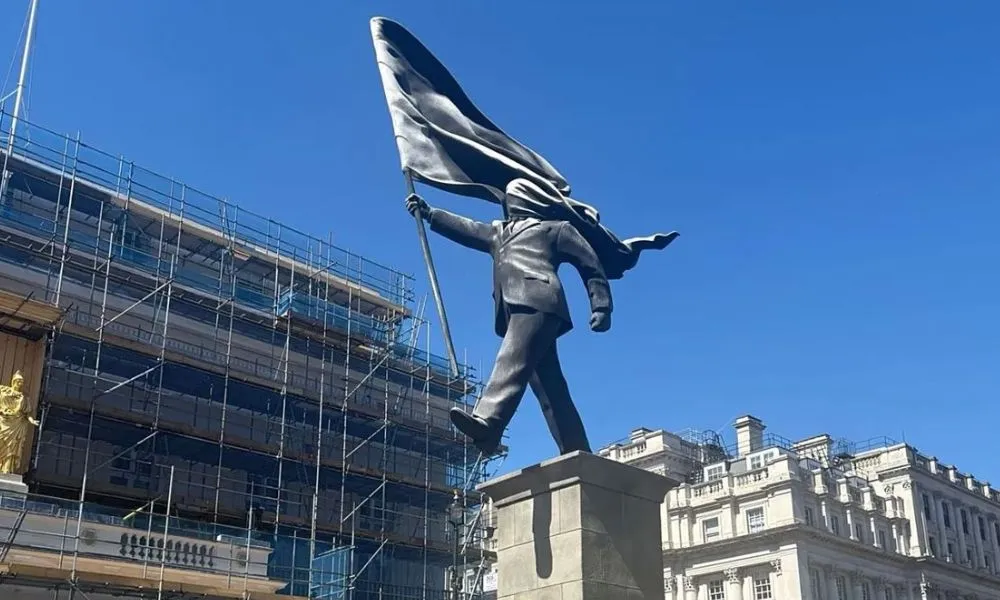

At Waterloo Place in central London, very close to Buckingham Palace, there is a modern statue depicting a man walking with a flag covering his face. It is a work by Banksy, who placed it there unexpectedly in 2026.
The image functions as a symbolic representation of a familiar socio‑political phenomenon: when collective identity becomes absolute under the pressure of the far right or any extreme ideology, critical thinking is restricted and tolerance for authoritarian practices widens. The comparative historical experience of the 20th century shows that wherever far‑right ideologies prevailed, the initial promise of national revival and popular satisfaction led to shrinking institutions, suppression of rights and, often, widespread destruction.
History is not a fading past. It is a present that demands responsibility. And when responsibility is silenced, history does not end, it repeats itself.
In Cyprus, the far‑right version of nationalism is now attempting a dangerous comeback. Not with the tools of the past, but through rhetoric, slogans and 'heroic' promises. It is presented as a new, untainted force. In reality, however, it is a continuation of an ideology that was tested and failed in tragic fashion.
The coup of 1974 was not a 'bad moment.' It was the result of a far‑right and nationalist political mindset that disregarded democracy and overestimated the power of slogans and reckless decisions. A mindset that believed history could bend to will and desire. The outcome is known: collapse, invasion, deaths, occupation, missing persons, partition.
And yet today, those who represent this mindset systematically avoid taking responsibility. They make no reference to their past. They do not attempt an honest assessment. They choose silence, a silence that is not neutral.
Instead of responsibility, they offer promises. They promise “national uplift, restoration of dignity,” even imagined successes with no relation to reality. They speak of distant goals while avoiding the essential issue: Cyprus itself, its occupation and the difficult need for a solution.
The contradiction is evident. Where planning is required, there is rhetoric. Where seriousness is needed, there is evasion.
The real risk lies with citizens. Not because they are to blame, but because they can be misled. When memory weakens and historical knowledge recedes, the ground becomes fertile for the return of the same illusion in new packaging.
Cyprus was filled with 'heroic' promises and easy victories, words that had no basis in reality. The cost was heavy: lost land, lost lives, a divided country.
The image of the 1974 landing remains a silent reminder, and a brutal shock. Landing craft approaching the shore, military vehicles disembarking in order, supply lines being set up without defensive resistance. It is not an image of battle, but of absence. Where defence should have existed, there was none. And that absence was not accidental. It was the result of betrayal and illusion. Not a single shot was fired as Attila advanced undisturbed. The code phrase used by the Turkish army for the invasion, “Ayşe is going on holiday,” a tragic mockery. A “holiday” effectively invited by far‑right nationalists, paid for by Cyprus in blood, displacement and missing persons.
Those who revive the same rhetoric today must answer: what has changed? What is the strategy? What is the real capability? Or is this, once again, a case of words and illusions?
The truth is simple, and difficult: no country can base its future on slogans. Even more so a country carrying an open wound of decades.
Responsibility, however, does not lie only with those who speak. It also lies with those who listen. Democracy does not protect itself. It requires citizens who remember, who judge, who are not easily impressed.
The lie of the “heroic promise” is always attractive. It offers hope without cost, solutions without effort, vindication without strategy. That is precisely why it is dangerous.
Cyprus was not captured only by troops. It was also captured by illusions, by the belief that difficult problems can be solved easily, by the rejection of prudent policy.
And if there is one lesson that must remain alive, it is this: mistakes are not repeated only by those who made them. They are also repeated by those who forget them.
The continuation, therefore, is not only of the far right. It is also of the society that will choose whether to accept it or reject it.
Cyprus does not need new illusions. It needs memory, judgement and responsibility. Only then can there be a future that does not resemble the past, not a reproduction of the same mechanisms that, then as now, promise national revival while undermining the very conditions that make it possible.
History does not repeat mechanically. What repeats are the illusions that create it. And each time the flag is raised to cover judgement instead of guide it, the cost is not symbolic; it is real, collective and, as has already been proven, destructive. The responsibility, therefore, lies not only with those who revive such narratives, but also with those who choose not to recognise them in time.