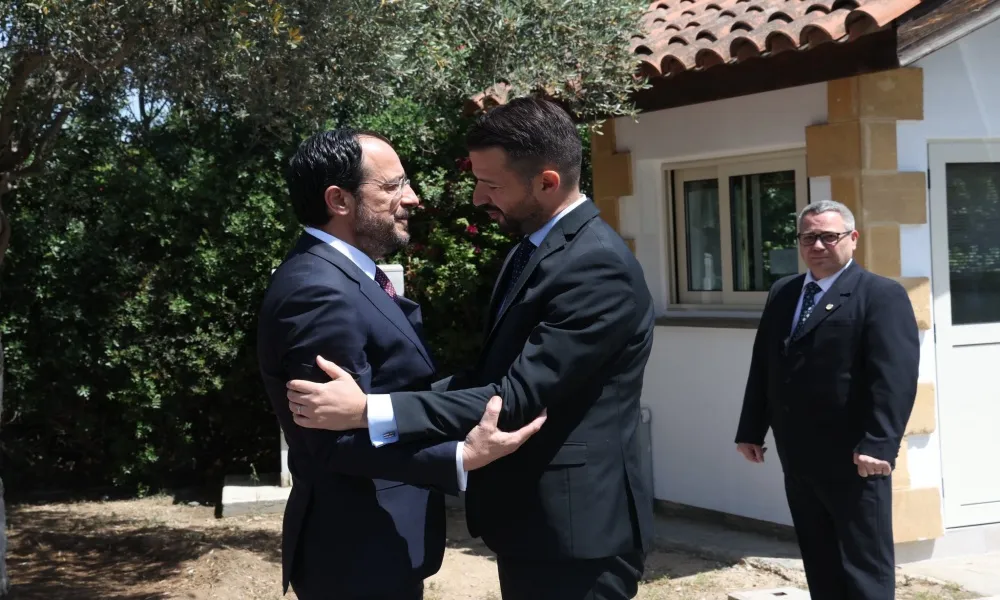
Cyprus and Montenegro will work to further strengthen their bilateral cooperation, President Nikos Christodoulides said on Monday after talks in Nicosia with Montenegro’s President Jakov Milatović.
Speaking at the Presidential Palace, Christodoulides said the two governments had agreed to build on recent contacts and deepen cooperation at bilateral level. Milatović thanked Cyprus for its support in Montenegro’s EU accession process, describing Nicosia as a “sincere friend”.
Christodoulides also expressed appreciation for Montenegro’s longstanding support on the Cyprus problem, saying it remained firmly based on respect for the sovereignty and territorial integrity of the Republic of Cyprus and on a comprehensive settlement in line with UN Security Council resolutions, as well as EU law, values and principles.
Milatović opened his remarks by saying in Greek that “Cyprus and Montenegro are friends forever”. He said Montenegro wanted more cooperation with Cyprus, including more investment and joint projects that could deliver tangible improvements in living standards.
During their private meeting, Christodoulides noted that Montenegro had been the first country he visited ahead of Cyprus assuming the Presidency of the Council of the European Union. Milatović, for his part, said the Cypriot President had delivered on what he had promised in relation to Montenegro’s accession process.
Cyprus Presidency and Montenegro’s EU path
Christodoulides said that when he visited Montenegro a year ago, he had pledged that the Cyprus Presidency would work “with determination” to deliver concrete results and turn the momentum on enlargement into real progress.
“Today, I can say with confidence and pride: we did it,” he said, referring to the recent agreement in Brussels, under the Cyprus Presidency, to establish an ad hoc working group to draft Montenegro’s Accession Treaty.
He said it was the first time in more than a decade that such an ad hoc working group had been set up for an Accession Treaty, adding that the move sent a clear message that enlargement was possible when candidate countries delivered on reforms.
Christodoulides also said Milatović’s visit came shortly before Montenegro hosts the EU-Western Balkans Summit for the first time. He described the meeting as a milestone for the European future of the Western Balkans and confirmed that he would attend.
“The Western Balkans belong in Europe,” he said, adding that Montenegro’s progress made that prospect more tangible.
He said Cyprus recognised the strategic importance of the Western Balkans for a stable, secure and reunited Europe, particularly at a time of global uncertainty and fragmentation.
Christodoulides also said Cyprus would continue working until the end of June to advance Montenegro’s EU accession process, adding that Montenegro, provided it remained committed to reforms, could become the EU’s 28th member state by 2028.
Investment and people-to-people links
On bilateral relations, Christodoulides said the two sides had held a productive exchange of views and referred to progress made since Milatović’s previous visit to Cyprus two years ago and his own visit to Montenegro last year, including the signing of a bilateral memorandum on shipping.
Milatović said Cyprus was already one of the most prominent investors in Montenegro and expressed confidence that the coming period would bring greater connectivity in tourism, energy, infrastructure, logistics and services.
He said Montenegro wanted to connect the two countries’ business communities, students, universities and people, adding that lasting friendships between nations are built through people-to-people ties.
For that reason, he said, it was important to develop relations through education, science, culture, maritime affairs and internal affairs.
Milatović described the current period as a historic moment for Montenegro, saying the country was marking 20 years since restoring its independence and was closer to the European Union than ever before.
When I visited Montenegro a year ago, ahead of the Cyprus Presidency, I committed that the Cyprus Presidency will work with determination to deliver in concrete terms. To take steps to transform the momentum in enlargement into real progress.
— NikosChristodoulides (@Christodulides) May 18, 2026
Today, I can confidently and… pic.twitter.com/qnObKJgKE3
He welcomed the launch of the ad hoc working group for the preparation of Montenegro’s Accession Treaty, which took place during the Cyprus Presidency, and thanked Christodoulides for his support.
Milatović also welcomed Christodoulides’ planned attendance at the EU-Western Balkans Summit and expressed hope that he would be able to arrive in Montenegro a day earlier, on 4 June, for events marking the 20th anniversary of the country’s restored independence.
Following the statements, the two Presidents and their delegations attended a working lunch.