The parliamentary elections taking place today may prove to be far more than another routine contest to renew the composition of the House of Representatives. The real stakes are not limited to which party will come first or which political leaders will record gains or losses. The central question is what kind of parliament will emerge and, by extension, how the legislature will function in the years ahead.
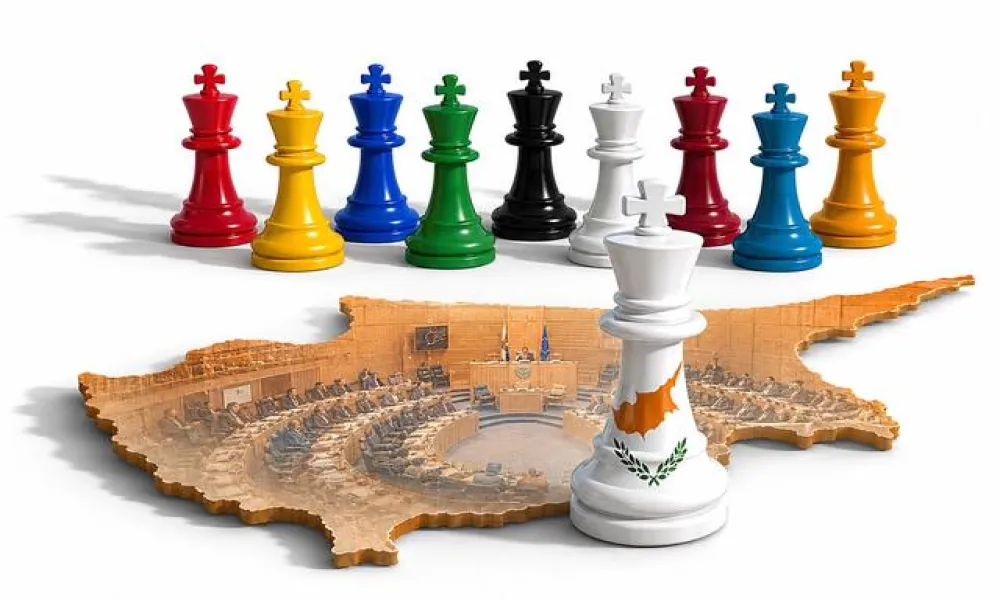
For the first time in decades, Cyprus’s political system is facing three distinct and plausible scenarios, all pointing to a deep reordering of the political landscape. A six‑party parliament would not constitute a major institutional shock. An eight‑party House would significantly alter political functioning. A parliament of nine or more parties could mark the definitive end of the post‑transition party map as we have known it. This would not be due primarily to the sheer number of parties, but to the serious weakening of the main political poles that have traditionally acted as the system’s anchors and power brokers.
The House elected in 2006 and 2011 comprised six parliamentary parties, in 2016 eight parties, and in 2021 seven parties. The issue, therefore, is not numerical. The concern lies in the erosion of the two major parties, around which parliamentary life revolved for decades, both in electoral strength and, more importantly, in political authority and prestige. In 2011, AKEL and DISY together secured 66.94 per cent. In 2016 this fell to 56.36 per cent, and in 2021 to 50.11 per cent. In the current elections, polling suggests their combined share will fall to around 43–45 per cent.
At the same time, the traditional centrist parties are shrinking sharply, while parties that describe themselves as anti‑system are emerging with significant support and are likely to be less inclined towards cooperation. Looking at the evolution of the centre since 2011, and taking into account the stable performance of DIKO and EDEK alongside, at different times, EUROKO, the Citizens’ Alliance, Solidarity and DIPA, the combined vote stood at 28.57 per cent in 2011, rose to 31.92 per cent in 2016 and fell to 24.11 per cent in 2021. For 2026, opinion polls place this bloc at just 12–15 per cent.
A confrontational parliament
Numbers alone do not tell the whole story. Cyprus operates under a presidential system, where the government does not depend on a parliamentary vote of confidence, as in a classic parliamentary democracy. There is no risk of a government falling due to the loss of a majority. This, however, does not make the composition of the House a secondary matter. On the contrary, in a system where the executive must pass budgets, reforms and key legislation through parliament, the ability to form stable majorities is crucial.
If the result produces a six‑party House consisting of DISY, AKEL, DIKO, ELAM, ALMA and Direct Democracy, the picture will be contradictory. On the one hand, there would be no institutional collapse. On the other, this would not represent a return to familiar political normality. Such a configuration would primarily signal the collapse of the traditional centre, the political buffer zone that for decades acted as a stabiliser between the major poles.
The absence of DIPA, EDEK or other established centrist formations would carry real political weight. Historically, the House has functioned not only through the DISY–AKEL confrontation, but also via smaller, institutionally predictable actors that shaped balances and compromises. If this space is replaced by parties with an anti‑system, strongly reformist or punitive character, parliamentary dynamics will change markedly.
ELAM is not a neutral institutional actor. It constitutes a dangerous force for democratic governance, given that Nazi ideology is fundamentally hostile to democracy. New formations such as ALMA or Direct Democracy fall within the democratic spectrum, yet they display significant peculiarities. They are not products of organic evolution within the party system, but political vehicles expressing dissatisfaction, rejection of the old political class and deep distrust of the existing system.
In such a House, the climate would be more confrontational. Parliamentary sessions would be more politically charged, rhetoric would likely harden and legislative work would lean more towards public confrontation than consensual management. Even so, a six‑party parliament would remain manageable and democratically sound. Political poles would still be identifiable, alliances difficult but feasible, and institutional functioning would retain a basic level of predictability.
An eight‑party House
The picture changes substantially if the House becomes eight‑party, with the entry of Volt and EDEK. This would no longer be a simple numerical increase, but a qualitative fragmentation of the political spectrum.
Volt, which appears set to enter parliament, is not a conventional party in Cypriot politics. It introduces a different political language, more pro‑European and reform‑oriented, with a strong rights‑based profile and appeal to younger voters and disillusioned urban constituencies. EDEK, by contrast, represents the old institutional DNA of Cypriot politics, with experience in parliamentary practice and greater predictability, particularly on the Cyprus problem.
This produces a peculiar form of pluralism. Traditional right‑wing politics, organised left‑wing forces, nationalist right‑wing ideology, anti‑system populism, social‑democratic patriotism, pro‑European progressivism and personality‑driven political projects would all coexist under one roof.
The result would be a parliament of permanent negotiation. No majority would be taken for granted. Each bill would require separate political groundwork. Real power would shift even more decisively to parliamentary committees, where small parties could delay, amend or block government initiatives.
In this environment, even the major parties would see their capacity to set the pace reduced. DISY and AKEL would remain large players, with an estimated 12–14 MPs each compared with 15–17 today, but they would no longer be automatic arbiters. The agenda would be shaped more by ad hoc convergences than by stable party axes.
This would also have direct implications for the presidency. President Nikos Christodoulides was elected without his own party machinery, relying on a web of alliances with centrist forces. If this space weakens or fragments, relations between the executive and parliament become far more volatile.
A nine‑party parliament
The most radical scenario is that of a nine‑party, or larger, House, with the addition of DIPA, the Hunters’ Movement or other formations. At this point, the system would move beyond pluralism into a new political era.
If DIPA were the ninth force, the system would gain a small but predictable actor. While increasing the number of parties, its presence could also offer a limited degree of institutional stability, given its more conventional parliamentary behaviour.
If, however, the Hunters’ Movement were to enter parliament, the picture would change. This would be a more thematic and less ideologically stable formation, with a greater likelihood of unpredictable positions depending on the issue at hand.
In a nine‑party House, even two or three seats would carry disproportionate influence. Small groups would become pivotal players. Political negotiation would be fragmented, slow and often personality‑driven.
Most importantly, the symbolic message would be powerful. Such a composition would not merely reflect electoral dispersion. It would signal deep social distrust towards the traditional party system. It would indicate that a significant segment of society no longer invests in parties of power, but in protest vehicles, thematic representation or anti‑system expression. It could, of course, also point to something else: a more inclusive and representative democracy.
Conclusion
The critical question, therefore, is not simply how many parties will enter parliament, whether six or ten.
The real question is whether the new House will function primarily as a parliament of governance, capable of synthesis and cooperation, or as a parliament of protest. Much will depend on the political maturity of the people’s representatives in the legislature.