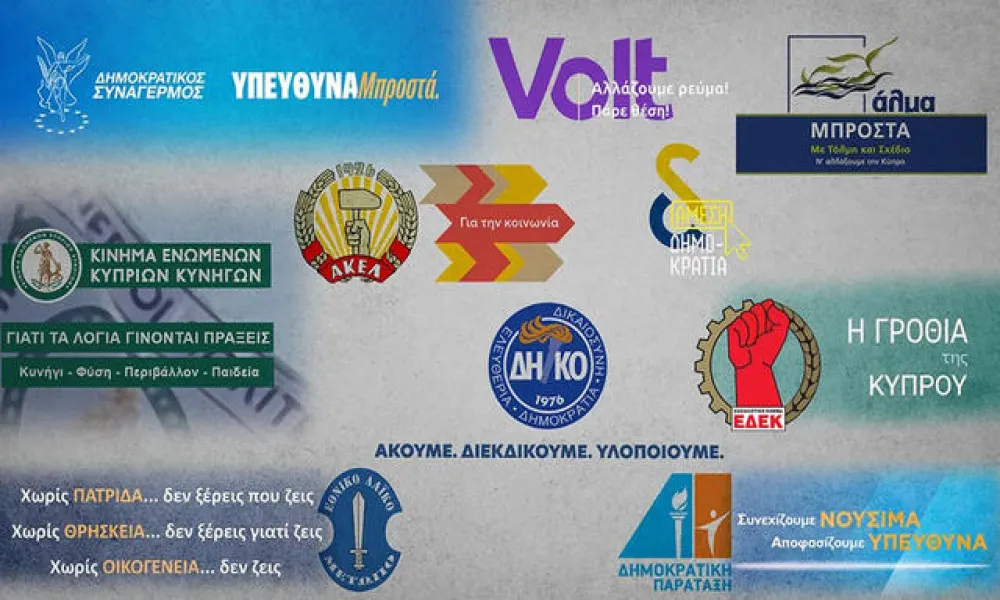
The pre‑election period ahead of today’s vote to elect the new House of Representatives of the Republic of Cyprus evolved into a political thriller for strong nerves. The reason is that the latest opinion polls – recording wear and tear among traditional parties, but also an interesting presence of new and/or so‑called anti‑system formations – offer result projections with a very wide margin of error, ‘like the tomb of Saint Neophytos, where everyone fits’.
In recent days, the campaign focused mainly on the cost of living, the housing crisis, energy and electricity prices, pensions, traffic congestion, corruption, and the broader crisis of trust towards the political system and institutions. Within this climate, each party attempted to construct its own narrative.
DISY
The Democratic Rally entered the pre‑election period with the main objective of retaining first place and limiting losses to newer formations, mainly ELAM, ALMA and Volt. In the final days of the campaign, the party focused on the economy, investment, energy policy and housing support for young couples.
The party leadership attempted to revive the narrative of a ‘responsible force of governance’, highlighting DISY’s experience in crisis management. At the same time, it invested in preserving the country’s European identity and clear Western orientation, the need to attract foreign investment and the creation of quality jobs.
On the Cyprus issue, DISY insisted on the line of a bizonal, bicommunal federation and the need to resume talks, differentiating itself from ELAM. At the same time, it emphasised its renewal under new leadership, without severing ties with the legacy of the Anastasiades governments. In the final days, it attacked ALMA leader Odysseas Michaelides, highlighted differences with ELAM, and its ‘constructive opposition’ to the government became even more constructive, given that several government figures originate from the party’s core.
‘Come with us’
In her final message, DISY president Annita Demetriou called on broader society to align with the party. ‘I believe we agree on the most important thing: that we need a safe country and a stable economy, capable of supporting every person in need,’ Ms Demetriou said, adding that the aim is a House of Representatives staffed by the best and most capable people.
‘Come with us. On Sunday we support the Democratic Rally. And on Monday we move forward responsibly together,’ she concluded.
AKEL
AKEL placed particular emphasis on the social agenda. It focused on the cost of living, low wages, housing policy and the need to strengthen the welfare state. At the same time, it brought transparency and accountability back to the forefront, seeking to capitalise on dissatisfaction with the political establishment.
The leadership framed the elections as a battle of ‘social survival’ for the middle and lower‑middle classes and workers. The party also invested in criticism of recent economic policy, arguing that growth is not distributed fairly. On the Cyprus issue, it stressed the need to resume substantive negotiations and repositioned reunification as a strategic priority.
At the same time, through attacks on the Right and the far Right, and references to fascism and Nazis, AKEL attempted to mobilise traditional voters who appear disappointed or undecided. In addition, AKEL did not spare Odysseas Michaelides or its former MP Eirini Charalambidou, directing sharp criticism at them, particularly after ELAM’s leader questioned the ‘honesty’ of the party’s general secretary over the Vasiliko issue.
‘For society’
In his final pre‑election statement, AKEL general secretary Stefanos Stefanou said that on Sunday ‘we vote for society’ and asked for public support.
‘At AKEL we have learned to look you in the eye. And today, as the campaign cycle closes, we look you in the eye and ask you to support us with your vote. We need your support so that we can defend your rights and needs in parliament. So that we can continue the fight against the cost of living, against the arbitrariness of big interests and establishments, against inequalities,’ Mr Stefanou said, among other remarks.
ELAM
ELAM fought tooth and nail to consolidate itself as the third political force. In the final days, its campaign focused on migration (despite the fact that it is now being managed more effectively, it still ‘sells’ to part of the electorate), crime, security, opposition to the political establishment and anti‑communism, primarily through attacks on AKEL.
ELAM capitalised on the broader European rise of right‑wing and far‑right rhetoric, presenting hard‑line positions on controlling migration flows and strengthening state security. At the same time, it continued to appeal to younger voters who feel disappointed by traditional parties. On the Cyprus issue, ELAM rejects a bizonal, bicommunal federation and speaks of a ‘assertive’ strategy towards Turkey, rhetoric that differentiates it from DISY.
Political experiment?
In his final message, ELAM leader Christos Christou spoke of a time of crucial decisions for Cyprus’s future. ‘ELAM is not just another political experiment. It is the force of people who refused to compromise with decay, injustice and the abandonment of our homeland […]. A strong ELAM means a strong Cyprus,’ he said.
DIKO
The Democratic Party attempted to convince voters that it must retain its traditional role as the dominant centrist force and perennial kingmaker. However, opinion polls showed DIKO under significant pressure, with voter leakage towards newer formations.
DIKO’s final interventions focused on institutional stability, support for the middle class and the need for reforms in public administration. The party also highlighted credibility and political experience, contrasting itself with what it described as ‘experimental choices’. In the final days, it launched fierce attacks against the ‘twin towers’ of ALMA, Odysseas Michaelides and Eirini Charalambidou, with DIKO figures clashing repeatedly with them in pre‑election panels.
On the Cyprus issue, DIKO – faithful to its slogan of ‘right content’ – maintained a more cautious stance on talks, calling for stricter conditions and stronger guarantees for the functionality of a solution.
Let us build… even more
‘Now is the time to protect what we have achieved and build even more,’ DIKO president Nikolas Papadopoulos said in his final pre‑election statement. ‘Cyprus can and deserves more: more economic growth, more opportunities for our youth, more security for our families, more care for our society,’ he added, concluding: ‘With clear positions, DIKO was and will remain a force of responsibility for society and for Cyprus. Cyprus has prospects. Cyprus has a future. Let us secure it. This Sunday we vote DIKO.’
ALMA
ALMA is one of the major question marks of the elections. Despite having a party life of only a few months, it managed to express a notable part of social dissatisfaction and anger towards the traditional party system and to attract voters from across the political spectrum.
Its rhetoric focused obsessively – mainly by the party leader – on corruption, transparency, accountability, renewal of political personnel and the need for a ‘new political culture’ and ‘re‑institutionalisation of the state’ (a radical refounding of institutions). It made extensive use of social media and cultivated the image of a movement ‘outside the system’.
In recent weeks, the party’s leader, former auditor‑general Odysseas Michaelides, and former AKEL MP of 15 years Eirini Charalambidou, who recently joined ALMA, came under fierce attack from DISY, AKEL and DIKO. They responded with equal intensity. In the final days, ALMA focused on youth disappointment, the housing problem, corruption and distrust towards political institutions, directing sharp arrows in all directions, implying that almost everyone else is corrupt.
Mistakes by Michaelides and Charalambidou in the final days were reflected in opinion polls (up to the last day publication was allowed) with some decline in the party’s percentages. It also remains unclear how ALMA will position itself after the elections, raising questions about its real political orientation.
Strong citizen
‘Strong ALMA means a strong citizen’ was the party’s final message, expressing optimism about the result and calling on voters to make the ‘big leap’ and give the movement the push it needs to become the third force in parliament.
‘Just as the leader of ALMA stood up to the system, ALMA will serve in parliament as a barrier against the clientelist and ineffective state, defending the public interest above all particular interests,’ the statement concluded.
Direct Democracy
Direct Democracy made considerable efforts to capitalise on general disappointment with the political system, promoting models and applications for greater and electronic citizen participation in decision‑making and the reduction of party dependencies – despite being unable to specify which issues would go to referendums or whether referendum outcomes would bind the party and its MPs.
At the same time, it adopted strongly anti‑system rhetoric against the political establishment, the media and the elites of Cypriot public life, framing the contest as ‘new and fresh’ versus ‘old and outdated’. The campaign was based largely on the idea of ‘returning power to citizens’.
Despite its rise in polls, questions remain about whether it can sustain momentum until election day, the extent of any hidden vote from undecided voters, and its internal cohesion and capacity to exercise meaningful parliamentary politics. Its leader, MEP Fidias Panayiotou, faced continuous criticism from all rivals for lack of awareness of risks, major gaps in knowledge and political experience, political naïveté, and inability to distinguish a vote from a ‘like’ or political discourse from TikTok soundbites.
‘No to abstention’
Direct Democracy sent messages on X/Twitter yesterday stating: ‘Change will come from the new, not from the same things tested for years’. Other slogans included: ‘We have one ideology only: to serve the Cypriot people’ and ‘No to abstention, YES to Direct Democracy Cyprus’.
Volt
Volt sought to represent a more European, progressive and technocratic audience. Its campaign focused on transparency and human rights, digital transformation and green development. It targeted younger age groups, educated urban voters and citizens who feel unrepresented by traditional parties.
It emphasised innovation, sustainable development and European integration, arguing that this agenda differentiates Volt from other new formations. At the same time, it invested heavily in issues of political ethics and institutional renewal, seeking to present itself as a new, serious and non‑conservative political force.
The ‘Santi’ affair, which emerged following a social‑media post by a Volt candidate on 30 March 2026, disoriented both the party and the wider political system, monopolising publicity for over a month and disrupting campaign strategies across the board.
‘The voice becomes power’
On Friday, the final day of public political statements, Volt recalled months of action and engagement with citizens, countless discussions, smiles, positive energy and hope.
‘Months that brought us closer to people and closer to the vision of a different political culture […]. Now, the voice becomes power. Good luck to us – and on Sunday we vote Volt,’ the party’s final message said.
EDEK, DEPA, Greens, Hunters
EDEK, DEPA and the Green Party are fighting to secure the electoral threshold of 3.6 per cent in order to enter parliament. Their pre‑election agendas followed traditional themes and sought to underline their usefulness and reasons for survival.
Electoral analysts note that the United Cypriot Hunters’ Movement could spring a surprise, having organised quietly, with premises in many communities, and having become visible through reactions by livestock farmers over foot‑and‑mouth disease.
The overall picture
The defining features of these elections are the further weakening of traditional bipartisanship and the rise of formations seeking to express social contestation, anger and even revenge. Opinion polls in recent weeks (up to Saturday 16 May 2026, when publication was permitted) showed DISY and AKEL remaining the leading forces, but with clearly reduced percentages compared with previous elections.
At the same time, ELAM appears to be consolidating third place, while ALMA, Direct Democracy and Volt are vying for a significant role in the new House. Increased uncertainty, a large number of undecided voters and low party cohesion have created conditions that may lead to surprises tonight.
Today’s result will determine not only the composition of the new House, but also the shape of Cyprus’s political landscape for the next five years. These elections are already being recorded as a transition point from the traditional party model to a more fragmented and unpredictable political environment.
What we did not discuss during the campaign
If one followed only the slogans, debates and media confrontations of the campaign, public discussion revolved around ‘stability’, ‘change’, ‘everyday life’, ‘transparency/corruption’ and the rise of new parties. Crucial issues were either discussed superficially or almost disappeared from the central agenda.
It was not that certain topics were entirely absent, but that meaningful debate and confrontation of ideas were rare. The campaign focused more on impression management, mobilisation and party arithmetic than on competing visions for Cyprus’s future. As a result, serious discussion was largely absent on:
- The productive model of the Cypriot economy – Much was said about prices and housing, very little about what Cyprus’s economy will be based on over the next decade.
- Climate adaptation – Reduced largely to green transition and electricity costs, with little discussion of environmental degradation, water scarcity and agriculture.
- Demographic change and ageing – Pensions, healthcare and welfare sustainability were addressed fragmentarily, without a long‑term societal vision.
- Institutional quality – Corruption was mentioned, but not deep reform of the public service, justice system efficiency or concentration of power in parties.
- Education, national myths, the Church, digital transition – Almost no discussion of public education quality, pressure on teachers and students, or overdue educational reform.
- The Cyprus problem as the country’s main issue – Treated peripherally or with vague declarations.
- Technology and artificial intelligence – Virtually no serious discussion on AI, work, digital adaptation, cybersecurity or platform regulation.
- Urban development models – Housing was discussed in terms of prices, not urban planning, transport or quality of life.
- Citizen–politics relations – Abstention was feared, but not analysed as a crisis of representation.
- Foreign policy beyond the obvious – Little discussion of Cyprus’s role in the EU and Eastern Mediterranean.
- Intergenerational inequality – Youth issues were treated rhetorically rather than substantively.