
American forward Folarin Balogun's suspension has been lifted following communication between United States President Donald Trump and FIFA president Gianni Infantino, raising serious questions about the consistent application of regulations, the independence of disciplinary bodies and the possibility of political intervention.
The United States' top scorer at the tournament, with three goals, will be available to face Belgium in the World Cup round of 16, despite the Belgian football association arguing that FIFA's decision runs contrary to the competition's rules.
As BBC Sport notes in its analysis, one of the clearest World Cup rules until now was that any player sent off automatically misses the next match, with no exceptions, appeals or loopholes.
The Balogun case, however, overturns that certainty and leaves behind a series of unanswered questions.
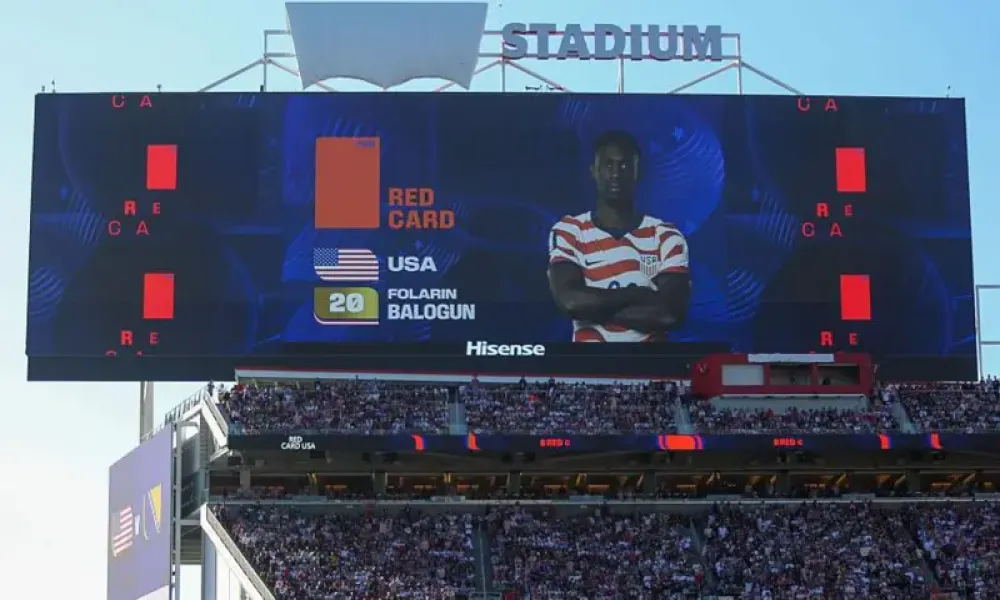
The American striker was sent off during the United States' victory over Bosnia and Herzegovina in the round of 32 after stepping on the ankle of Tarik Muharemovic while contesting the ball. The red card was issued following a VAR review.
Despite the dismissal, Balogun will now be available for Monday's match against Belgium.
Trump's communication with infantino
According to CBS News, a BBC partner in the United States, the suspension of the ban was decided following a telephone conversation between Donald Trump and Gianni Infantino.
Sources familiar with the contents of the conversation told CBS News that Infantino assured the US president that FIFA's Disciplinary Committee would examine the case.
White House World Cup Task Force executive director Andrew Giuliani also reportedly contacted the FIFA president, while US Commerce Secretary Howard Lutnick held discussions with football's world governing body as well.
Representatives of the White House, Lutnick and Giuliani did not immediately respond to requests for comment from CBS News.
Trump later thanked FIFA, describing the decision in a Truth Social post as "the reversing of a great injustice."
The intervention followed public comments by US Secretary of State Marco Rubio, who argued that the United States had been "wronged by that red card" and called for the possibility of an appeal.
BBC notes that before the decision there had been no expectation that FIFA would grant a special exception allowing the former Arsenal striker to play in the next round.
No explanation from FIFA
FIFA did not publish the reasoning behind its decision.
In its statement, it cited only Article 27 of its Disciplinary Code, which allows the organisation to suspend the enforcement of a disciplinary sanction either fully or partially.
According to BBC Sport, the article had never previously been used at a World Cup.
The report notes that FIFA's Disciplinary Code provides for a suspension of at least two matches for serious foul play, while World Cup regulations do not allow teams to appeal red cards.
BBC Sport asked FIFA to explain why Balogun's suspension had been lifted but received no specific answer.
The governing body instead referred to the case of Cristiano Ronaldo, part of whose suspension had been suspended prior to the tournament.
Ronaldo had been sent off for elbowing Dara O'Shea during Portugal's 2-0 defeat to Ireland in qualifying. He served a one-match suspension, while the remaining two matches of the ban were suspended.
As BBC points out, Ronaldo's dismissal occurred in a qualifying match rather than at the World Cup itself. Furthermore, FIFA explained its decision at the time by noting that Ronaldo had not been sent off in his previous 225 international appearances.
No comparable explanation was provided in Balogun's case.
BBC also reports that there is no indication that the referee requested the suspension of the punishment or that the VAR process was not correctly followed.
Fury in Belgium: FIFA bypassed the rules
The decision triggered a strong reaction from the Belgian football association, which said it was "astonished" by the lifting of Balogun's suspension.
The Belgian federation cited a range of regulations, briefing presentations and coordination meetings that had taken place before the start of the tournament.
It argued that FIFA's decision contradicts the rule stating that a player who is sent off is automatically suspended for the team's next match.
According to BBC, FIFA used its general Disciplinary Code in order to bypass the tournament's specific regulations.
Belgium head coach Rudi Garcia sarcastically remarked that he had not realised 5 July had become April Fool's Day.
"We are not just defending the national team or the federation. We are defending football," he said.
Is a precedent being created?
BBC describes Balogun's red card as harsh but notes that a harsh decision is not necessarily a wrong one, nor does it automatically justify FIFA intervention.
According to the analysis, the ruling could create a precedent because teams and players may now seek similar treatment in cases where dismissals result from accidental actions.
A player's intention has not been a decisive factor in red-card decisions for many years. Referees examine primarily the outcome of the challenge and whether it endangered an opponent's physical safety.
BBC cites the example of Xavi Simons' dismissal in a Tottenham-Liverpool match. Simons did not intend to step on the back of Virgil van Dijk's leg, but his challenge was deemed dangerous and resulted in a three-match suspension.
Tottenham chose not to appeal, believing they had little chance of success.
According to BBC, the Balogun case could also create difficulties for domestic competitions, as clubs and supporters may ask national associations to show the same leniency as FIFA.
What will the other players be thinking?
BBC also raises the question of how the decision is viewed by the other eleven players who were sent off during the tournament and served their suspensions in full.
As a notable example, it cites Qatari player Assim Madibo, who was involved in an incident that resulted in a fractured leg for Canada midfielder Ismaël Koné.
According to the report, there were strong arguments that Madibo had not even attempted a tackle and that the injury occurred accidentally.
Nevertheless, FIFA imposed a five-match suspension on him, three games more than the standard punishment for serious foul play.
"A farce," says Micah Richards
Former England defender and BBC pundit Micah Richards described the situation as "a farce."
"Suspending the ban for a year makes the entire tournament look ridiculous. This is being done to keep the big names in the competition. How can something like this happen? FIFA has to do better," he said.
Richards added that the decision had left "a very bad taste" for many people.
Only the second such case
There have been 189 red cards in World Cup history and, according to BBC, only two players have avoided serving a suspension.
The previous case involved Brazilian star Garrincha in 1962.
Garrincha was sent off in the semi-final against Chile but still played in the final against Czechoslovakia.
At the time, however, there was no automatic suspension system and the matter was reviewed by a committee that considered testimony from match officials.
BBC notes that the decision was also accompanied by allegations of political intervention.
According to the British broadcaster, the Balogun affair bears similarities to the Garrincha case, as presidential intervention was also reported then in an effort to ensure that the Brazilian player would not miss the final.
FIFA's Ethics Committee has already been asked to examine Infantino following claims that he violated the organisation's political neutrality rules in relation to FIFA's Peace Prize award to Donald Trump.
FIFA's statutes prohibit political interference in football.
BBC concludes that the involvement of the US administration in the Balogun case is expected to raise further questions for FIFA. Before those questions are answered, however, all eyes will be on the United States' clash with Belgium and on the presence of the American forward who, under normal circumstances, would have been suspended.