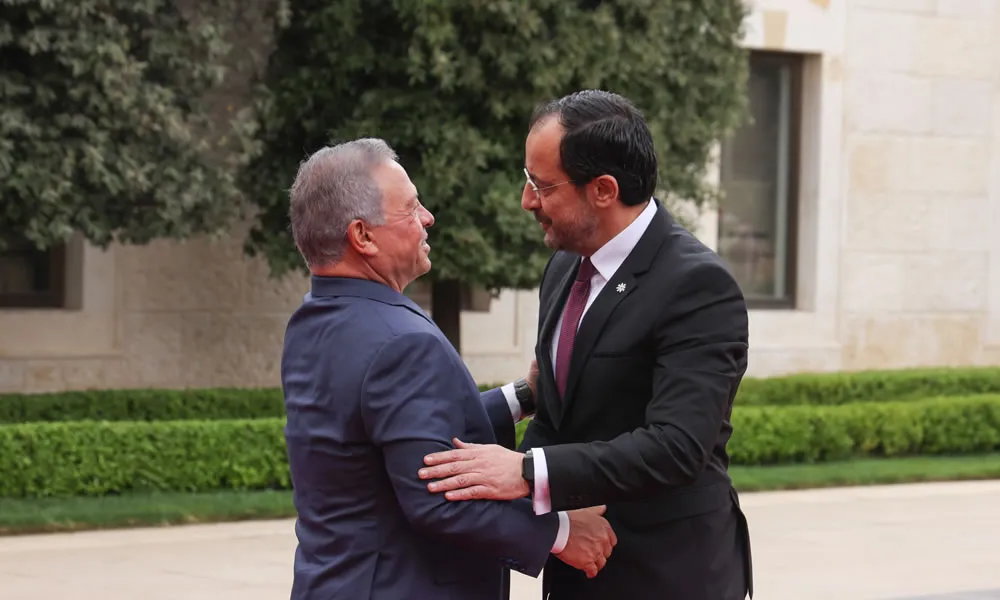

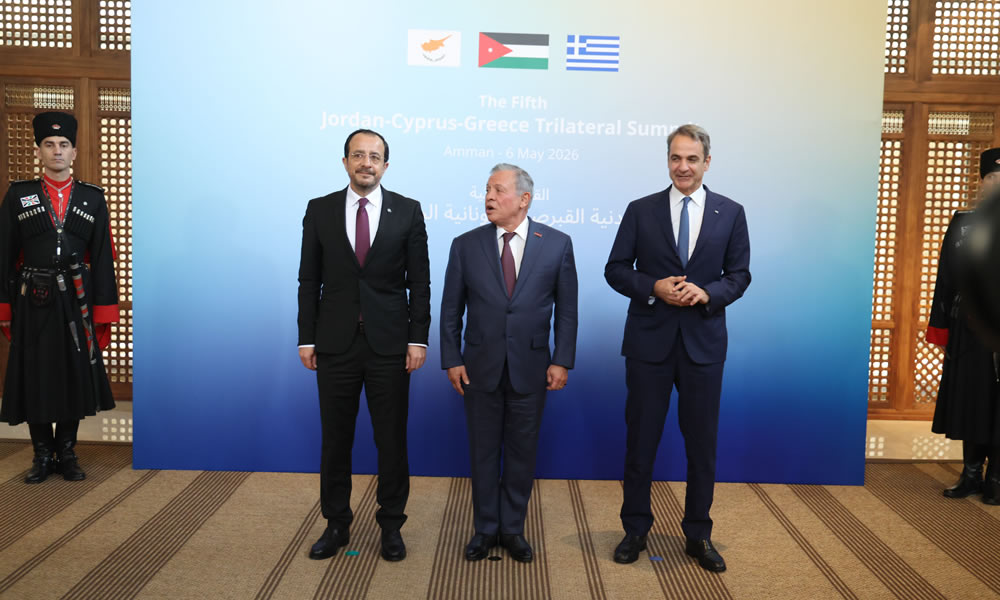
The fifth Trilateral Summit of Cyprus, Greece and Jordan concluded on Wednesday in Amman, as leaders from the three countries pledged to deepen cooperation at a time of heightened instability across the Eastern Mediterranean and the Middle East.
President Nikos Christodoulides, King Abdullah II of Jordan and Greek Prime Minister Kyriakos Mitsotakis met for talks at the Al Husseiniya Palace.
According to Government Spokesperson Konstantinos Letymbiotis, the summit took place amid “geopolitical realignments with direct implications for regional security, energy, migration, maritime routes and overall stability”.
In his opening remarks, King Abdullah underlined the strategic importance of the trilateral format, stressing that it has evolved into a practical mechanism for cooperation since its launch in 2018. “Our trilateral cooperation serves as an important mechanism for dialogue and joint action rooted in international law and respect for the sovereignty of all states,” the Jordanian monarch said.
King Abdullah warned that ongoing regional crises require “continued cooperation and coordination and a commitment to stability and peace”.
He called for any agreement on the conflict with Iran to address all causes of tensions and guarantee the security of the region. The King expressed support to Lebanon’s sovereignty and territorial integrity, while standing firm “in rejecting Israeli measures aimed at exploiting the situation to create new facts on the ground in Jerusalem, the West Bank, and Gaza”.
The leaders reviewed progress made so far under the trilateral framework and discussed ways to further deepen cooperation in order to deliver tangible results. Particular emphasis was placed on economic ties, energy, water management, tourism and education, as well as on enhancing regional connectivity.
Critical juncture
For his part, President Christodoulides said: “Cyprus is a stable and reliable partner and a bridge between Europe and the Middle East, and it is proud to stand alongside Jordan and Greece in this vital trilateral partnership of regional stability.” He hailed as a “milestone” the signing of the EU-Jordan Strategic and Comprehensive Partnership last year.
Christodoulides also reiterated Cyprus’ full solidarity with Jordan following what he described as “unjustifiable attacks” in recent weeks, adding that the three countries share a commitment to dialogue, de‑escalation and the building of a framework for regional peace. He noted the importance of jointly addressing shared challenges, from migration and climate change to regional stability.
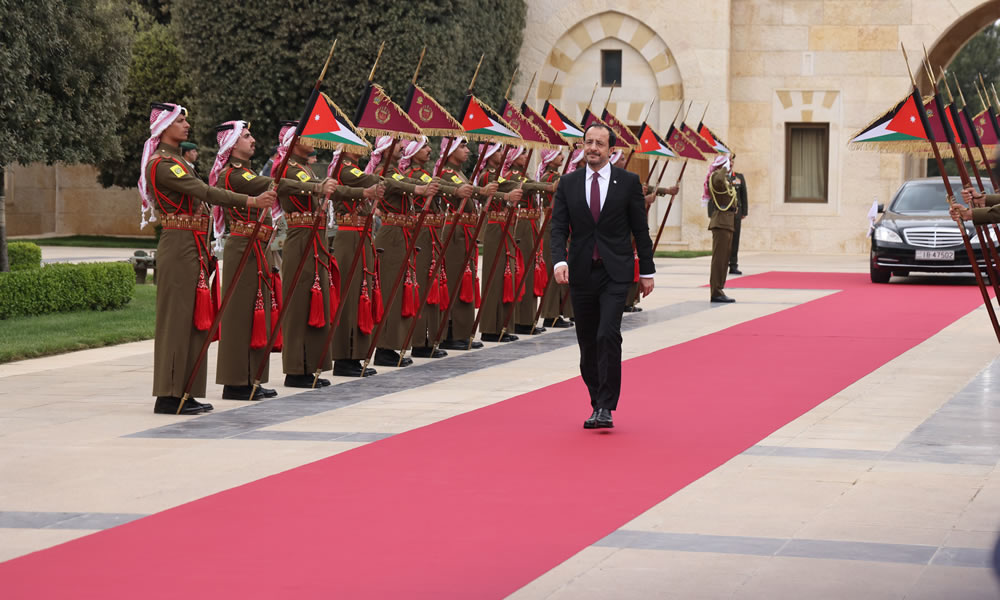
Prime Minister Mitsotakis described the meeting as taking place at a “critical juncture” for the wider region, noting that conflicts in the Middle East have repercussions far beyond the immediate neighbourhood. “This trilateral meeting is sending a very clear and timely message – a message of friendship, cooperation and unwavering commitment to international law and peaceful coexistence,” he said.
According to the government spokesperson, the leaders stressed the need to prevent further spillover of crises and to create conditions for lasting peace and stability.
Civil protection and regional preparedness also featured prominently. Reference was made to the Cyprus Regional Aerial Firefighting Station (CRAFS) as a concrete example of cooperation with regional value, an initiative that originated from joint Cyprus-Jordan action following President Christodoulides’ first bilateral visit to Jordan in August 2023.
The leaders also examined prospects for strengthening strategic connectivity, including the India–Middle East–Europe Economic Corridor (IMEC), noting that Cyprus, Greece and Jordan form a natural geopolitical and geographic axis linking Europe with the Middle East.
A joint declaration adopted at the conclusion of the summit reaffirmed the shared objectives and priorities discussed.
Following the trilateral meeting, President Christodoulides travelled to Abu Dhabi for talks with UAE President Sheikh Mohammed bin Zayed Al Nahyan, as part of Cyprus’ broader effort to strengthen coordination with partners in the Middle East and the Gulf amid escalating regional tensions.