
On 1 April 2026, around 160 people boarded the MV Hondius, a polar cruise ship, at the southern tip of Argentina for a month’s voyage across the Atlantic to visit some of the most remote places on the planet and do a spot of birdwatching.
The trip included stops at Antarctic territories, the sparsely populated Tristan da Cunha and St Helena where Napoleon spent the last years of his life in exile.
Trip of lifetime turns to nightmare
Nobody could have imagined that over the next six weeks, three of the passengers would die from a rare strain of hantavirus, while the vessel would struggle to find a port to dock in, to evacuate its sick and to disembark those on board, as the world watched from a distance with great interest and fear of another pandemic.
In the first week, a Dutch passenger fell ill. On 11 April, he died on board, with the vessel sailing in the middle of the Atlantic between Argentina and South Africa. Nobody was thinking infectious disease yet. The deceased was taken to St Helena from where his Dutch wife took a flight to Johannesburg on 24 April. She died two days later. A sick passenger on oxygen, meanwhile, was dropped off at Ascension Island to be flown to South Africa for hospitalisation.
On 2 May, a day before the cruise’s scheduled end at Cape Verde off the north-west coast of Africa, the Hondius passengers were informed that hantavirus had been identified. The virus is usually spread by inhaling wild rodent faeces, but there is also a rare Andes strain that can be spread by close human-to-human contact. It has a reported fatality rate of around 30-40%. On the same day, they learned that a third passenger, an 80-year-old German woman had died on board.
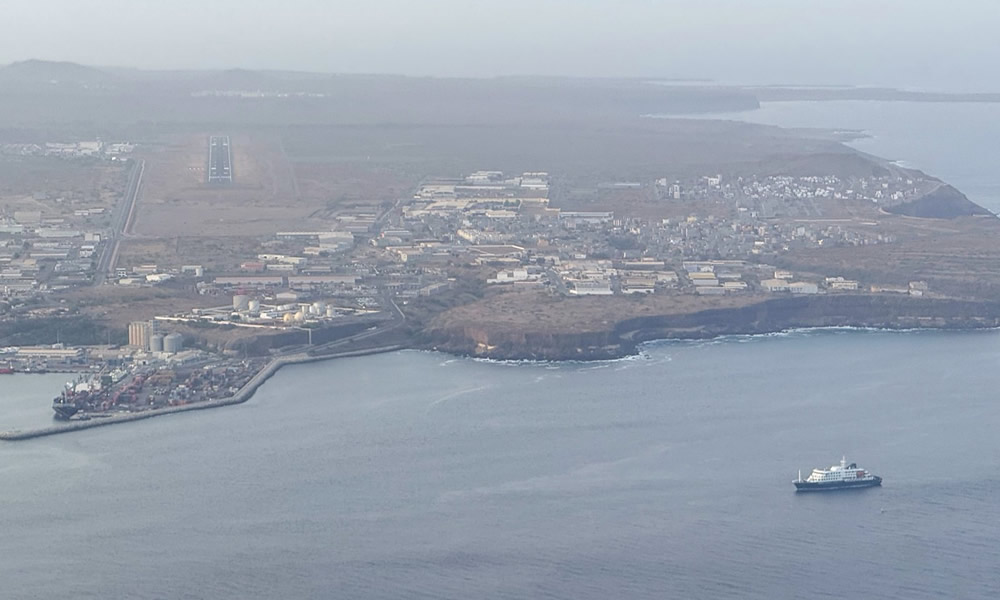
By 3 May, the ship is anchored off Cape Verde at a safe distance. Its only doctor is sick and needs evacuating along with two other passengers. The Cape Verde authorities are reluctant to take the sick passengers. They ultimately agree to do so but only if the three patients are taken directly from the Hondius to shore, and then by ambulance straight to a plane for immediate evacuation.
Evacuation needed
At this point, the maritime insurer of the Netherlands-registered MV Hondius made a call to a company based in Larnaca, specialising in maritime medical evacuations.
That Sunday evening, on 3 May, the General Manager of Global Voyager Assistance Maritime, Oxana Razoronova, answered the call. She barely slept over the next four days. Politis spoke with Razoronova and the company’s CEO Costas Danilenko about the experience.

“This was one of the most challenging cases I’ve worked on in my 17-year career in the medical business. It was very complicated, requiring very complex medical management,” said Razoronova.
“There were also a lot of parties involved in the process,” she added.
The company had to evacuate three MV Hondius passengers with hantavirus from Cape Verde to Amsterdam. One was in a serious condition, one less serious and the third asymptomatic.
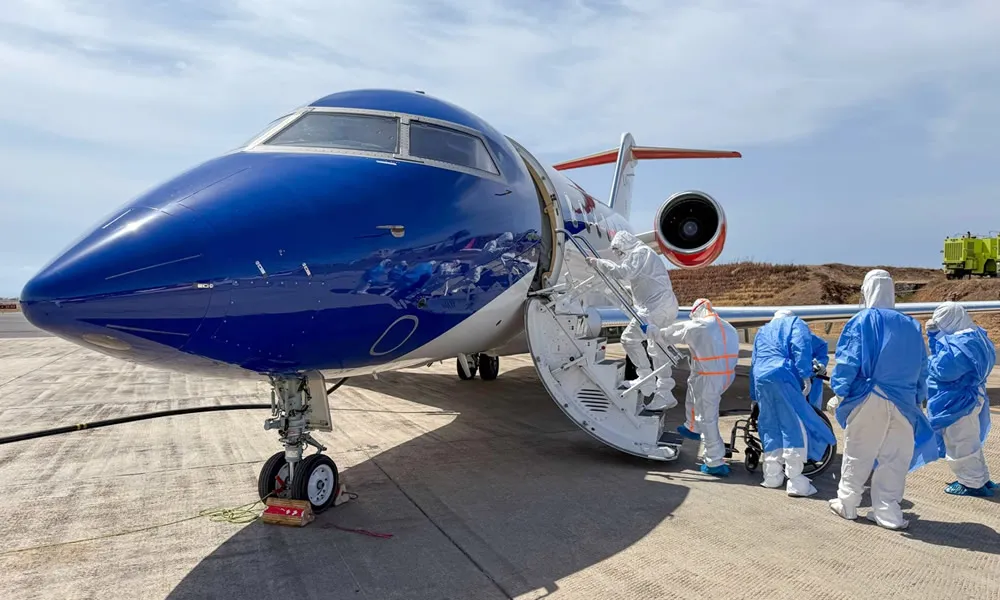
The air ambulances needed to be prepared for infectious disease patients, with an EPI Shuttle (transport isolation system) and a crew in full personal protective equipment. Under normal conditions, depending on flight distance, they can cost anywhere between $30,000 to $400,000.
Negotiations
The next challenge was to get authorisation from Cape Verde to disembark the three patients. GVA Maritime dispatched two air ambulance jets to Cape Verde by Tuesday, 5 May. But the patients were still on the Hondius.
“The problem was the patients were not allowed to be disembarked. This is where we were involved in an extensive coordination process with different institutions, Capo Verde authorities, British representatives, diplomatic corps from the Netherlands. All were involved, working to find a solution,” Razoronova.
After much negotiation, the authorities finally allowed the patients to disembark from the ship on Wednesday morning, following strict protocols, with the military present.
Danilenko said he understood the weariness of the authorities to be associated with the virus, as it could seriously harm their economy.
“The most difficult thing in all this process was the multiple parties involved with decisions changing all the time,” said Razoronova.
For example, the authorities might insist on a specific time for departure, without taking into consideration limitations imposed, such as the maximum flight duty times of pilots, which might be exceeded if the pilots were on standby for too long or the minimum rest time after a long flying mission the day before.
Then other challenges would appear which normally would not be an issue, but when dealing with infectious diseases, normal procedures do not apply.
“We tried different solutions to facilitate the process and to act in the interest of the patients. Finally, we managed to depart Wednesday morning,” said Razoronova.
Word spreads, permits rescinded
Two patients left in one plane which flew directly to Amsterdam, arriving later that evening. The third patient flew in a smaller plane, the Learjet 45, with a maximum range of 3000km. The flight plan, agreed in advance, included a refuelling stop in Marrakesh. However, word soon got around about the hantavirus cruise ship in the global media. As the plane approached Marrakesh, landing authorisation was rescinded. The Learjet flew back to Las Palmas in the Canary Islands which gave them permission to land but surrounded the plane with armed guards.
Nobody was allowed to step outside the plane as the GVA Maritime team tried to find a workaround. It became increasingly obvious that no country was going to let the Learjet stop for refuelling. Danilenko said one could see people in Tenerife already protesting against the idea of allowing the Hondius to disembark its people there.
“We became the pariah plane of Europe. Nobody wanted us,” he said.
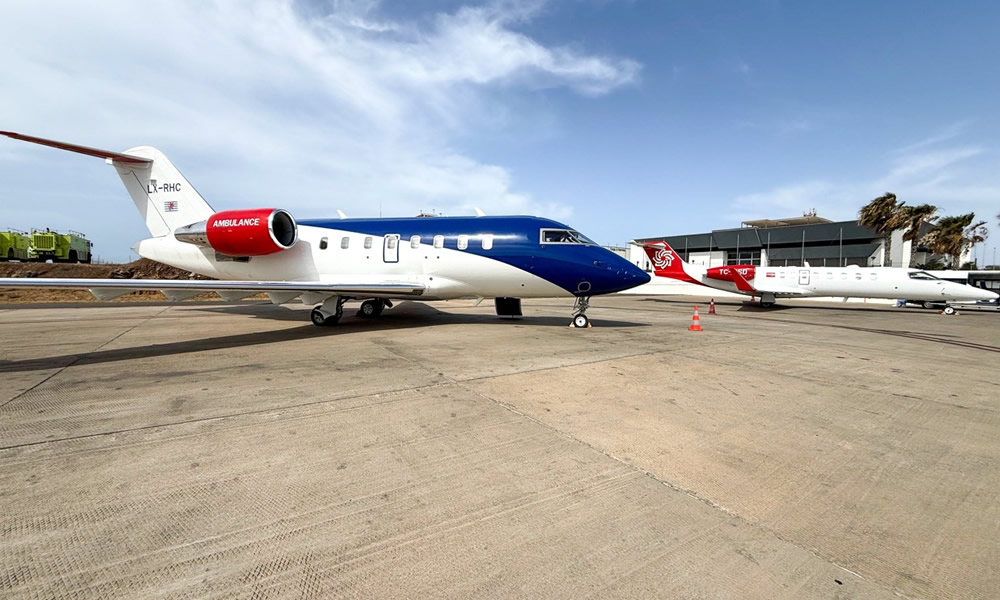
To avoid wasting time, the team dispatched a larger aircraft, Challenger 605, from Oslo which could fly direct from Las Palmas to Amsterdam.
The patient and crew remained in the Learjet the whole time and had no contact with the ground crew. When the Challenger arrived, the Las Palmas authorities wanted the planes to line up next to each other to avoid as much as possible any contact with the tarmac.
Finally, the plane departed and the third patient arrived in Amsterdam Thursday morning, 7 May.
“My team and I were working non-stop 24 hours a day because it was not only about arrangements but about reacting to unforeseen circumstances urgently. Every five minutes, we would get a call with new developments and need to find solutions promptly,” said Razoronova.
“We didn’t sleep for four days.”
Compassion and solidarity
As for the Hondius, it eventually docked in Tenerife on 10 May, under the strictest safety protocols, with passengers evacuated to their home states.
World Health Organisation (WHO) chief Tedros Adhanom Ghebreyesus thanked Spain for the “compassion and solidarity” it had shown by taking in the cruise ship that nobody wanted.
In a “divided and divisive world”, he said, “kindness and taking care of each other” were important.